Affichage des articles dont le libellé est Poland (Pologne). Afficher tous les articles

vendredi 5 juin 2026

"Works of art by Wojciech Siudmak" crypto-stamps on cover from Poland

Crypto timbres "Œuvres de Wojciech Siudmak" sur lettre de Pologne 

Wojciech Siudmak (né en 1942), peintre et sculpteur polonais, est considéré comme un des principaux représentants du réalisme fantastique.
Il a débuté sa formation artistique à l'Académie des Beaux-Arts de Varsovie, puis l'a poursuivie à la prestigieuse École des Beaux-Arts de Paris. Depuis 1966, il vit et travaille en France. Il est aujourd'hui l'un des artistes polonais les plus reconnus au monde.
Ses peintures, sculptures et dessins ornent des couvertures de livres et de disques, figurent sur des affiches d'événements prestigieux et font partie de collections muséales et privées.
Siudmak est un artiste aux multiples talents : outre la peinture et la sculpture, il conçoit des bijoux, des décors, du mobilier et même des éléments architecturaux. Il est considéré comme un représentant majeur du réalisme fantastique, un mouvement qui allie les techniques picturales classiques à une imagination débordante. Son style s'inscrit dans la tradition du surréalisme, et l'influence de Salvador Dalí et de René Magritte transparaît dans sa maîtrise de la lumière, de l'espace et des formes.
Dans ses œuvres, Siudmak crée l'illusion de la tridimensionnalité. Ses peintures captivent par leur richesse intellectuelle, leur minutie et leur poésie onirique. 
Wojciech Siudmak (born in 1942), a Polish painter and sculptor, is considered one of the leading figures of fantastic realism.
He began his artistic training at the Academy of Fine Arts in Warsaw, then continued it at the prestigious École des Beaux-Arts in Paris. Since 1966, he has lived and worked in France. He is now one of the most renowned Polish artists in the world.
His paintings, sculptures, and drawings grace book and record covers, appear on posters for prestigious events, and are part of museum and private collections.
Siudmak is a multi-talented artist: in addition to painting and sculpture, he designs jewelry, sets, furniture, and even architectural elements. He is considered a major representative of fantastic realism, a movement that combines classical painting techniques with boundless imagination. His style is rooted in the Surrealist tradition, and the influence of Salvador Dalí and René Magritte is evident in his mastery of light, space, and forms.
In his works, Siudmak creates the illusion of three-dimensionality. His paintings captivate with their intellectual richness, meticulous detail, and dreamlike poetry.  

Le 27 octobre 2025, la poste polonaise a mis en circulation un impressionnant bloc-feuillet composé de 4 crypto timbres (5,80 PLN chacun, tirage : 80000 blocs-feuillets), intitulé "Mondes fantastiques" ("Fantastyczne światy"), reproduisant des œuvres emblématiques de Wojciech Siudmak.
Un grand merci Andrzej pour l'envoi de la lettre ci-dessus, le 4 mai 2026 depuis Nowy Sącz, affranchie avec 2 timbres (de très grand format : 51 x 79 mm) extraits de ce bloc-feuillet !
Les 2 œuvres à l'honneur ici : "L'énergie jouant avec un électron" (1994) - une représentation dynamique d'une femme entourée d'éclairs de lumière, une allégorie de la joie de la création et du pouvoir du mouvement, ​​une danse symbolique de l'énergie, et "Amour éternel" (1985) - dans des tons froids et bleus, l'artiste a représenté deux têtes de pierre reliées par un anneau lumineux, une métaphore de l'amour plus fort que le temps et un symbole d'unité.
Cette émission s'inscrit dans le cadre des nombreuses initiatives de la poste polonaise visant à promouvoir la culture et l'art polonais. Depuis près de 2 ans, les bureaux de poste à travers le pays organisent en effet des rencontres avec des écrivains dont les ouvrages sont disponibles via le réseau postal, dans le cadre du projet "Installations culturelles" ("Placówka Kultura") en particulier. 
On October 27, 2025, the Polish Post released an impressive souvenir sheet containing four crypto-stamps (5.80 PLN each, print run: 80,000 souvenir sheets), entitled "Fantastic Worlds" ("Fantastyczne światy"), reproducing iconic works by Wojciech Siudmak.
Many thanks to Andrzej for sending the above cover on May 4, 2026, from Nowy Sącz, franked with two stamps (very large format: 51 x 79 mm) from this souvenir sheet!
The two featured works are: "Energy Playing with an Electron" (1994) - a dynamic depiction of a woman surrounded by flashes of light, an allegory of the joy of creation and the power of movement, a symbolic dance of energy; and "Eternal Love" (1985) - in cool, blue tones, the artist depicted two stone heads connected by a ring of light, a metaphor for love stronger than time and a symbol of unity.
This issue is part of the Polish Post's numerous initiatives to promote Polish culture and art. For nearly two years, post offices across the country have been organizing meetings with writers whose works are available through the postal network, particularly within the framework of the "Cultural Installations" ("Placówka Kultura") project.  

jeudi 9 avril 2026

"Milano Cortina 2026 Paralympic Games" stamp on FDC from Poland

Timbre "Jeux paralympiques de Milano Cortina 2026" sur FDC de Pologne 

La poste polonaise est l'une des rares administrations postales dans le monde à émettre des timbres consacrés aux jeux paralympiques d'été et d'hiver, ce qui est le cas depuis les jeux de Rio 2016.
Le 6 mars 2026, jour de la cérémonie d'ouverture, la poste polonaise a ainsi mis en circulation un timbre consacré à la participation du pays aux jeux paralympiques d'hiver de Milano Cortina (Italie), organisés du 6 au 15 mars 2026. 
Ce timbre (tarif permanent "B" - 5,80 PLN, tirage : 63000), imprimé en feuillet de 9 timbres, figure en 2 exemplaires sur le FDC officiel ci-dessous (avec TAD "Flocon de neige" de Varsovie), envoyé le 16 mars 2026 depuis la ville de Nowy Sącz. Merci beaucoup Andrzej ! 
Ce timbre (conception : Roch Stefaniak) met en scène des membres de l'équipe paralympique polonaise engagée à Milano Cortina 2026 : Krzysztof Plewa (ski de fond assis) et Witold Skupień (ski de fond debout sans bâtons). 
The Polish Post is one of the few postal administrations in the world to issue stamps dedicated to the Summer and Winter Paralympic Games, a practice that began with the Rio 2016 Games.
On March 6, 2026, the day of the opening ceremony, the Polish Post released a stamp commemorating the country's participation in the Milano Cortina Winter Paralympic Games (Italy), held from March 6 to 15, 2026.
This stamp (permanent rate "B" - 5.80 PLN, print run: 63,000), printed in a sheetlet of 9 stamps, appears twice on the official First Day cover below (along with the "Snowflake" cancellation from Warsaw), postmarked on March 16, 2026, from the city of Nowy Sącz. Thank you very much, Andrzej!
This stamp (design: Roch Stefaniak) features members of the Polish Paralympic team competing in Milano Cortina 2026: Krzysztof Plewa (sitting cross-country skiing) and Witold Skupień (standing cross-country skiing without poles).  

Sur l'enveloppe Premier Jour, on peut voir Aneta Kobryń (avec son guide Bartłomiej Puto), engagée également en ski de fond dans la catégorie "malvoyants".
L'emblème du comité paralympique polonais figure en haut à droite sur le timbre. 
Lors de ces jeux paralympiques 2026, la délégation polonaise (6 hommes et 3 femmes, engagés dans 4 sports : ski de fond, ski alpin, biathlon, snowboard) a remporté 2 médailles, une en argent et une en bronze grâce à Michał Gołaś (guide: Kacper Walas), engagé en ski alpin (slalom et slalom géant) dans la catégorie "malvoyants".
A noter que Witold Skupień figurait déjà sur le timbre polonais consacré aux jeux paralympiques de Beijing en 2022. 
The First Day cover features Aneta Kobryń (with her guide Bartłomiej Puto), who also competed in cross-country skiing in the visually impaired category.
The emblem of the Polish Paralympic Committee appears in the upper right corner of the stamp.
At these 2026 Paralympic Games, the Polish delegation (6 men and 3 women, competing in 4 sports: cross-country skiing, alpine skiing, biathlon, and snowboarding) won two medals, one silver and one bronze, thanks to Michał Gołaś (guide: Kacper Walas), who competed in alpine skiing (slalom and giant slalom) in the visually impaired category.
It's worth noting that Witold Skupień was already featured on the Polish stamp commemorating the 2022 Beijing Paralympic Games.  

lundi 2 mars 2026

"Milano Cortina 2026 Olympic Games" stamp on FDC from Poland

Timbre "Jeux olympiques de Milano Cortina 2026" sur FDC de Pologne 

Le 6 février 2026, jour de la cérémonie d'ouverture, la poste polonaise a mis en circulation un timbre consacré à la participation du pays aux jeux olympiques d'hiver de Milano Cortina (Italie), organisés du 6 au 22 février 2026.
Ce timbre (tarif permanent "B" - 5,80 PLN, tirage : 63000), imprimé en feuillet de 9 timbres, figure en 2 exemplaires sur le FDC officiel ci-dessous (avec TAD "Flocon de neige" de Varsovie), envoyé le 11 février 2026 depuis la ville de Nowy Sącz. Merci beaucoup Andrzej !
Ce timbre, conçu en collaboration avec le comité olympique polonais, s'inspire de photographies de Szymon Sikora prises lors d'une séance photo spéciale avec les athlètes sélectionnés pour l'équipe olympique polonaise. 
Le timbre représente en particulier trois disciplines hivernales : le patinage de vitesse, le ski alpin et le biathlon. Les athlètes mis à l'honneur sont respectivement Kaja Ziomek-Nogal, Maryna Gąsienica-Daniel et Konrad Badacz. 
On February 6, 2026, the day of the opening ceremony, the Polish Post issued a stamp commemorating the country's participation in the Milano Cortina Winter Olympics (Italy), held from February 6 to 22, 2026.
This stamp (permanent rate "B" - 5.80 PLN, print run: 63,000), printed in a sheetlet of 9 stamps, appears twice on the official First Day Cover below (along with the "Snowflake" postmark from Warsaw), sent on February 11, 2026, from the city of Nowy Sącz. Thank you very much, Andrzej!
This stamp, designed in collaboration with the Polish Olympic Committee, is based on photographs by Szymon Sikora taken during a special photo shoot with the athletes selected for the Polish Olympic team.
The stamp specifically depicts three winter sports: speed skating, alpine skiing, and biathlon. The athletes being honored are respectively Kaja Ziomek-Nogal, Maryna Gąsienica-Daniel and Konrad Badacz.  

Leurs portraits dynamiques capturent le rythme et l'essence des compétitions hivernales, soulignant leur vitesse, leur précision et leur technique exceptionnelles. La composition graphique est complétée par le logo de l'équipe de Pologne (Team PL), symbole officiel de l'équipe olympique polonaise.
Le design général se caractérise par un style moderne, des formes épurées, des contrastes de couleurs saisissants et un dynamisme expressif.
A Milano Cortina, l'équipe polonaise était composée de 59 athlètes (28 hommes, 31 femmes) engagés dans 12 sports et a remporté 4 médailles (3 argent, 1 bronze) en saut à ski et patinage de vitesse, Kacper Tomasiak gagnant 3 médailles à lui tout seul en saut à ski.
La poste polonaise va également émettre, le 6 mars 2026, un timbre consacré aux jeux paralympiques de Milano Cortina 2026. La poste polonaise est ainsi l'une des rares administrations postales dans le monde à émettre des timbres consacrés aux jeux paralympiques d'été et d'hiver, ce qui est le cas depuis les jeux de Rio 2016.
Their dynamic portraits capture the rhythm and essence of winter competitions, highlighting their exceptional speed, precision, and technique. The graphic composition is completed by the logo of Team Poland (Team PL), the official symbol of the Polish Olympic team.
The overall design is characterized by a modern style, clean lines, striking color contrasts, and expressive dynamism.
In Milano Cortina, the Polish team consisted of 59 athletes (28 men, 31 women) competing in 12 sports and won 4 medals (3 silver, 1 bronze) in ski jumping and speed skating, with Kacper Tomasiak winning 3 medals himself in ski jumping.
The Polish Post will also issue a stamp on March 6, 2026, dedicated to the Milano Cortina 2026 Paralympic Games. The Polish Post is thus one of the few postal administrations in the world to issue stamps dedicated to the summer and winter Paralympic Games, which has been the case since the Rio 2016 Games.  

lundi 7 avril 2025

"Nicolaus Copernicus - 550th birth anniversary" joint m/s with Vatican, on cover from Poland

Bloc-feuillet "Nicolas Copernic - 550 ans de sa naissance", commun avec le Vatican, sur lettre de Pologne

Comme la République serbe de Bosnie-Herzégovine, la Bulgarie ou la République tchèque, la Pologne et la Cité du Vatican ont mis en circulation, le 27 février 2023, un bloc-feuillet commun consacré au 550ème anniversaire de la naissance de l'astronome, chanoine, médecin et mathématicien polonais Nicolas Copernic (1473-1543).
Après avoir étudié les arts à l'Université Jagellon de Cracovie, il découvre la médecine, les mathématiques et surtout l'astronomie à l'université de Bologne (Italie), observant alors des éclipses ou des occultations d'étoiles par la Lune. De retour en Pologne à partir de l'an 1500, Copernic va consacrer le reste de sa vie à mener de front son travail de chanoine et ses recherches astronomiques qu'il conduit dans son observatoire de Frombork. 
Alors que depuis Ptolémée et Aristote, la Terre est placée au centre de l'Univers (géocentrisme), Copernic envisage de mettre le Soleil au centre de tout (héliocentrisme), une hypothèse qu'avait déjà envisagée Aristarque de Samos, un astronome grec qui vécut 300 ans avant J-C. 
Copernic annonce également que la Terre tourne sur elle-même, que la Lune est son satellite et que toutes les planètes tournent autour du Soleil. Il développe ses théories dans deux ouvrages majeurs : "Commentariolus" et "De Revolutionibus Orbium Coelestium" achevé vers 1530.
Like the Serbian Republic of Bosnia & Herzegovina, Bulgaria or Czech Republic, Poland and the Vatican City put into circulation, on February 27, 2023, a joint miniature sheet dedicated to the 550th anniversary of the birth of the Polish astronomer, canon, doctor and mathematician Nicolaus Copernicus (1473-1543).
After studying arts at the Jagiellonian University of Krakow, he discovered medicine, mathematics and especially astronomy at the University of Bologna, Italy, observing eclipses or occultations of stars by the Moon. Back in Poland from the year 1500, Copernic will devote the rest of his life to carrying out his work as a canon and his astronomical research which he conducts in his observatory at Frombork.
While since Ptolemy and Aristotle, the Earth has been placed at the center of the Universe (geocentrism), Copernicus plans to put the Sun at the center of everything (heliocentrism), a hypothesis that had already been considered by Aristarque of Samos, a Greek astronomer who lived 300 years BC.

Copernicus also announces that the Earth rotates on itself, that the Moon is its satellite and that all the planets revolve around the Sun. He develops his theories in two major works: "Commentariolus" and "De Revolutionibus Orbium Coelestium" completed around 1530. 

Copernic a volontairement retardé la publication de ses idées, craignant la réaction hostile de l'Église qui se refuse à envisager la mobilité de la Terre autour du Soleil et n'acceptera cette idée qu'au début du 19ème siècle.
Quand Copernic meurt en 1543, ses idées ne sont connues que de quelques scientifiques. Au cours du 16ème siècle elles circuleront en cachette et séduiront de grands esprits comme Galilée, Léonard de Vinci ou Johannes Kepler.
La version polonaise de ce bloc-feuillet commun (8 PLN, tirage : 120000, conception : Joanna Fleszar-Haspert) a été utilisée sur la lettre ci-dessus envoyée le 17 octobre 2024 depuis la ville de Piekary Śląskie. Merci beaucoup Bartek !
Ce bloc-feuillet a été conçu à partir du tableau intitulé "L'astronome Copernic ou Conversations avec Dieu", une œuvre de Jan Matejko (1838-1893), considéré comme le plus grand peintre historique polonais, peinte vers 1873 à l'occasion du 400ème anniversaire de la naissance de Nicolas Copernic.
Cette peinture fait partie des collections du musée de l'Université Jagellon de Cracovie.
Le TAD illustré évoque le 100ème anniversaire de l'école secondaire "Roi Jean III Sobieski" à Piekary Śląskie. En 1683 le roi s'arrêta en effet dans cette ville alors qu'il était en route pour aller délivrer Vienne des Ottomans.
Dans le cadre de ces célébrations, une opération postale était organisée dans le cadre d'une marche nordique, avec application d'une marque spéciale "Dostarczono Pocztą Nordic Walking" ("Livré par poste de marche nordique"), comme celle figurant en haut à gauche sur cette enveloppe.
Le 2ème timbre ci-dessus (3,90 PLN) fait partie d'un feuillet (6 timbres, tirage : 540000, conception : Paweł Myszka) émis le 28 avril 2023, d'une série intitulée "Beautés de la Pologne" (débutée en 2022), en particulier consacrée à la région de Lublin, à la ville de Szczebrzeszyn ici, avec son ancienne synagogue restaurée.
Copernicus deliberately delayed the publication of his ideas, fearing the hostile reaction of the Church which refused to consider the mobility of the Earth around the Sun and would not accept this idea until the beginning of the 19th century.
When Copernicus died in 1543, his ideas were only known to a few scientists. During the 16th century they circulated in secret and seduced great minds such as Galileo, Leonardo da Vinci or Johannes Kepler.

The Polish version of this joint miniature sheet (PLN 8, print run: 120,000, design: Joanna Fleszar-Haspert) was used on the above cover sent on October 17, 2024, from the city of Piekary Śląskie. Thank you very much, Bartek!
This miniature sheet was designed from the work of art entitled "Astronomer Copernicus or Conversations with God", a work by Jan Matejko (1838-1893), considered the greatest Polish historical painter, painted around 1873 on the occasion of the 400th anniversary of the birth of Nicolaus Copernicus.
This painting is part of the collections of the Jagiellonian University Museum in Krakow.

The illustrated postmark commemorates the 100th anniversary of the "King Jan III Sobieski" Secondary School in Piekary Śląskie. In 1683, the king stopped in this city on his way to liberate Vienna from the Ottomans.
As part of these celebrations, a postal operation was organized as part of a Nordic walk, with the application of a special cachet "Dostarczono Pocztą Nordic Walking" ("Delivered by Nordic Walking Post"), like the one in the top left corner of this cover.
The second stamp above (PLN 3.90) is part of a sheetlet (6 stamps, print run: 540,000, design: Paweł Myszka) issued on April 28, 2023, from a series entitled "Beauties of Poland" (begun in 2022), devoted in particular to the Lublin region, and to the city of Szczebrzeszyn, with its restored old synagogue. 

dimanche 9 mars 2025

"100th anniversary of Polish emigration to France" stamps on cover from Poland

Timbres "100ème anniversaire de l'émigration polonaise vers la France" sur lettre de Pologne

Dans les années 1920, des milliers de polonais ont quitté leur terre natale pour venir travailler dans les secteurs agricoles et miniers, dont une bonne partie dans le nord et l'est de la France.
Après la Première guerre mondiale, la France est exsangue et a un besoin immédiat de main-d'œuvre. La France se tourne alors vers l'Europe de l'est et la Pologne en particulier. Le 3 septembre 1919, les 2 pays signent une convention et la France obtient le droit d'effectuer le recrutement en Pologne même, dans des centres de regroupement.
Dans les années 1920, près de 500000 polonais et polonaises (dont 200000 dans le bassin minier du nord de la France) vont ainsi arriver en France, directement de Pologne ou de la Ruhr, quittant leur pays par nécessité économique. 
Mais après l'âge d'or des années 1920, la crise économique des années 1930 touche sensiblement les polonais travaillant dans les mines. Nombreux sont ceux qui sont exclus du pays, quand d'autres font le choix de partir d'eux-mêmes. 
In the 1920s, thousands of Poles left their native land to work in the agricultural and mining sectors, many of them in the north and east of France.
After the First World War, France was exhausted and had an immediate need for labor. France then turned to Eastern Europe and Poland in particular. On September 3, 1919, the two countries signed an agreement and France obtained the right to carry out recruitment in Poland, in regroupment centers.
In the 1920s, nearly 500,000 Polish men and women (including 200,000 in the mining basin of northern France) arrived in France, directly from Poland or the Ruhr, leaving their country out of economic necessity.
But after the golden age of the 1920s, the economic crisis of the 1930s significantly affected the Poles working in the mines. Many people are excluded from the country, while others choose to leave on their own. 

Après la Seconde guerre mondiale, lors de laquelle certains s'illustrent dans la Résistance, l'immigration polonaise est moins importante dans les mines et l'agriculture. Pour les polonais sur place, si un certain nombre fait le choix de repartir au pays, d'autres décident de rester en France. Alors que pour beaucoup, l'immigration en France se voulait temporaire au début, ils y ont trouvé du travail, ils y ont eu des enfants.
Un siècle plus tard, l'immigration polonaise laisse incontestablement une trace importante dans l'histoire de la France. 
Le 29 septembre 2023, la poste polonaise a mis en circulation un timbre (3,90 PLN, tirage : 144000), conçu par Roch Stefaniak, consacré au 100ème anniversaire de l'émigration polonaise vers la France ("100-lecie polskiej emigracji do Francji"), utilisé en 3 exemplaires sur la lettre ci-dessus envoyée le 15 octobre 2024 depuis la ville d'Oleśnica. Merci beaucoup Bartek !
Ce timbre représente la silhouette d'un mineur polonais sur fond de paysages du nord de la France et des couleurs nationales de la Pologne et de la France. Ce timbre a été imprimé "tête-bêche" en feuillet de 12 timbres.
La poste française avait émis un timbre sur le même thème le 4 septembre 2023.
A noter enfin sur cette enveloppe ce TAD spécial consacré au 70ème anniversaire du magazine "Filatelista" de l'association polonaise des philatélistes, le plus ancien magazine philatélique en Pologne. 
After the Second World War, during which some distinguished themselves in the Resistance, Polish immigration was less significant in mining and agriculture. For the Poles there, if a certain number choose to return to Poland, others decided to stay in France. While for many, immigration to France was intended to be temporary at the beginning, they found work and had children there.
A century later, Polish immigration undoubtedly leaves an important mark in the history of France.

On September 29, 2023, the Polish Post put into circulation a stamp (PLN 3.90, print run: 144,000), designed by Roch Stefaniak, dedicated to the 100th anniversary of Polish emigration to France ("100-lecie polskiej emigracji do Francji"), used in 3 copies on the above cover sent on October 15, 2024 from the city of Oleśnica. Many thanks Bartek!
This stamp depicts the silhouette of a Polish miner with, in the background, the landscapes of northern France and the national colors of Poland and France. This stamp was printed "head to tail" in a sheet of 12 stamps.
The French Post issued a stamp on the same theme on September 4, 2023.
Finally, to note on this envelope this special postmark dedicated to the 70th anniversary of the magazine "Filatelista" of the Polish Philatelists Association, the oldest philatelic magazine in Poland.  

vendredi 14 février 2025

"Grigol Peradze (1899-1942)" joint stamps with Georgia, on cover from Poland

Timbres "Grigol Peradze (1899-1942)", commun avec la Géorgie, sur lettre de Pologne

Le 6 décembre 2022, les administrations postale de Pologne et de Géorgie ont mis en circulation un timbre commun à l'occasion du 80ème anniversaire de la mort de Grigol Peradze (1899-1942), figure ecclésiastique géorgienne de premier plan, philologue, théologien, historien et professeur, saint des églises orthodoxes de Géorgie et de Pologne.
La version polonaise de ce timbre (3,90 PLN, tirage : 128000, conception : David Kolbaia) a été utilisée en 3 exemplaires sur la lettre ci-dessous envoyée le 18 octobre 2024 depuis la ville de Rogoźno. Merci beaucoup Bartek !
En 1921, après l'invasion de la Géorgie par l'Armée rouge, Grigol Peradze part en exil en Allemagne où il obtient à l'université de Bonn un doctorat sur le thème "l'histoire monastique géorgienne jusqu'en 1064".
Il est ensuite réfugié en France en 1931 puis en Pologne à partir de 1933 où il devient professeur de patrologie à la Faculté de théologie orthodoxe de l'université de Varsovie. 
On December 6, 2022, the postal administrations of Poland and Georgia put into circulation a joint stamp on the occasion of the 80th anniversary of the death of Grigol Peradze (1899-1942), a leading Georgian ecclesiastical figure, philologist, theologian, historian and professor, Saint of the Orthodox churches of Georgia and Poland.
The Polish version of this stamp (PLN 3.90, print run: 128,000, design: David Kolbaia) was used in three copies on the cover below sent on October 18, 2024 from the city of Rogoźno. Thank you very much Bartek!
In 1921, after the invasion of Georgia by the Red Army, Grigol Peradze went into exile in Germany where he obtained a doctorate at the University of Bonn on the theme "Georgian monastic history until 1064".
He then took refuge in France in 1931 and then in Poland from 1933 where he became professor of patrology at the Faculty of Orthodox Theology of the University of Warsaw. 

Il effectue des recherches de manuscrits géorgiens en Europe et au Moyen-Orient. En 1939, après l'invasion de la Pologne par l'armée allemande, il soutient toutes les personnes inquiétées qu'elles soient juives, polonaises ou géorgiennes. Il est arrêté le 5 mai 1942 et transféré au camp d'Auschwitz en novembre, il y décède officiellement le 6 décembre 1942 (en ayant peut-être pris la place d'un déporté juif).
Sur ce timbre, Grigol Peradze est représenté devant l'entrée de l'université de Varsovie dans les années 1930. En 2013, il a reçu à titre posthume le titre et l'ordre du héros national de Géorgie.
A noter que cette émission commune a eu lieu dans le contexte du 30ème anniversaire de l'établissement de relations diplomatiques entre la Pologne et la Géorgie (le 28 avril 1992). 
Bartek a utilisé un TAD illustré mis en circulation à Rogoźno à l'occasion d'une exposition intitulée "Souvenirs historiques de la poste" organisée dans le musée régional "Wojciecha Dutkiewicz".
Ce TAD représente l'édifice du bureau de poste de Rogoźno, construit entre 1894 et 97, entièrement rénové en 1996-97.
He researched Georgian manuscripts in Europe and the Middle East. In 1939, after the invasion of Poland by the German army, he supported all those concerned, whether Jewish, Polish or Georgian. He was arrested on May 5, 1942 and transferred to the Auschwitz camp in November, where he officially died on December 6, 1942 (probably having taken the place of a Jewish deportee).
On this stamp, Grigol Peradze is featured in front of the entrance to the University of Warsaw in the 1930s. In 2013, he was posthumously awarded the title and Order of National Hero of Georgia.

It is worth noting that this joint issue took place in the context of the 30th anniversary of the establishment of diplomatic relations between Poland and Georgia (on April 28, 1992).
Bartek used an illustrated postmark put into circulation in Rogoźno on the occasion of an exhibition entitled "Historical Memories of the Post" organised in the regional museum "Wojciecha Dutkiewicz".
This postmark depicts the building of the Rogoźno post office, built between 1894 and 97, completely renovated in 1996-97. 

samedi 1 février 2025

"EMS Cooperative" joint stamp and "100 years of diplomatic relations with Poland" set on cover from Peru

Timbres "Coopérative EMS" et "100 ans de relations diplomatiques avec la Pologne" sur lettre du Pérou

La Coopérative EMS (Express Mail Service), un organe de l'Union postale universelle (UPU) créé en 1999 à Beijing, regroupe aujourd'hui plus de 180 opérateurs postaux dans le monde, qui ont accepté de travailler ensemble pour fournir le produit postal transfrontalier EMS le plus rapide.
Le 10 septembre 2019, plusieurs administrations postales ont mis en circulation un timbre commun (conçu par l'UPU) consacré au 20ème anniversaire (jour pour jour) de la création de cette Coopérative EMS.
Ce timbre commun représente une carte du monde avec le logo EMS dans la partie supérieure et la mention "Priorité à l'excellence 1999-2019 - Coopérative EMS de l'UPU" dans la langue du pays, précédée par le drapeau de l'UPU et celui du pays émetteur.
La version péruvienne de ce timbre commun (2,60 PEN, tirage : 5000), émis le 3 février 2020, figure en haut à gauche sur la lettre ci-dessous envoyée le 20 décembre 2024 depuis la ville de Chimbote. Merci beaucoup César ! 
The EMS (Express Mail Service) Cooperative, an organ of the Universal Postal Union (UPU) created in 1999 in Beijing, consists of over 180 postal operators who have agreed to work together to provide the fastest EMS cross-border postal product. 
On September 10, 2019, several postal administrations issued a joint stamp (designed by the UPU) devoted to the 20th anniversary (to the day) of the creation of this EMS Cooperative. 
This joint stamp features a world map with the EMS logo at the top and the mention "Delivering Excellence 1999-2019 - UPU EMS Cooperative" in the language of the country, preceded by the UPU flag and the flag of the issuing country.
The Peruvian version of this joint stamp (2.60 PEN, print run: 5,000), issued on February 3, 2020, was used at the top left on the cover below sent on December 20, 2024 from the city of Chimbote. Thank you very much Cesar!

Les 2 timbres se-tenant (2,60 PEN, tirage : 5000, conception : Marco Antonio Quispe Yalli), émis le 14 décembre 2023, commémorent le 100ème anniversaire des relations diplomatiques entre le Pérou et la Pologne.
Le logo officiel de ce 100ème anniversaire est reproduit sur ces 2 timbres illustrant des sites inscrits par l'UNESCO sur la liste du Patrimoine Mondial :  le célèbre sanctuaire historique de Machu Picchu, construit par les Incas au 15ème siècle, à 2430 m d'altitude, dans un site montagneux des Andes d'une extraordinaire beauté, et la cathédrale et le château royal du Wawel, château des rois de Pologne construit entre le 11ème et le 17ème siècle sur la colline du Wawel, à Cracovie, ancienne capitale de la Pologne.
The two se-tenant stamps (2.60 PEN, print run: 5,000, design: Marco Antonio Quispe Yalli), issued on December 14, 2023, commemorate the 100th anniversary of diplomatic relations between Peru and Poland.
The official logo of this 100th anniversary is reproduced on these two stamps illustrating sites inscribed by UNESCO on the World Heritage list: the famous historic sanctuary of Machu Picchu, built by the Incas in the 15th century, at an altitude of 2,430 m, in a mountainous site of the Andes of extraordinary beauty, and the cathedral and the royal castle of Wawel, castle of the kings of Poland built between the 11th and 17th centuries on Wawel Hill, in Krakow, former capital of Poland.

A noter qu'il ne s'agit pas d'une émission commune avec la Pologne, la poste polonaise ayant mis en circulation, le 27 septembre 2023, l'entier postal ci-dessus (tarif "A", tirage : 5000, conception : Jan Konarzewski) pour illustrer ce 100ème anniversaire.
Le même logo officiel est reproduit en bas à gauche ainsi qu'une vue identique du Machu Picchu, une vue aérienne différente du château et de la cathédrale de Wawel étant représentée à droite.
To note that this is not a joint issue with Poland, as the Polish Post put into circulation, on September 27, 2023, the postal stationery above (rate "A", print run: 5,000, design: Jan Konarzewski) to illustrate this 100th anniversary.
The same official logo is reproduced at the bottom left as well as an identical view of Machu Picchu, a different aerial view of the Wawel cathedral and castle being shown on the right.

mercredi 15 janvier 2025

"Birds - 100 years of diplomatic relations" joint stamp set with Argentina, on cover from Poland

Série "Oiseaux - 100 ans de relations diplomatiques", commune avec l'Argentine, sur lettre de Pologne

Dans le cadre du 100ème anniversaire de l'établissement de relations diplomatiques entre l'Argentine et la Pologne, les administrations postales des 2 pays ont mis en circulation, le 25 novembre 2022, une jolie série commune (2 timbres) consacrées à des espèces de passereaux locales.
Plus de 500000 argentins sont d'origine polonaise, faisant de l'Argentine le 2ème pays d'Amérique latine avec la plus grande communauté polonaise à l'étranger, après le Brésil. 
La première arrivée significative d'immigrants polonais en Argentine s'est produite à la fin des années 1800 lorsque des polonais fuyant la pauvreté et la guerre sont arrivés en Argentine pour commencer un nouveau départ avec de nombreux établissements dans la province de Misiones, dans le nord-est du pays.
Un grand merci Bartek pour cette jolie lettre envoyée le 7 octobre 2024 depuis la ville de Komorniki, affranchie avec cette série commune !
Ces 2 timbres polonais (4 PLN, tirage : 120000 chacun) ont été imprimés se-tenant dans une même feuille composée de 4 paires de timbres.
As part of the 100th anniversary of the establishment of diplomatic relations between Argentina and Poland, the postal administrations of the two countries put into circulation, on November 25, 2022, a nice joint series (2 stamps) devoted to species of local passerines.
More than 500,000 Argentineans are of Polish origin, making Argentina the 2nd country in Latin America with the largest Polish community abroad, after Brazil.
The first significant arrival of Polish immigrants to Argentina occurred in the late 1800s when Poles fleeing poverty and war arrived in Argentina to start a new beginning with many settlements in the province of Misiones, in the northeast of the country.
Many thanks to Bartek for this lovely cover sent on October 7, 2024 from the city of Komorniki, stamped with this joint set!
These two Polish stamps (4 PLN, print run: 120,000 each) have been printed se-tenant in the same sheetlet composed of 4 pairs of stamps.

Chacun des timbres comporte le nom en polonais et latin de l'oiseau représenté ainsi que le thème de cette émission commune ("Oiseaux d'Argentine et de Pologne"), les drapeaux des 2 pays figurant dans la marge supérieure, comme sur l'exemple ci-dessus.
Le timbre à gauche (conception : Maria de Los Angeles Nores) représente un fournier roux (Furnarius rufus), dans son nid caractéristique, l'oiseau national de l'Argentine depuis 1928.
Cet oiseau, présent en Argentine, Brésil, Uruguay, Paraguay et Bolivie, est devenu le centre de nombreuses légendes et chansons appartenant au folklore des peuples d'Amérique du Sud. 
Le nid du fournier roux est fait de roseaux et de boue et ressemble à un pot en argile fermé ou à un four à pain (comme illustré sur le timbre).
L'autre timbre (conception : Paweł Myszka) est consacré à un oiseau familier en Pologne et en Europe occidentale, la mésange huppée (Lophophanes cristatus). Son plumage présente une huppe noire très prononcée sur la tête (la femelle a la huppe plus courte que celle du mâle).
A noter ce TAD illustré, mis en circulation du 15 juin au 31 décembre 2024, consacré au 60ème anniversaire du musée national d'agriculture de Szreniawa, un village situé près de Poznań, dans le centre-ouest du pays.
Fondé en 1964, ce musée a obtenu le statut de musée national en 1975. Il présente de nombreuses expositions en plein air, notamment des exemples d'outils et de machines agricoles, des ruches et d'autres objets historiques. 
Each stamp features the Polish and Latin name of the bird depicted, as well as the theme of this joint issue ("Birds of Argentina and Poland"), with the flags of the two countries appearing in the upper margin, as in the example above.
The stamp on the left (design: Maria de Los Angeles Nores) depicts a rufous hornero (Furnarius rufus), in its characteristic nest, the national bird of Argentina since 1928.
This bird, present in Argentina, Brazil, Uruguay, Paraguay and Bolivia, has become the center of many legends and songs belonging to the folklore of the peoples of South America.
The rufous hornero's nest is made of reeds and mud and resembles a closed clay pot or bread oven (as shown on the stamp).
The other stamp (design: Paweł Myszka) is dedicated to a familiar bird in Poland and Western Europe, the crested tit (Lophophanes cristatus). Its plumage has a very pronounced black crest on the head (the female has a shorter crest than the male).
To note this illustrated postmark, in circulation from June 15 to December 31, 2024, dedicated to the 60th anniversary of the National Museum of Agriculture in Szreniawa, a village located near Poznań, in the center-west of the country.
Founded in 1964, this museum obtained the status of national museum in 1975. It presents many open-air exhibitions, including examples of agricultural tools and machines, beehives and other historical objects. 

mardi 24 décembre 2024

"Paris 2024 Paralympic Games" stamps on (transported by railway mail) cover from Poland

Timbres "Jeux paralympiques Paris 2024" sur lettre de Pologne

Le 9 août 2024, la poste polonaise a mis en circulation un timbre consacré aux jeux paralympiques de Paris 2024 (17ème édition) organisés du 28 août au 8 septembre 2024.
Ce timbre (4,90 PLN, tirage : 126000), imprimé en feuillet de 9 timbres et conçu par Paweł Myszka en collaboration avec le comité paralympique polonais, a été utilisé en 3 exemplaires sur la lettre ci-dessous envoyée le 19 octobre 2024 depuis la ville de Legnica (Basse-Silésie). Merci beaucoup Bartek !
Ce timbre présente des éléments graphiques faisant référence à l'architecture de Paris : la Tour Eiffel, l'Arc de Triomphe et la torche olympique. Sur le bord supérieur du timbre se trouvent un pictogramme symbolisant un coureur paralympique et le logo du Comité paralympique polonais.
La marge supérieure du feuillet illustre les visages de grands paralympiens polonais, médaillés d'or lors des jeux paralympiques de Tokyo 2020 : Patryk Chojnowski (tennis de table), Karolina Kucharczyk (athlétisme), Barbara Bieganowska-Zając (athlétisme), Piotr Kosewicz (athlétisme), Renata Śliwińska (athlétisme) et Róża Kozakowska (athlétisme). 
On August 9, 2024, the Polish Post put into circulation a stamp dedicated to the Paris 2024 Paralympic Games (17th edition) held from 28 August to 8 September 2024.
This stamp (PLN 4.90, print run: 126,000), printed in a sheetlet of 9 stamps and designed by Paweł Myszka in collaboration with the Polish Paralympic Committee, was used in 3 copies on the cover below sent on October 19, 2024 from the city of Legnica (Lower Silesia). Thank you very much Bartek!
This stamp features graphic elements referring to the architecture of Paris: the Eiffel Tower, the Arc de Triomphe and the Olympic torch. On the upper edge of the stamp there is a pictogram symbolizing a Paralympic runner and the logo of the Polish Paralympic Committee.
The top margin of the sheetlet depicts the faces of great Polish Paralympians, gold medalists at the Tokyo 2020 Paralympic Games: Patryk Chojnowski (table tennis), Karolina Kucharczyk (athletics), Barbara Bieganowska-Zając (athletics), Piotr Kosewicz (athletics), Renata Śliwińska (athletics) and Róża Kozakowska (athletics).

Lors de ces jeux paralympiques de Paris 2024, la Pologne était représentée par 82 athlètes engagés dans 15 sports et a terminé à la 16ème place au classement des médailles avec un total de 23 médailles remportées (8 or, 6 argent, 9 bronze).
Cette lettre est par ailleurs intéressante car l'empreinte bleue en bas à gauche indique que cette enveloppe a été "transportée par la poste ferroviaire sur la ligne Wrocław-Legnica" ("Przewieziono Pocztą Kolejową na trasie Wrocław-Legnica").
Cette opération spéciale a eu lieu ce 19 octobre 2024 dans le cadre du 180ème anniversaire de cette ligne de chemin de fer reliant Wrocław à Legnica, ce que mentionne les 2 TADs spéciaux appliqués à Wrocław sur les timbres.
Ce TAD représente une locomotive "A. Woehler" datant de 1867, exploitée sur cette ligne qui constituait une partie de la ligne ferroviaire de la Basse-Silésie-Marche ("Kolej Dolnośląsko-Marchijska", 330 km de long), reliant Berlin à Wrocław, alors capitale de la Silésie prussienne. Cette ligne a été construite entre 1842 et 1846.
August Wöhler (1819-1914) était un ingénieur prussien spécialisé dans le comportement mécanique des fontes et des aciers, qui fut nommé en 1847 ingénieur en chef sur cette ligne de chemin de fer, basé à Francfort-sur-l'Oder.
At these Paris 2024 Paralympic Games, Poland was represented by 82 athletes competing in 15 sports and finished in 16th place in the medal standings with a total of 23 medals won (8 gold, 6 silver, 9 bronze).
This cover is also interesting because the blue imprint at the bottom left indicates that this envelope was "transported by railway mail on the Wrocław-Legnica line" ("Przewieziono Pocztą Kolejową na trasie Wrocław-Legnica").
This special operation took place on October 19, 2024, as part of the 180th anniversary of this railway line connecting Wrocław to Legnica, which is mentioned on the two special postmarks applied in Wrocław on the stamps.
This postmark features a "A. Woehler" locomotive dating from 1867, operated on this line which was part of the Lower Silesian-Marcher railway line ("Kolej Dolnośląsko-Marchijska", 330 km long), connecting Berlin to Wrocław, then capital of Prussian Silesia. This line was built between 1842 and 1846.
August Wöhler (1819-1914) was a Prussian engineer specializing in the mechanical behavior of cast iron and steel, who was appointed chief engineer on this railway line in 1847, based in Frankfurt an der Oder.  

jeudi 5 décembre 2024

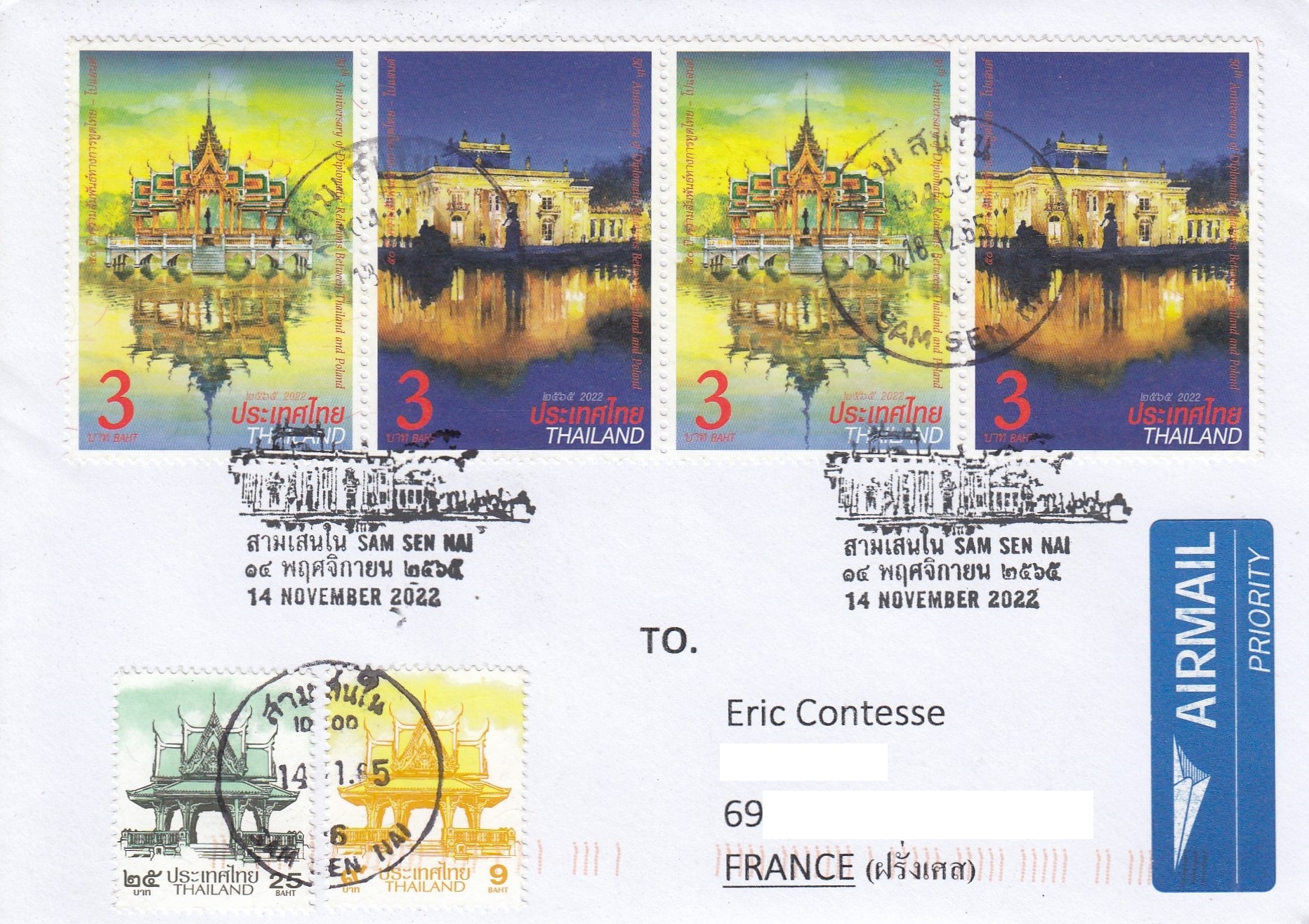
"Floating Palaces" joint stamp set with Thailand, on cover from Poland

Série "Palais flottants", commune avec la Thaïlande, sur lettre de Pologne

Le 14 novembre 2022, les administrations postales de Thaïlande et de Pologne ont mis en circulation une jolie série commune (2 timbres) illustrant des "palais flottants", afin de célébrer le 50ème anniversaire (jour pour jour) de l'établissement de relations diplomatiques entre les 2 pays.
Les 2 pays entretiennent aujourd'hui des relations étroites, dans le domaine économique (la Thaïlande est pour la Pologne le 2ème partenaire commercial de l'ASEAN), culturel ou scientifique.
Les 2 pays ont imprimé ces 2 timbres dans un feuillet similaire composé de 8 timbres (4 paires).
Trois timbres de cette série (4 PLN, tirage : 240000) émise par la poste polonaise ont été utilisés sur la jolie lettre ci-dessous envoyée le 7 octobre 2024 depuis la ville de Leszno. Merci beaucoup Bartelk ! 
A noter ce TAD spécial consacrée à la Semaine internationale de compositions épistolaires, proposé au public entre le 6 et le 12 octobre 2024 (le 9 octobre étant la Journée mondiale de la poste).
Cette Semaine internationale de compositions épistolaires a été initiée lors de la 14ème Conférence de l'Union Postale Universelle en 1957, mise en place avec l'intention de développer les échanges culturels et de contribuer à la paix dans le monde. 
On November 14, 2022, the postal administrations of Thailand and Poland put into circulation a beautiful joint series (2 stamps) illustrating "floating palaces", in order to celebrate the 50th anniversary (to the day) of the establishment of diplomatic relations between the two countries.
The two countries maintain today close relations, in the economic (Thailand is for Poland the 2nd trading partner in ASEAN), cultural or scientific fields.
The two countries printed these two stamps in a similar sheetlet composed of 8 stamps (4 pairs).
Three stamps of this series (4 PLN, print run: 240,000) issued by the Polish Post have been used on the cover below sent on October 7, 2024 from the city of Leszno. Thank you very much Bartelk!
To note this special postmark dedicated to the International Letter Writing Week, offered to the public between October 6 and 12, 2024 (October 9 being World Post Day).
This International Letter Writing Week was initiated at the 14th Conference of the Universal Postal Union in 1957, set up with the intention of developing cultural exchanges and contributing to world peace.

Le timbre en 2 exemplaires ci-dessus reproduit une aquarelle du peintre thaïlandais Thaneth Ponchaiwong, représentant le pavillon flottant du Palais royal de Bang Pa-In, aussi connu sous le nom de "Palais d'été", un palais autrefois utilisé par les rois de Thaïlande, situé sur la rive du fleuve Chao Phraya, dans le district de Bang Pa-In, dans le sud de la province d'Ayutthaya.
La plupart des bâtiments actuels de ce Palais royal, dont ce pavillon flottant ("Aisawanthipphaya-at"), pavillon thaï en teck construit au milieu d'un lac, ont été construits entre 1872 et 1889 par le roi Rama V.
L'autre timbre représente le Palais Łazienki ou Palais-sur-l'Île ("Pałac Na Wyspie"), situé dans le parc Łazienki à Varsovie, à partir d'une aquarelle de l'artiste polonais Andrzej Gosik.
Ce palais de style classique a été construit sur une île artificielle qui divise un lac en deux parties. L'origine de l'actuel Palais remonte à la fin du 17ème siècle.
Sur l'ordre du prince Herakliusz Lubomirski, homme politique, écrivain et philosophe parmi les plus illustres de son temps fut construit un pavillon abritant des bains, dans un style baroque rococo.
En 1766, le roi Stanisław II August transforma le pavillon en Palais-sur-l'Île, de style classique. Inspiré des réalisations italiennes telles que la Villa Borghèse ou la Villa Medicis, il devait incarner le rêve d'un état idéal, moderne et souverain. 
The above stamp in two copies reproduces a watercolor by Thai painter Thaneth Ponchaiwong, depicting the floating pavilion of the Bang Pa-In Royal Palace, also known as "Summer Palace", a palace once used by the kings of Thailand, located on the bank of the Chao Phraya River, in Bang Pa-In district, in the south of Ayutthaya province.
Most of the current buildings of this Royal Palace, including this floating pavilion ("Aisawanthipphaya-at"), a Thai teak pavilion built in the middle of a lake, were built between 1872 and 1889 by King Rama V.
The other stamp depicts the Łazienki Palace or Palace-on-the-Isle ("Pałac Na Wyspie"), located in the Łazienki park in Warsaw, from a watercolor by Polish artist Andrzej Gosik.
This classic styled palace was built on an artificial island that divides a lake into two parts. The origin of the current Palace dates back to the end of the 17th century.

On the order of Prince Herakliusz Lubomirski, politician, writer and philosopher among the most illustrious of his time, a pavilion housing baths was built in a Baroque Rococo style.
In 1766, King Stanisław II August transformed the pavilion into this classic-styled Palace-on-the-Isle. Inspired by Italian achievements such as the Villa Borghese or the Villa Medici, it was to embody the dream of an ideal, modern and sovereign state.

dimanche 17 novembre 2024

"Olympic Games Paris 2024" stamps on (transported by railway mail) cover from Poland

Timbres "Jeux olympiques Paris 2024" sur lettre de Pologne

Le 18 juillet 2024, la poste polonaise a mis en circulation un timbre consacré aux jeux olympiques de Paris 2024 (33ème olympiade) organisés du 26 juillet au 11 août 2024.
Ce timbre (4,90 PLN, tirage : 126000), imprimé en feuillet de 9 timbres et conçu en collaboration avec le comité olympique polonais, a été utilisé en 3 exemplaires sur la lettre ci-dessous envoyée le 19 octobre 2024 depuis la ville de Legnica (Basse-Silésie). Merci beaucoup Bartek !
Ce timbre reprend l'emblème de la "Team Poland", composée de 218 athlètes (99 hommes, 119 femmes) engagés dans 23 sports lors de ces jeux de Paris 2024.
Lors de ces jeux, la Pologne célébrait les 100 ans de sa première participation olympiques, déjà à Paris en 1924, mais a obtenu l'un des pires résultats de son histoire (depuis 1956) avec uniquement 1 médaille d'or (Aleksandra Mirosław en escalade de vitesse féminine) et un total de 10 médailles.
On July 18, 2024, the Polish Post put into circulation a stamp dedicated to the Paris 2024 Olympic Games (33rd Olympiad) held from July 26 to August 11, 2024.
This stamp (PLN 4.90, print run: 126,000), printed in a sheetlet of 9 stamps and designed in collaboration with the Polish Olympic Committee, was used in three copies on the cover below sent on October 19, 2024 from the city of Legnica (Lower Silesia). Thank you very much Bartek!
This stamp features the emblem of "Team Poland", composed of 218 athletes (99 men, 119 women) competing in 23 sports at the Paris 2024 Games.
During these games, Poland celebrated 100 years since its first Olympic participation, already in Paris in 1924, but obtained one of the worst results in its history (since 1956) with only one gold medal (Aleksandra Mirosław in women's speed climbing) and a total of 10 medals.

Cette lettre est par ailleurs intéressante car l'empreinte bleue en bas à gauche indique que cette enveloppe a été "transportée par la poste ferroviaire sur la ligne Wrocław-Legnica" ("Przewieziono Pocztą Kolejową na trasie Wrocław-Legnica").
Cette opération spéciale a eu lieu ce 19 octobre 2024 dans le cadre du 180ème anniversaire de cette ligne de chemin de fer reliant Wrocław à Legnica, ce que mentionne les 2 TADs spéciaux appliqués à Wrocław sur les timbres.
Ce TAD représente une locomotive "A. Woehler" datant de 1867, exploitée sur cette ligne qui constituait une partie de la ligne ferroviaire de la Basse-Silésie-Marche ("Kolej Dolnośląsko-Marchijska", 330 km de long), reliant Berlin à Wrocław, alors capitale de la Silésie prussienne. Cette ligne a été construite entre 1842 et 1846.
August Wöhler (1819-1914) était un ingénieur prussien spécialisé dans le comportement mécanique des fontes et des aciers, qui fut nommé en 1847 ingénieur en chef sur cette ligne de chemin de fer, basé à Francfort-sur-l'Oder.
This letter is also interesting because the blue imprint at the bottom left indicates that this envelope was "transported by railway mail on the Wrocław-Legnica line" ("Przewieziono Pocztą Kolejową na trasie Wrocław-Legnica").
This special operation took place on October 19, 2024, as part of the 180th anniversary of this railway line connecting Wrocław to Legnica, which is mentioned on the two special postmarks applied in Wrocław on the stamps.
This postmark features a "A. Woehler" locomotive dating from 1867, operated on this line which was part of the Lower Silesian-Marcher railway line ("Kolej Dolnośląsko-Marchijska", 330 km long), connecting Berlin to Wrocław, then capital of Prussian Silesia. This line was built between 1842 and 1846.
August Wöhler (1819-1914) was a Prussian engineer specializing in the mechanical behavior of cast iron and steel, who was appointed chief engineer on this railway line in 1847, based in Frankfurt an der Oder. 

mercredi 20 septembre 2023

EUROPA 2023 (Peace - the highest value of humanity) stamp on cover from Poland

Timbre EUROPA 2023 (La Paix - la valeur humaine la plus importante) sur lettre de Pologne

Sur proposition de la poste ukrainienne, le thème choisi par l'organisation PostEurop pour les timbres EUROPA 2023 est "La Paix - la valeur humaine la plus importante" ("Pokój - najwyższa wartość ludzkości" en polonais), en écho à l'agression du pays par la Russie débutée en février 2022.
Ce choix sonne comme un rappel de la volonté qui avait présidé en 1950 à la création de l'Union européenne après la 2ème Guerre mondiale, résumée par Robert Schuman en une formule désormais célèbre : faire l'Europe pour faire la Paix.
Pour illustrer ce thème 2023, PostEurop a organisé un concours au sein des pays membres et c'est le projet "Nœud de la paix" de la poste luxembourgeoise (auteurs : Linda Bos et Runa Egilsdottir - A Designers' Collective) qui a été choisi, parmi 29 propositions.
Ce projet représente des cœurs entrelacés, et des mains aux doigts entremêlés, inspirés des nœuds d'amour celtiques. Les différentes couleurs renvoient à tous les pays du monde, unis par ce nouveau symbole de paix, une sorte de société fondée sur la coopération, dans laquelle les individus sont solidaires.
On the proposal of the Ukrainian Post, the theme chosen by the PostEurop organization for the EUROPA 2023 stamps is "Peace - the highest value of humanity" ("Pokój - najwyższa wartość ludzkości" in Polish), echoing the aggression of the country by Russia which started on February 2022.
This choice sounds like a reminder of the will that presided over the creation of the European Union in 1950 after the Second World War, summed up by Robert Schuman in a now famous formula: make Europe to make Peace.
To illustrate this 2023 theme, PostEurop organized a competition within the member countries and the Luxembourg Post's "Peace Knot" project (authors: Linda Bos and Runa Egilsdottir - A Designers' Collective) was chosen from among 29 proposals.
This project represents intertwined hearts, and hands with intertwined fingers, inspired by Celtic love knots. The different colors refer to all the countries of the world, united by this new symbol of peace, a kind of society based on cooperation, in which individuals stand together.

Le 25 avril 2023, la poste polonaise a mis en circulation un timbre EUROPA unique (3,90 PLN), reproduisant ce "Nœud de la paix" commun, imprimé en feuillet de 12 timbres (tirage : 144000 timbres).
Ce timbre a été utilisé sur cette lettre envoyée le 31 août 2023 depuis la ville d'Oleśnica. Merci beaucoup Adam !
Adam a utilisé 2 autres timbres, en particulier celui (4 PLN, tirage : 5000000, conception : Andrzej Gosik) émis le 29 mai 2021 dans le cadre de la série courante illustrant différentes villes polonaises, consacré ici à la ville de Mińsk Mazowiecki (centre-est du pays, 41000 habitants).
Cette émission coïncide avec le 600ème anniversaire de l'octroi du statut de ville de cette localité (le 29 mai 1421, par le prince de Mazovie Janusz Ier).
Ce timbre montre en particulier la façade de l'église de la Nativité de la Bienheureuse Vierge Marie (17ème siècle) et l'aigle couronné situé au sommet du monument de l'Indépendance local.
On April 25, 2023, the Polish Post put into circulation a unique EUROPA stamp (PLN 3.90), reproducing this common "Peace Knot", printed in a sheetlet of 12 stamps (print run: 144,000 stamps).
This stamp was used on this cover sent on August 31, 2023 from the town of Oleśnica. Thank you very much Adam!
Adam used two other stamps, in particular the one (4 PLN, print run: 5,000,000, design: Andrzej Gosik) issued on May 29, 2021 as part of the definitive series illustrating different Polish cities, dedicated here to the city of Mińsk Mazowiecki (center-east of the country, 41,000 inhabitants).
This issue coincides with the 600th anniversary of the granting of city status to this locality (on May 29, 1421, by Prince of Mazovia Janusz I).
This stamp shows in particular the facade of the Church of the Nativity of The Blessed Virgin Mary (17th century) and the crowned eagle located atop the local Independence Monument. 

mercredi 14 juin 2023

"Nicolaus Copernicus - 550th birth anniversary" joint m/s with Poland, on cover from Vatican

Bloc-feuillet "Nicolas Copernic - 550 ans de sa naissance", commun avec la Pologne, sur lettre du Vatican

Comme la République serbe de Bosnie-Herzégovine, la Bulgarie ou la République tchèque, la Pologne et la Cité du Vatican ont mis en circulation, le 27 février 2023, un bloc-feuillet commun consacré au 550ème anniversaire de la naissance de l'astronome, chanoine, médecin et mathématicien polonais Nicolas Copernic (1473-1543).
Après avoir étudié les arts à l'Université Jagellon de Cracovie, il découvre la médecine, les mathématiques et surtout l'astronomie à l'université de Bologne (Italie), observant alors des éclipses ou des occultations d'étoiles par la Lune. De retour en Pologne à partir de l'an 1500, Copernic va consacrer le reste de sa vie à mener de front son travail de chanoine et ses recherches astronomiques qu'il conduit dans son observatoire de Frombork. 
Alors que depuis Ptolémée et Aristote, la Terre est placée au centre de l'Univers (géocentrisme), Copernic envisage de mettre le Soleil au centre de tout (héliocentrisme), une hypothèse qu'avait déjà envisagée Aristarque de Samos, un astronome grec qui vécut 300 ans avant J-C. 
Like the Serbian Republic of Bosnia & Herzegovina, Bulgaria or Czech Republic, Poland and the Vatican City put into circulation, on February 27, 2023, a joint miniature sheet dedicated to the 550th anniversary of the birth of the Polish astronomer, canon, doctor and mathematician Nicolaus Copernicus (1473-1543).
After studying arts at the Jagiellonian University of Krakow, he discovered medicine, mathematics and especially astronomy at the University of Bologna, Italy, observing eclipses or occultations of stars by the Moon. Back in Poland from the year 1500, Copernic will devote the rest of his life to carrying out his work as a canon and his astronomical research which he conducts in his observatory at Frombork.
While since Ptolemy and Aristotle, the Earth has been placed at the center of the Universe (geocentrism), Copernicus plans to put the Sun at the center of everything (heliocentrism), a hypothesis that had already been considered by Aristarque of Samos, a Greek astronomer who lived 300 years BC.

Copernic annonce également que la Terre tourne sur elle-même, que la Lune est son satellite et que toutes les planètes tournent autour du Soleil. Il développe ses théories dans deux ouvrages majeurs : "Commentariolus" et "De Revolutionibus Orbium Coelestium" achevé vers 1530.
Copernic a volontairement retardé la publication de ses idées, craignant la réaction hostile de l'Église qui se refuse à envisager la mobilité de la Terre autour du Soleil et n'acceptera cette idée qu'au début du 19ème siècle.
Quand Copernic meurt en 1543, ses idées ne sont connues que de quelques scientifiques. Au cours du 16ème siècle elles circuleront en cachette et séduiront de grands esprits comme Galilée, Léonard de Vinci ou Johannes Kepler.
La version vaticane de ce bloc-feuillet commun (1,25€, tirage : 38500) a été utilisée sur cette lettre envoyée le 3 mai 2023 depuis la Cité du Vatican. Merci beaucoup Salvatore !
Ce bloc-feuillet a été conçu à partir du tableau intitulé "L'astronome Copernic ou Conversations avec Dieu", une œuvre de Jan Matejko (1838-1893), considéré comme le plus grand peintre historique polonais, peinte vers 1873 à l'occasion du 400ème anniversaire de la naissance de Nicolas Copernic.
Cette peinture fait partie des collections du musée de l'Université Jagellon de Cracovie.
Copernicus also announces that the Earth rotates on itself, that the Moon is its satellite and that all the planets revolve around the Sun. He develops his theories in two major works: "Commentariolus" and "De Revolutionibus Orbium Coelestium" completed around 1530.
Copernicus deliberately delayed the publication of his ideas, fearing the hostile reaction of the Church which refused to consider the mobility of the Earth around the Sun and would not accept this idea until the beginning of the 19th century.
When Copernicus died in 1543, his ideas were only known to a few scientists. During the 16th century they circulated in secret and seduced great minds such as Galileo, Leonardo da Vinci or Johannes Kepler.
The Vatican version of this joint miniature sheet (€1.25, print run: 38,500) was used on this cover sent on May 3, 2023 from the Vatican City. Thank you very much Salvatore!
This miniature sheet was designed from the work of art entitled "Astronomer Copernicus or Conversations with God", a work by Jan Matejko (1838-1893), considered the greatest Polish historical painter, painted around 1873 on the occasion of the 400th anniversary of the birth of Nicolaus Copernicus.
This painting is part of the collections of the Jagiellonian University Museum in Krakow.  

mercredi 26 avril 2023

"Emil Korytko (1813-1839)" joint stamp with Poland, on cover from Slovenia

Timbre "Emil Korytko (1813-1839)", commun avec la Pologne, sur lettre de Slovénie

Le 6 mars 2023, les administrations postales de Slovénie et de Pologne ont mis en circulation un timbre commun à l'occasion du 210ème anniversaire de la naissance d'Emil Korytko (1813-1839), militant politique polonais de la période de la grande émigration, exilé à Ljubljana où il devint un important ethnographe, philologue et traducteur.
À Ljubljana, il a cultivé des amitiés avec de nombreux intellectuels slovènes de l'époque (Blaž Crobath, Matija Čop, France Prešeren). Son recueil de chansons folkloriques slovènes (carnioliennes) a été publié en cinq volumes (1839-1844) après sa mort.
En 1838, il publia, dans le journal Illyrisches Blatt, le premier questionnaire concernant la collecte de documents sur les traditions folkloriques de la Carniole, qui était aussi un appel à collecter des documents concernant d'autres peuples slaves. En plus des chansons, des contes et des énigmes, il a recueilli du matériel sur la culture matérielle, en particulier les tenues vestimentaires et les costumes régionaux distinctifs.
Emil Korytko a contribué de manière significative au dialogue mutuel entre les auteurs et lecteurs polonais et slovènes. 
On March 6, 2023, the postal administrations of Slovenia and Poland put into circulation a joint stamp on the occasion of the 210th anniversary of the birth of Emil Korytko (1813-1839), Polish political activist in the period of Great Emigration, exiled to Ljubljana where he became an important ethnographer, philologist and translator.
In Ljubljana, he cultivated friendships with many Slovenian intellectuals of the time (Blaž Crobath, Matija Čop, France Prešeren). His collection of Slovene (Carniolan) folk songs was published in five volumes (1839-1844) after his death.
In 1838 he published, in the newspaper Illyrisches Blatt, the first questionnaire regarding the collection of material on folk traditions in Carniola, which was also a call to collect material pertaining to other Slav peoples. In addition to songs, tales and riddles, he collected material on material culture, in particular attire and distinctive regional costumes.
Emil Korytko has made a significant contribution to the mutual dialogue between Polish and Slovene authors and readers.

La version slovène de ce timbre (0,88€, tirage : 30000), conçu par Marko Prah, figure à droite sur cette jolie lettre envoyée le 27 mars 2023 depuis Kranj. Merci beaucoup Petra !
La silhouette de profil d'Emil Korytko est représentée sur ce timbre, avec un extrait manuscrit de son recueil de chansons folkloriques dans le fond.
Le timbre au centre (tarif "B" pour un envoi domestique ordinaire jusqu'à 50g - 0,88€), émis le 27 janvier 2023, est le timbre de vœux de cette année, en forme de cœur comme d'habitude, illustrant l'un des nombreux proverbes slovènes sur l'amour : "L'amour donne naissance à l'amour". Ce timbre (tirage : 35000) a été conçu par l'agence villa creativa à partir d'un dessin de Mance Šestan (école primaire d'Ilirska Bistrica).
Le bloc-feuillet à gauche (2,58€, tirage : 20000), émis le même jour, fait partie d'une jolie série consacrée à des lacs naturels de Slovénie, le lac noir ici, situé dans le massif du Pohorje (Préalpes orientales méridionales, 1500 mètres d'altitude), près de la ville de Maribor.
Conçu par villa creativa à partir d'une photographie de Matjaž Corel, ce bloc-feuillet montre une vue de ce lac (50 hectares) qui doit son nom à sa couleur sombre, presque noire, conséquence d'une épaisse couche de limon sur son fond. Le lac est entouré de forêt et la forêt et le lac sont protégés en tant que réserve forestière.
The Slovenian version of this stamp (€0.88, print run: 30,000), designed by Marko Prah, was used on the right on this pretty cover sent on March 27, 2023 from Kranj. Thank you very much Petra!
Emil Korytko's profile silhouette is featured on this stamp, with a handwritten excerpt from his collection of folk songs in the background.
The stamp in the center ("B" rate for ordinary domestic postage up to 50g - €0.88), issued on January 27, 2023, is this year's greetings stamp, heart-shaped as usual, illustrating one of the many Slovenian proverbs about love: "Love gives birth to love". This stamp (print run: 35,000) was designed by the agency villa creativa from a drawing by young Mance Šestan (primary school of Ilirska Bistrica).
The souvenir sheet on the left (€2.58, print run: 20,000), issued the same day, is part of a nice series devoted to the natural lakes of Slovenia, the black lake here, located in the Pohorje massif (Southern Limestone Alps, 1500 meters above sea level), near the town of Maribor.
Designed by villa creativa from a photograph by Matjaž Corel, this souvenir sheet shows a view of this lake (50 hectares) which owes its name to its dark, almost black color, the result of a thick layer of silt on its bottom. The lake is surrounded by forest and both the forest and the lake are protected as a forest reserve. 

lundi 24 avril 2023

"Grigol Peradze (1899-1942)" joint stamp with Poland, on cover from Georgia

Timbre "Grigol Peradze (1899-1942)", commun avec la Pologne, sur lettre de Géorgie

Le 6 décembre 2022, les administrations postale de Pologne et de Géorgie ont mis en circulation un timbre commun à l'occasion du 80ème anniversaire de la mort de Grigol Peradze (1899-1942), figure ecclésiastique géorgienne de premier plan, philologue, théologien, historien et professeur, saint des églises orthodoxes de Géorgie et de Pologne.
La version géorgienne de ce timbre (7 GEL, tirage : 50000, conception : D. Kolbaia et B. Koblianidze) a été utilisée à droite sur cette jolie lettre envoyée le 22 février 2023 depuis Tbilissi, la capitale. Merci beaucoup Khatuna !
En 1921, après l'invasion de la Géorgie par l'Armée rouge, Grigol Peradze part en exil en Allemagne où il obtient à l'université de Bonn un doctorat sur le thème "l'histoire monastique géorgienne jusqu'en 1064".
Il est ensuite réfugié en France en 1931 puis en Pologne à partir de 1933 où il devient professeur de patrologie à la Faculté de théologie orthodoxe de l'université de Varsovie. 
On December 6, 2022, the postal administrations of Poland and Georgia put into circulation a joint stamp on the occasion of the 80th anniversary of the death of Grigol Peradze (1899-1942), a leading Georgian ecclesiastical figure, philologist, theologian, historian and professor, Saint of the Orthodox churches of Georgia and Poland.
The Georgian version of this stamp (7 GEL, print run: 50,000, design: D. Kolbaia and B. Koblianidze) was used on the right on this attractive cover sent on February 22, 2023 from Tbilisi, the capital. Thank you very much Khatuna!
In 1921, after the invasion of Georgia by the Red Army, Grigol Peradze went into exile in Germany where he obtained a doctorate at the University of Bonn on the theme "Georgian monastic history until 1064".

He then took refuge in France in 1931 and then in Poland from 1933 where he became professor of patrology at the Faculty of Orthodox Theology of the University of Warsaw. 

Il effectue des recherches de manuscrits géorgiens en Europe et au Moyen-Orient. En 1939, après l'invasion de la Pologne par l'armée allemande, il soutient toutes les personnes inquiétées qu'elles soient juives, polonaises ou géorgiennes. Il est arrêté le 5 mai 1942 et transféré au camp d'Auschwitz en novembre, il y décède officiellement le 6 décembre 1942 (en ayant peut-être pris la place d'un déporté juif).
Sur ce timbre, Grigol Peradze est représenté devant l'entrée de l'université de Varsovie dans les années 1930. En 2013, il a reçu à titre posthume le titre et l'ordre du héros national de Géorgie.
A noter à gauche ce timbre (0,10 GEL) faisant partie d'une jolie série (6 timbres, conception : G. Mamulashvili) émise en septembre 2022, consacrée à différentes villes historiques, Zugdidi (ouest du pays) et son célèbre palais Dadiani (1840, musée d'histoire et architecture) ici.
Le dernier timbre ci-dessus (0,80 GEL) fait partie d'une série (2 timbres) émise le 12 décembre 2000 à l'occasion du 50ème anniversaire de la Convention européenne des droits de l'homme, ayant pour but de protéger les droits de l'homme et les libertés fondamentales en permettant un contrôle judiciaire du respect de ces droits individuels.
He researched Georgian manuscripts in Europe and the Middle East. In 1939, after the invasion of Poland by the German army, he supported all those concerned, whether Jewish, Polish or Georgian. He was arrested on May 5, 1942 and transferred to the Auschwitz camp in November, where he officially died on December 6, 1942 (probably having taken the place of a Jewish deportee).
On this stamp, Grigol Peradze is featured in front of the entrance to the University of Warsaw in the 1930s. In 2013, he was posthumously awarded the title and Order of National Hero of Georgia.
To note on the left this stamp (0.10 GEL) part of a nice series (6 stamps, design: G. Mamulashvili) issued in September 2022, dedicated to different historic cities, Zugdidi (west of the country) and its famous Dadiani palace (1840, History and Architecture Museum) here.
The last stamp above (0.80 GEL) is part of a series (2 stamps) issued on December 12, 2000 on the occasion of the 50th anniversary of the European Convention on Human Rights, with the aim of protecting human rights and fundamental freedoms by allowing judicial control of respect for these individual rights. 

mercredi 12 avril 2023

"Birds - 100 years of diplomatic relations" joint stamp set with Poland, on cover from Argentina

Série "Oiseaux - 100 ans de relations diplomatiques", commune avec la Pologne, sur lettre d'Argentine

Dans le cadre du 100ème anniversaire de l'établissement de relations diplomatiques entre l'Argentine et la Pologne, les administrations postales des 2 pays ont mis en circulation, le 25 novembre 2022, une jolie série commune (2 timbres) consacrées à des espèces de passereaux locales.
Plus de 500000 argentins sont d'origine polonaise, faisant de l'Argentine le 2ème pays d'Amérique latine avec la plus grande communauté polonaise à l'étranger, après le Brésil. 
La première arrivée significative d'immigrants polonais en Argentine s'est produite à la fin des années 1800 lorsque des polonais fuyant la pauvreté et la guerre sont arrivés en Argentine pour commencer un nouveau départ avec de nombreux établissements dans la province de Misiones, dans le nord-est du pays.
Un grand merci Gabriel pour cette jolie lettre envoyée le 16 mars 2023 depuis Buenos Aires, affranchie en partie avec cette série commune !
Ces 2 timbres argentins ont été imprimés se-tenant dans une même feuille composée de 8 paires de timbres et de 4 vignettes incluant le logo officiel de ces 100 ans de relations diplomatiques entre les 2 pays. 
As part of the 100th anniversary of the establishment of diplomatic relations between Argentina and Poland, the postal administrations of the two countries put into circulation, on November 25, 2022, a nice joint series (2 stamps) devoted to species of local passerines.
More than 500,000 Argentineans are of Polish origin, making Argentina the 2nd country in Latin America with the largest Polish community abroad, after Brazil.
The first significant arrival of Polish immigrants to Argentina occurred in the late 1800s when Poles fleeing poverty and war arrived in Argentina to start a new beginning with many settlements in the province of Misiones, in the northeast of the country.
A big thank you Gabriel for this lovely cover sent on March 16, 2023 from Buenos Aires, partly stamped with this joint series!
These two Argentinian stamps have been printed se-tenant in the same sheet composed of 8 pairs of stamps and 4 labels including the official logo of these 100 years of diplomatic relations between the two countries.

 
Le timbre à droite (150 pesos, conception : Maria de Los Angeles Nores) représente un fournier roux (Furnarius rufus), dans son nid caractéristique, l'oiseau national de l'Argentine depuis 1928.
Cet oiseau, présent en Argentine, Brésil, Uruguay, Paraguay et Bolivie, est devenu le centre de nombreuses légendes et chansons appartenant au folklore des peuples d'Amérique du Sud. 
L'autre timbre (870 pesos, conception : Paweł Myszka) est consacré à un oiseau familier en Pologne et en Europe occidentale, la mésange huppée (Lophophanes cristatus). Son plumage présente une huppe noire très prononcée sur la tête (la femelle a la huppe plus courte que celle du mâle).
Le timbre à 130 pesos à gauche fait partie d'un bloc-feuillet (4 timbres) émis le 16 août 2022, consacré à la présence argentine en Antarctique, le 4ème timbre ci-dessus (50 pesos) étant un timbre ordinaire d'unité postale ("UP") émis le 22 juillet 2019, consacré au parc national Predelta (crée en 1992, province d'Entre Ríos).
The stamp on the right (150 pesos, design: Maria de Los Angeles Nores) depicts a rufous hornero (Furnarius rufus), in its characteristic nest, the national bird of Argentina since 1928.
This bird, present in Argentina, Brazil, Uruguay, Paraguay and Bolivia, has become the center of many legends and songs belonging to the folklore of the peoples of South America.
The other stamp (870 pesos, design: Paweł Myszka) is dedicated to a familiar bird in Poland and Western Europe, the crested tit (Lophophanes cristatus). Its plumage has a very pronounced black crest on the head (the female has a shorter crest than the male).
The 130 pesos stamp on the left is part of a souvenir sheet (4 stamps) issued on August 16, 2022, dedicated to the Argentine presence in Antarctica, the 4th stamp above (50 pesos) being an ordinary postal unit ("UP") stamp issued on July 22, 2019, dedicated to the Predelta National Park (created in 1992, province of Entre Ríos). 
 

dimanche 12 février 2023

EUROPA 2022 (Stories and Myths) stamp on cover from Poland

Timbre EUROPA 2022 (Mythes et légendes) sur lettre de Pologne

Comme de coutume, la poste polonaise n'a mis en circulation qu'un seul timbre EUROPA en 2022, illustrant le thème des "histoires et mythes" ("Baśni i legend" en polonais).
Mis en circulation le 21 avril 2022, ce timbre EUROPA (4,50 PLN, tirage : 171000), conçu par Maciej Jędrysik, a été imprimé en feuillet de 9 timbres, avec marges illustrées.
Ce timbre est à mon avis l'un des plus beaux timbres EUROPA émis en 2022, illustrant la légende de Krak et du dragon de Wawel ("Legenda o Kraku i smoku wawelskim").
Merci beaucoup Adam pour cette jolie lettre affranchie en partie avec ce timbre, envoyée le 10 janvier 2023 depuis la ville d'Oleśnica ! 
Ce timbre représente dans une stylisation médiévale ce dragon de Wawel et le cordonnier Skuba portant un bélier bourré de soufre. En arrière-plan, on peut voir la célèbre colline avec les bâtiments du château de Wawel  et la grotte du dragon en contrebas. 
Cette légende est encore bien ancrée dans la culture polonaise et l'histoire de la ville de Cracovie. 
As usual, the Polish Post has put into circulation only one EUROPA in 2022, illustrating the theme of "Stories and myths" ("Baśni i legend" in Polish).
Put into circulation on April 21, 2022, this EUROPA stamp (4.50 PLN, print run: 171,000), designed by Maciej Jędrysik, was printed in a sheetlet of 9 stamps, with illustrated margins.
This stamp is in my opinion one of the most beautiful EUROPA stamps issued in 2022, illustrating the legend of Krak and the Wawel dragon ("Legenda o Kraku i smoku wawelskim").
Thank you very much Adam for this nice cover partly franked with this stamp, sent on January 10, 2023 from the city of Oleśnica!
This stamp depicts in medieval stylization this Wawel dragon and the cobbler Skuba carrying a ram stuffed with sulphur. In the background one can see the famous hill with the buildings of Wawel Castle and the Dragon Cave below.
This legend is still firmly rooted in Polish culture and the history of the city of Krakow.

 
Selon cette légende, le terrible dragon parcourait la campagne, tuant les habitants, pillant leurs maisons et dévorant leur bétail. 
Le prince Krak voulu en finir avec ce dragon et promis la main de sa fille Wanda en mariage à celui qui pourrait le tuer. Les plus valeureux des guerriers se battirent contre l'animal mais aucun ne réussit à vaincre le dragon.
Un jour, un pauvre cordonnier, nommé Skuba, fourra un agneau avec du soufre et le mit à l'extérieur de la grotte du dragon. Ce dernier sortit et dévora rapidement l'animal. Peu de temps après il eut énormément soif. Il se dirigea vers la Vistule et son ventre gonfla énormément à mesure qu'il buvait l'eau. Il finit par exploser et le cordonnier épousa Wanda comme promis et ils vécurent heureux.
Adam a utilisé d'autres timbres en particulier celui (1 PLN, tirage : 10000000, conception : Jan Konarzewski) émis le 25 mars 2021, consacré à Michał Jankowski (1842-1912), un noble polonais qui s'est installé dans l'Extrême-Orient russe après avoir purgé une peine en Sibérie pour avoir participé au soulèvement de janvier 1863.
Après avoir été libéré en 1868, il resta vivre à Sidemi (Primorsky Krai) où il établi une ferme d'élevage de chevaux, élevé des cerfs et est devenu un chasseur et naturaliste bien connu. Il a collecté des spécimens de faune et de flore pour les musées.
According to this legend, the terrible dragon roamed the countryside, killing the inhabitants, plundering their homes and devouring their livestock.
Prince Krak wanted to put an end to this dragon and promised the hand of his daughter Wanda in marriage to whoever could kill him. The most valiant of the warriors fought against the animal but none succeeded in defeating the dragon.
One day, a poor cobbler, named Skuba, stuffed a lamb with sulfur and put it outside the dragon cave. The latter came out and quickly devoured the animal. A short time later he was very thirsty. He walked towards the Vistula river and his belly swelled enormously as he drank the water. He eventually exploded and the cobbler married Wanda as promised and they lived happily ever after.
Adam used other stamps in particular the one (1 PLN, print run: 10,000,000, design: Jan Konarzewski) issued on March 25, 2021, dedicated to Michał Jankowski (1842-1912), a Polish nobleman who settled in the Russian Far East after serving a sentence in Siberia for participating in the January 1863 uprising.
After being released in 1868, he remained to live in Sidemi (Primorsky Krai) where he established a horse-breeding farm, raised deer and became a well-known hunter and naturalist. He collected specimens of fauna and flora for museums.
 

dimanche 29 janvier 2023

"Floating Palaces" joint stamp set with Poland, on FDC from Thailand

Série "Palais flottants", commune avec la Pologne, sur FDC de Thaïlande

Le 14 novembre 2022, les administrations postales de Thaïlande et de Pologne ont mis en circulation une jolie série commune (2 timbres) illustrant des "palais flottants", afin de célébrer le 50ème anniversaire (jour pour jour) de l'établissement de relations diplomatiques entre les 2 pays.
Les 2 pays entretiennent aujourd'hui des relations étroites, dans le domaine économique (la Thaïlande est pour la Pologne le 2ème partenaire commercial de l'ASEAN), culturel ou scientifique.
Les 2 pays ont imprimé ces 2 timbres dans un feuillet similaire composé de 8 timbres (4 paires).
Deux paires de cette série (3 baht, tirage : 250000) émise par la poste thaïlandaise figurent sur cette jolie lettre avec TAD Premier Jour de Sam Sen Nai, bureau postal situé dans le quartier de Phaya Thai (centre de Bangkok), où est implanté le musée philatélique thaïlandais. Merci beaucoup Thapanaphong ! 
On November 14, 2022, the postal administrations of Thailand and Poland put into circulation a nice joint series (2 stamps) illustrating "floating palaces", in order to celebrate the 50th anniversary (to the day) of the establishment of diplomatic relations between the two countries.
The two countries now maintain close relations, in the economic (Thailand is for Poland the 2nd commercial partner of ASEAN), cultural or scientific fields.
The two countries printed these two stamps in a similar sheetlet composed of 8 stamps (4 pairs).
Two pairs from this series (3 Baht, print run: 250,000) issued by the Thai Post have been used on this pretty cover with First Day cancellations from the post office of Sam Sen Nai in the district of Phaya Thai (central Bangkok), where the Thai Philatelic Museum is located. Thank you very much Thapanaphong!

 
Ce TAD illustre le Palais Łazienki ou Palais-sur-l'Île ("Pałac Na Wyspie"), situé dans le parc Łazienki à Varsovie, également représenté sur un des 2 timbres de cette série commune, à partir d'une aquarelle de l'artiste polonais Andrzej Gosik.
Ce palais de style classique a été construit sur une île artificielle qui divise un lac en deux parties.
L'origine de l'actuel Palais remonte à la fin du 17ème siècle. Sur l'ordre du prince Herakliusz Lubomirski, homme politique, écrivain et philosophe parmi les plus illustres de son temps fut construit un pavillon abritant des bains, dans un style baroque rococo.
En 1766, le roi Stanisław II August transforma le pavillon en Palais-sur-l'Île, de style classique. Inspiré des réalisations italiennes telles que la Villa Borghèse ou la Villa Medicis, il devait incarner le rêve d'un état idéal, moderne et souverain. 
This postmark represents the Łazienki Palace or Palace-on-the-Isle ("Pałac Na Wyspie"), located in the Łazienki park in Warsaw, also featured on one of the two stamps of this joint series, from a watercolor by the Polish artist Andrzej Gosik.
This classic styled palace was built on an artificial island that divides a lake into two parts.
The origin of the current Palace dates back to the end of the 17th century. On the order of Prince Herakliusz Lubomirski, politician, writer and philosopher among the most illustrious of his time, a pavilion housing baths was built in a Baroque Rococo style.
In 1766, King Stanisław II August transformed the pavilion into this classic-styled Palace-on-the-Isle. Inspired by Italian achievements such as the Villa Borghese or the Villa Medici, it was to embody the dream of an ideal, modern and sovereign state.

 
Ces 4 mêmes timbres ont été utilisés sur cette 2ème lettre ci-dessus envoyée le 31 décembre 2022 (2022 correspondant à l'année 2565 dans le calendrier bouddhiste) depuis le bureau postal Boromarajajonani à Bangkok.
A noter dans la marge supérieure la présence du logo officiel du 50ème anniversaire de ces relations diplomatiques, créé par Mayuree Narknisorn pour la poste thaïlandaise.
L'autre timbre de cette série reproduit une aquarelle du peintre thaïlandais Thaneth Ponchaiwong, représentant le pavillon flottant du Palais royal de Bang Pa-In, aussi connu sous le nom de "Palais d'été", un palais autrefois utilisé par les rois de Thaïlande, situé sur la rive du fleuve Chao Phraya, dans le district de Bang Pa-In, dans le sud de la province d'Ayutthaya.
La plupart des bâtiments actuels de ce Palais royal, dont ce pavillon flottant ("Aisawanthipphaya-at"), pavillon thaï en teck construit au milieu d'un lac, ont été construits entre 1872 et 1889 par le roi Rama V.
These same 4 stamps were used on this 2nd letter above sent on December 31, 2022 (2022 corresponding to the year 2565 in the Buddhist calendar) from the Boromarajajonani post office in Bangkok.
To note in the top margin the presence of the official logo of the 50th anniversary of these diplomatic relations, created by Mayuree Narknisorn for the Thai Post.
The other stamp in this series reproduces a watercolor by Thai painter Thaneth Ponchaiwong, depicting the floating pavilion of the Bang Pa-In Royal Palace, also known as "Summer Palace", a palace once used by the kings of Thailand, located on the bank of the Chao Phraya River, in Bang Pa-In district, in the south of Ayutthaya province.
Most of the current buildings of this Royal Palace, including this floating pavilion ("Aisawanthipphaya-at"), a Thai teak pavilion built in the middle of a lake, were built between 1872 and 1889 by King Rama V. 
 
Related Posts Plugin for WordPress, Blogger...