dimanche 8 mars 2020
Favorit bicycle and postal uniform "B" stamps on FDC from Czech Republic
Le 1er février 2020, la poste tchèque a mis en circulation 2 timbres au nouveau tarif permanent "B" correspondant à un envoi domestique standard jusqu'à 50g en mode économique (19 CZK), l'ancien tarif "A" (même type d'envoi mais en prioritaire) passant à 26 CZK.
Ces 2 timbres figurent au centre sur la jolie lettre ci-dessous envoyée en recommandé de Prague le 1er jour d'émission. Merci beaucoup Bret !
Le timbre à droite représente un employé en uniforme postal (18ème siècle), à cheval, jouant du cor (l'emblème de nombreuses administrations postales, dont la poste tchèque).
Ce timbre, conçu par Karel Zeman, a été imprimé dans un carnet composé de 10 timbres autocollants (tirage : 200000 carnets).
On February 1, 2020, the Czech Post put into circulation two stamps at the new permanent rate "B" corresponding to a standard domestic item up to 50g in economy service (19 CZK), the previous rate "A" (same type of sending but in priority mail) passing to 26 CZK.
These two stamps are present in the center on the pretty letter below sent by registered mail from Prague on the first day of issue. Thank you very much Bret!
The stamp on the right represents an employee in postal uniform (18th century), on horseback, playing the horn (the emblem of many postal administrations, including the Czech Post).
This stamp, designed by Karel Zeman, was printed in a booklet composed of 10 self-adhesive stamps (print run: 200,000 booklets).
L'autre timbre au tarif "B" ci-dessus, conçu par Petr Ptáček, représente une ancienne bicyclette Favorit, de couleur verte.
Ce type de bicyclette, conçue dans les années 1950 et 1960 dans une usine située à Rokycany (centre-ouest du pays), fut très populaire à l'époque et tous les enfants du pays rêvaient d'en avoir une.
À son apogée, cette usine produisait 200000 vélos par an et les meilleurs cyclistes tchécoslovaques, comme les frères Pospíšil ou Jiří Daler qui ont remporté une médaille d'or aux Jeux olympiques de Tokyo en 1964, ont utilisé différents types de bicyclettes Favorit.
Bret a complété son affranchissement avec un timbre (tarif permanent "Z" pour un envoi hors d'Europe - 45 CZK actuellement), émis le 20 janvier 2020, consacré au peintre Josef Čapek (1887-1945) et à une œuvre intitulée "Orgue de Barbarie" (1913).
Le timbre à gauche (11 CZK) fait partie de la série EUROPA (2 timbres) émise le 5 mai 1998, consacrée cette année-là aux fêtes et festivals nationaux, illustrant ici la parade des rois, une tradition datant du 16ème siècle, probablement liée à assurer et à protéger les récoltes.
De nos jours, cette tradition n'est maintenue qu'à Vlčnov et dans quelques autres villages de Moravie du Sud.
The other "B" stamp above, designed by Petr Ptáček, depicts a vintage Favorit bicycle, green in color.
This type of bicycle, designed in the 1950s and 1960s in a factory located in Rokycany (center-west of the country), was very popular at the time and all the children of the country dreamed of having one.
At its peak, this factory produced 200,000 bikes per year, and the best Czechoslovak cyclists, such as the Pospíšil brothers or Jiří Daler who won a gold medal at the Tokyo Olympics in 1964, used different types of Favorit bicycles.
Bret completed his postage with a stamp (permanent rate "Z" for a shipment outside Europe - currently 45 CZK), issued on January 20, 2020, dedicated to the painter Josef Čapek (1887-1945) and to a work entitled "The Organ Grinder" (1913).
The stamp on the left (11 CZK) is part of the EUROPA series (2 stamps) issued on May 5, 1998, devoted that year to national festivals, here illustrating the King's Parade, a tradition dating from the 16th century, probably connected with ensuring and protecting the harvest.
Nowadays this tradition is upheld only in Vlčnov and a few other villages in South Moravia.
Ce 1er février 2020, la poste tchèque a également mis en circulation l'entier postal ci-dessus (prix de vente : 20 CZK, tirage inconnu), avec un timbre pré-imprimé (tarif "B") évoquant ce même uniforme postal.
Merci beaucoup Bret pour l'envoi de cet entier postal depuis Prague le 1er jour d'émission également !
This February 1, 2020, the Czech Post also put into circulation the postal stationary above (sale price: 20 CZK, unknown print run), with a pre-printed stamp (tariff "B") evoking this same postal uniform.
Thank you very much Bret for sending this postal stationary from Prague on the first day of issue as well!
vendredi 17 décembre 2010
EUROPA 2009 (Astronomy) souvenir sheet on cover from Georgia
Bloc-feuillet EUROPA 2009 (Astronomie) sur lettre de Géorgie
Sacrée Géorgie !!!
La poste géorgienne a enfin émis, le 15 octobre 2010, sa série de 2 timbres EUROPA ayant pour thème l'astronomie, le thème retenu par l'association PostEurop pour l'année 2009 !!
Les livres pour enfants seront peut-être à l'honneur en 2011 avec également un an de retard ?
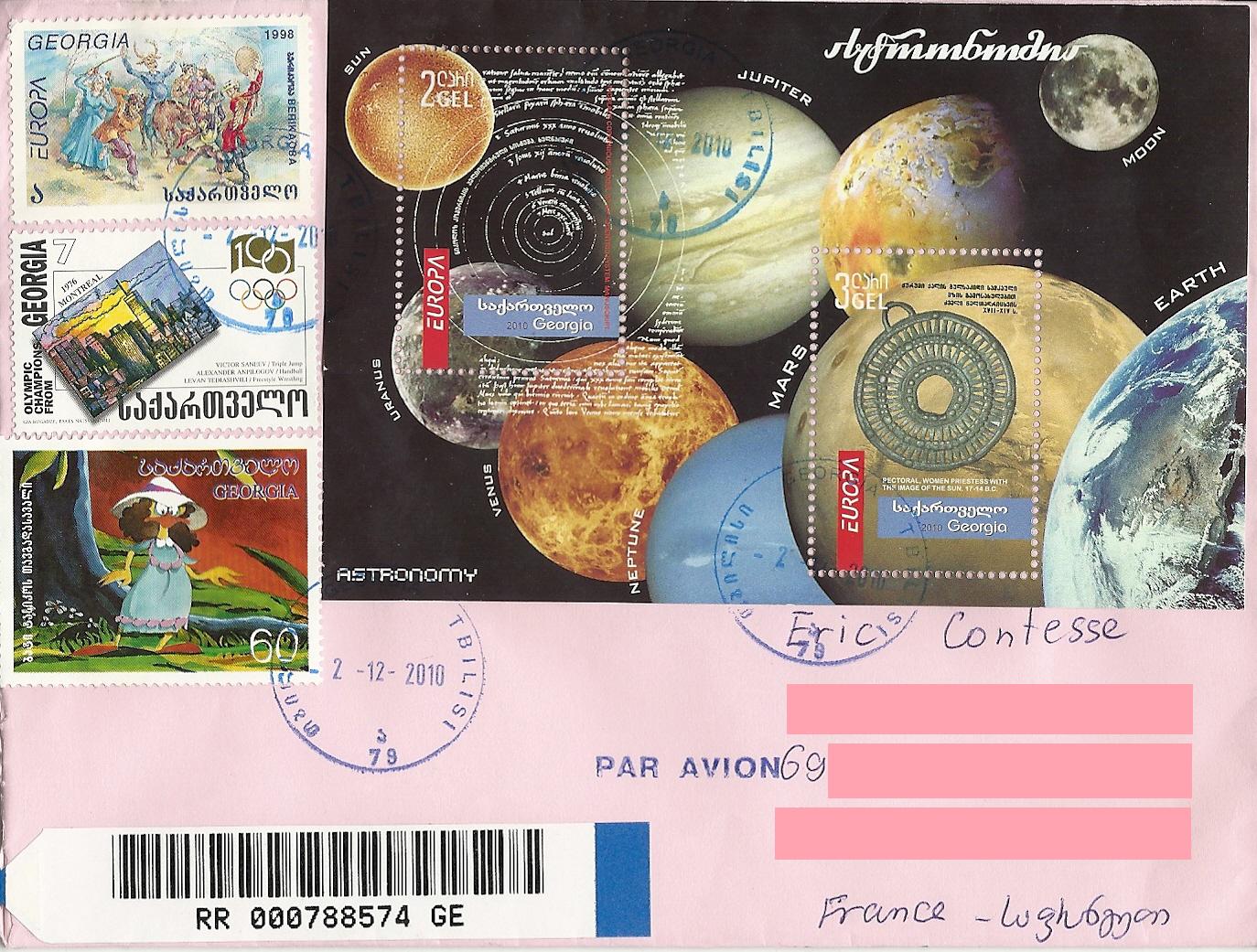
Consolation : cette série géorgienne est plutôt réussie je trouve, en particulier le magnifique bloc-feuillet réunissant les 2 timbres, figurant sur la lettre recommandée ci-dessous postée le 2 décembre 2010 de Tbilissi, la capitale. Merci beaucoup Khatuna !
Ces 2 timbres (2 et 3 laris), conçus par B. Koblianidze, évoquent un ornement pectoral d'une prêtresse en forme de soleil, daté entre le 17ème et le 14ème siècle avant JC, et le système héliocentrique simplifié de Nicolas Copernic au 16ème siècle dans son livre De Revolutionibus.
What a crazy Georgia !!!
The Georgian Post has finally issued on October 15, 2010, its series of two EUROPA stamps devoted to Astronomy, the theme chosen by the PostEurop association for the EUROPA stamps issued in 2009 !!
Children's books will perhaps be in the spotlight in 2011 with also a year late ?
Consolation : this Georgian series is quite successful I find, in particular the beautiful souvenir sheet featuring the two stamps, appearing on the cover below posted on December 2, 2010 in Tbilisi, the capital. Thank you very much Khatuna!
These two stamps (2 and 3 Laris), designed by B. Koblianidze, evoke a priestess pectoral ornament having the shape of the sun, dated between the 17th and 14th century BC, and the simplified heliocentric system by Nicolaus Copernicus in the 16th century in his book De Revolutionibus.
Ce nouveau système imaginé par Copernic, qui postule que la Terre n'est plus au centre de l'univers, que les planètes tournent autour du soleil ou que la Terre tourne sur elle-même, annonçait la fin du système géocentrique...
Les marges de ce bloc représentent 6 planètes du système solaire ainsi que le soleil et la lune. A noter qu'un astre est représenté à droite sans aucun nom (est-ce la planète Mercure ?). La 8ème planète du système solaire, Saturne, n'est curieusement pas représentée...
Khatuna a complété son affranchissement avec, en haut à gauche, un des 2 timbres EUROPA émis le 31 décembre 1998, ayant pour thème les festivals nationaux. Ce timbre évoque le Berikaoba, une compétition traditionnelle géorgienne d'improvisation. Les participants (Berika) doivent inventer des histoires ou des poèmes, accompagnés par des joueurs de gudastviri (cornemuse).
Le timbre à 7 tetris fait partie d'une série de 5 timbres, émis le 16 août 1996, commémorant les 100 ans des jeux olympiques modernes. Ce timbre mentionne les noms des 3 athlètes d'origine géorgienne, champions olympiques pour l'URSS lors des jeux de Montréal en 1976.
Le dernier timbre en bas à gauche fait partie d'une série de 5 timbres se-tenant émis le 15 juillet 1997, consacrée à différents personnages de dessins animés...
This new system imagined by Copernicus, which postulates that the Earth is not at the center of the universe, that the planets revolve around the sun and that the Earth rotates on itself, announced the end of the geocentric system...
The margins of this block are featuring six planets part of the solar system with also the sun and the Moon. To note that a planet is also depicted to the right without any name (is it the planet Mercury ?). The 8th planet of our solar system, Saturn, is curiously not represented...
Khatuna has completed her postage with, in the top left, one of the two EUROPA stamps issued on December 31, 1998, devoted to national festivals. This stamp evokes the Berikaoba, a traditional Georgian improvisation competition. Participants (Berika) have to invent epics or poems, accompanied by gudastviri (a bagpipe) players.
The 7 Tetris stamp is part of the set of five stamps issued on August 16, 1996, commemorating the 100th anniversary of modern Olympic Games. This stamp includes the names of the three Georgian athletes, then Olympic champions for the USSR team at the Montréal games in 1976.
The last stamp in the lower left is part of a series of five se-tenant stamps issued on July 15, 1997, devoted to different animated cartoon characters...
samedi 25 juillet 2009
EUROPA 1998 & 2003 stamps on covers from Slovakia
Timbres EUROPA 1998 et 2003 sur lettres de Slovaquie
Merci beaucoup Robert de me permettre encore une fois d'évoquer ces fabuleux timbres émis par la poste slovaque à travers ces trois nouvelles lettres postées fin juin de Bratislava et de Trnava !
La première lettre ci-dessous nous fait découvrir deux chefs-d'œuvre de l'architecture Renaissance et romane en Slovaquie. Le timbre à droite (22 Sk) fait partie d'une série de 3 timbres émis le 15 novembre 2002 consacrés à des édifices religieux. Celui-ci montre la façade de la cathédrale Saint-Martin de Spišská Kapitula (district de Levoča, nord-est du pays), une petite ville ecclésiastique très bien conservée.
Thank you so much Robert for allowing me once again to evoke these wonderful stamps issued by the Slovak Post through these three new covers mailed in late June from Trnava and Bratislava !
The first letter below makes us discover two masterpieces of Renaissance and Romanesque architecture in Slovakia. The stamp on the right (Sk 22.00) is part of a series of three stamps issued on November 15th 2002 devoted to religious buildings. This one depict the front of the St. Martin Cathedral in Spišská Kapitula (Levoca district, north-eastern country), a small well-preserved ecclesiastical town.
Cette cathédrale a été construite entre le 13ème et 15ème siècle dans un style roman puis gothique. Elle abrite de nombreux tombeaux des seigneurs du château de Spiš tout proche ainsi que de la famille Zapolsky. On y trouve également de très intéressantes fresques du 14ème siècle et une célèbre sculpture en travertin d'un lion blanc, représenté sur le timbre courant à 0,50€ émis en début d'année.
Spišská Kapitula, ainsi que le château de Spiš et ses monuments culturels associés, est inscrit sur la liste du patrimoine mondial de l'UNESCO depuis 1993.
Le timbre à gauche fait partie d'une série de 2 timbres, émis le 19 mai 2006, montrant des beffrois slovaques de style Renaissance. Celui ci-dessus à été construit en 1659 à Podolínec, dans la région de Prešov (nord-est du pays).
This cathedral was built between the 13th and 15th century in a Romanesque and Gothic style. It houses many tombs of the lords of the nearby Spiš castle and of the Zapolsky family. There are also some very interesting 14th century's frescoes and a famous travertine sculpture of a white lion, depicted on the € 0.50 definitive stamps issued earlier this year.
Spišská Kapitula, and the Spiš castle and its associated cultural monuments, is inscribed on the UNESCO World Heritage List since 1993.
The left stamp is part of a set of two stamps issued on May 19th 2006, depicting Renaissance Slovak belfries. The one above was built in 1659 in Podolínec, in the Prešov region (north-eastern country).
Le timbre à 14 Sk ci-dessus à droite a été émis le 9 mai 2003 dans le cadre de la série EUROPA dont le thème était l'art de l'affiche cette année-là. Une affiche pour une représentation de la pièce de théâtre Don Juan du français Molière y est reproduite. Ce timbre évoque en fait la triennale de l'affiche organisée depuis 1991 à Trnava. Cette affiche a été conçue par Vlastislav Rostoka qui a reçu à deux reprises le 1er prix lors de cette triennale.
Le timbre du centre a été émis le 10 mars 2003 pour célébrer les fêtes de Pâques. Il montre une jeune fille en costume traditionnel de la région de Vajnory tenant un "lesola" (branche décorée avec des oeufs peints et des rubans de couleurs), symbole du printemps.
Le petit timbre à gauche, émis le 15 mars 1995, fait partie de la série courante consacrée aux villes slovaques. Il montre l'église baroque Saint-Pierre et Paul de Nitra, l'une des plus anciennes villes de Slovaquie.
The Sk 14.00 stamp above on the right was issued on May 9th 2003 as part of the EUROPA series devoted to Poster art this year. A poster about the play Don Juan by the French Molière is reproduced here. This stamp is also evoking the Poster Triennial held since 1991 in Trnava. This poster was designed by Vlastislav Rostoka who has twice received the first prize at this triennial.
The stamp in the middle was issued on March 10, 2003 to celebrate Easter. It shows a young girl in traditional costume of the Vajnory region holding a "Lesola" (a twig decorated with painted eggs and ribbons of color), symbolizing spring season.
The small stamp on the left, issued on March 15th 1995, is part of the definitive series about cities of Slovakia. This one depicts the baroque St. Peter and St. Paul Church in Nitra, one of the oldest cities in Slovakia.
Un autre timbre de la série EUROPA de 1998, figure ci-dessus à droite. Émis le 5 mai 1998, il avait pour thème les fêtes et festivals. Je ne sais pas si ce timbre évoquait un festival slovaque en particulier mais l'oblitération "Premier jour" avait lieu dans le village de Starý Tekov, célèbre pour son festival folklorique (chants et danses).
Le timbre à 5,50 Sk fait partie d'une série de 2 timbres, émis le 22 février 2001, représentant chacun le costume traditionnel féminin et masculin de la ville de Detva (centre du pays).
Le timbre à 4 Sk a été émis le 3 septembre 1999 pour commémorer les 50 ans de la fondation de l'académie des beaux-arts et du design (VŠVU) de Bratislava.
Le dernier timbre à gauche, émis le 5 septembre 1995, évoque la biennale internationale de Bratislava (BIB) consacrée depuis 1967 à des illustrations de livres pour enfants et adolescents. Ce timbre reproduit un dessin de l'artiste slovaque Dušan Kállay qui a reçu des prix lors de cette biennale en 1973, 1975, 1983 et 1993.
An other stamp of the EUROPA series, is included above on the right. Issued on May 5th 1998, it focused on Festivals and national celebrations. I don't exactly know if this stamp referred to a Slovak festival in particular, but the FDC cancellation was held in the village of Starý Tekov, famous for its folk festival (songs and dances).
The Sk 5.50 stamp is part of a set of two stamps issued on February 22th 2001, each depicting women and men's folk costumes of the town of Detva (central region).
The Sk 4.00 stamp was issued on September 3, 1999 to commemorate the 50th anniversary of the founding of the Academy of Fine Arts and Design (VŠVU) in Bratislava.
The last stamp on the left, issued on September 5th 1995, is about the International Biennial of Illustrations of Bratislava (BIB) held since 1967 and devoted to illustrations of books for children and young adults. This stamp reproduces a drawing by the Slovak artist Dušan Kállay who received some Awards at this Biennial in 1973, 1975, 1983 and 1993.
dimanche 17 mai 2009
"Auguste Baillayre - 130th birth anniversary" prepaid envelope from Moldova
La poste moldave a émis, le 1er mai 2009, sa 9ème enveloppe (entier postal) avec un timbre préimprimé commémorant les 130 ans de la naissance de l'une des plus marquantes personnalités de l'art bessarabien de l'entre-deux-guerres, Auguste Baillayre (1879-1961).
Merci beaucoup Sergio pour cette jolie lettre avec oblitération "1er jour" de Chişinău !
Un portrait du peintre figure sur le timbre et deux de ses œuvres, "Nature morte aux poissons" (1927) et "Autoportrait avec des masques" (1945), sont reproduites à gauche sur l'enveloppe.
The Post of Moldova has issued, on May 1, 2009, its 9th postal stationery cover with a preprinted stamp commemorating the 130th anniversary of the birth of one of the most important personalities of the interwar Bessarabian Art, Auguste Baillayre (1879-1961).
Thank you very much Sergio for this nice cover with a FDC cancellation from Chişinău!
A portrait of the painter appears on the stamp and two of his works, "Still Life with Fish" (1927) and "Self Portrait with Masks" (1945), are also reproduced on the left on the envelope.
Son œuvre s'apparentera successivement au constructivisme (de 1899 à 1918), à l'impressionnisme (de 1918 à 1943 en Bessarabie) puis au post-impressionnisme (de 1943 à sa mort à Bucarest). Il fut professeur à l'école des Beaux-Arts de Chişinău.
Plusieurs de ses oeuvres sont conservées au Musée national d'art de Chişinău, dont il fut le premier directeur en 1939.
His work was successively close to constructivism (from 1899 to 1918), impressionism (from 1918 to 1943 in his Bessarabian period) and post-impressionism (from 1943 to his death in Bucharest). He was a professor at the Chişinău Art School.
Several of his works are kept at the National Museum of Art of Chişinău, whose the first director he was in 1939.
Le tarif postal de ce timbre (1,20 L) correspond aux envois de lettres de moins de 20g à l'intérieur de la Moldavie. Sergio a donc dû compléter cet affranchissement avec deux autres timbres collés sur l'autre face de cette lettre (voir ci-dessus), soit un tarif total de 4,50 L (tarif pour l'Europe de l'ouest).
J'ai déjà évoqué sur ce blog la série de 2008, consacrée à des puits, dont fait partie le timbre à 0,10 L ci-dessus à droite.
L'autre timbre à 2,20 L, émis le 18 juillet 1998, fait partie de la série EUROPA consacrée à des fêtes et festivals moldaves. Ce timbre évoque un festival de poterie qui a lieu à Iurceni (raion de Nisporeni, centre-ouest du pays).
Comme évoqué l'année dernière, le logo EUROPA sur ce timbre est erroné (la lettre "R" n'est pas conforme), comme d'ailleurs sur les 2 nouveaux timbres moldaves de la série EUROPA émis cette année dont je reparlerai très prochainement sur ce blog.
The postal rate of this stamp (L 1.20) corresponds to the sending of letters up to 20g inside Moldova. Sergio has therefore completed his postage with two other stamps affixed to the other side of this letter (see above) to obtain a total rate of L 4.50 (rate to western European countries).
I've already mentioned on this blog the series issued in 2008, devoted to the pits, including the L 0.10 stamp above on the right.
The other L 2.20 stamp, issued on 18th of July 1998, is part of the EUROPA series devoted to national festivals. This stamp evokes a pottery festival which takes place in Iurceni (district of Nisporeni, west-center of Moldova).
As mentioned last year, the EUROPA logo on this stamp is wrong (the "R" letter is not right), as besides on the two new EUROPA Moldovan stamps issued this year about which I'll speak soon on this blog.