Affichage des articles dont le libellé est Tunisia. Afficher tous les articles

dimanche 12 janvier 2025

"Solidarity with Gaza" joint Arab stamp and #UPU150 stamp on FDC from Tunisia

Timbres arabe commun "Solidarité avec Gaza" et #UPU150 sur FDC de Tunisie

Dans le cadre d'une initiative conjointe des opérateurs postaux arabes (des pays membres de la Ligue Arabe), décidée lors de la 27ème session du Conseil des ministres arabes des Communications et de l'Information, organisée le 18 janvier 2024 à Abou Dhabi, l'émission d'un timbre arabe unifié a été actée, en solidarité avec Gaza.
Depuis le 7 octobre 2023 et les ignobles attaques et prises d'otages du Hamas contre Israël, l'état hébreu mène en effet une répression contre le groupe terroriste dans la bande de Gaza, incluant des destructions de structures civiles et la mort de milliers de palestiniens, y compris des femmes et des enfants.
La plupart des administrations postales participantes (Algérie, Maroc, Tunisie, Qatar, Jordanie Syrie, Oman, Djibouti) ont mis en circulation ce timbre commun le 29 novembre 2024, Journée internationale de solidarité avec le peuple palestinien (résolution des Nations Unies adoptée en 1977).
Parmi les différents projets proposés par les postes des pays arabes, celui créé par Maram Hilal Salim Al Mazahra pour la poste jordanienne a été choisi.
As part of a joint initiative of Arab postal operators (of member countries of the Arab League), decided during the 27th session of the Council of Arab Ministers of Communications and Information, held on January 18, 2024 in Abu Dhabi, the issue of a unified Arab stamp was enacted, in solidarity with Gaza.
Since October 7, 2023 and the despicable attacks and hostage-taking by Hamas against Israel, the Hebrew state has been carrying out a crackdown on the terrorist group in the Gaza Strip, including the destruction of civilian structures and the death of thousands of Palestinians, including women and children.
Most of the participating postal administrations (Algeria, Morocco, Tunisia, Qatar, Jordan, Syria, Oman, Djibouti) put this joint stamp into circulation on November 29, 2024, the International Day of Solidarity with the Palestinian People (United Nations resolution adopted in 1977).
Among the various projects proposed by the Arab postal administrations, the one created by Maram Hilal Salim Al Mazahra for the Jordanian Post was chosen.

Ce timbre montre un petit garçon vivant à Gaza, portant le keffieh palestinien classique, regardant à travers un trou dans un mur. On voit une lueur d'espoir briller à travers ce minuscule trou, au milieu de la destruction et de la dévastation enregistrées à Gaza, avec le drapeau palestinien et trois colombes blanches symbolisant la paix.
L'emblème de la Ligue Arabe (22 états membres) est également présent sur ce timbre, en haut à gauche.
La version tunisienne de ce timbre arabe commun (4 TND, tirage : 100000) a été utilisée sur la lettre ci-dessus avec TAD Premier Jour du 29 novembre 2024, envoyée le 2 décembre 2024 depuis Tunis. Merci beaucoup Mourad!
Mourad a également utilisé le timbre (0,75 TND, tirage : 500000, conception : Souhir Charfi), de forme ronde, émis le 9 octobre 2024, Journée mondiale de la poste, commémorant le 150ème anniversaire de l'UPU (Union Postale Universelle).
Ce timbre; incluant le logo officiel de ce 150ème anniversaire, représente une lettre envoyée depuis la Tunisie, voyageant autour du globe.
La Tunisie est membre de l'UPU depuis le 1er juillet 1888 (le pays était alors un protectorat français). 
This stamp shows a little boy living in Gaza, wearing the classic Palestinian keffiyeh, looking through a hole in a wall. A glimmer of hope can be seen shining through this tiny hole, amidst the destruction and devastation in Gaza, with the Palestinian flag and three white doves symbolizing peace.
The emblem of the Arab League (22 member states) is also present on this stamp, at the top left.
The Tunisian version of this joint Arab stamp (4 TND, print run: 100,000) was used on the above cover with First Day cancellation of November 29, 2024, sent on December 2, 2024 from Tunis. Thank you very much Mourad!
Mourad also used the stamp (0.75 TND, print run: 500,000, design: Souhir Charfi), round in shape, issued on October 9, 2024, World Post Day, commemorating the 150th anniversary of the UPU (Universal Postal Union).
This stamp; including the official logo of this 150th anniversary, represents a letter sent from Tunisia, traveling around the globe.
Tunisia has been a member of the UPU since July 1, 1888 (the country was then a French protectorate).

mercredi 4 décembre 2024

"Arts - Painter Alexander Rubtsov" joint stamp set with Tunisia, on cover from Russia

Série "Arts - Peintre Alexander Rubtsov", commune avec la Tunisie, sur lettre de Russie

Le 5 septembre 2024, les administrations postales de Russie et Tunisie ont mis en circulation une intéressante série commune (2 timbres) consacrée aux arts et en particulier au peintre russe Alexander Rubtsov (1884-1949), à l'occasion du 75ème anniversaire de son décès.
Originaire de Saint-Pétersbourg, Alexandre Rubtsov était un peintre, graphiste et publiciste dont l'œuvre appartient à la fois aux cultures russe, française et tunisienne. L'artiste a peint des portraits, des paysages et des scènes de genre.
Entre 1904 et 1912, il a étudié à l'École supérieure d'art de peinture, de sculpture et d'architecture de l'Académie impériale des arts dans les classes de K. Makovsky et I. Repin. En 1912, son tableau "Intérieur" de style empire remporte le Grand Prix au concours académique, et Rubtsov reçoit le titre d'artiste et le droit de voyager à l'étranger pendant quatre ans. 
Après avoir visité plusieurs pays (France, Espagne, Maroc, Allemagne, Angleterre), il arrive en Tunisie en avril 1914 et entreprend un voyage dans le sud tunisien. 
On September 5, 2024, the postal administrations of Russia and Tunisia put into circulation an interesting joint series (2 stamps) dedicated to the arts and in particular to Russian painter Alexander Rubtsov (1884-1949), on the occasion of the 75th anniversary of his death.
Born in Saint Petersburg, Alexander Rubtsov was a painter, graphic artist and publicist whose work belongs to Russian, French and Tunisian cultures. The artist painted portraits, landscapes and genre scenes.
Between 1904 and 1912, he studied at the Higher School of Painting, Sculpture and Architecture of the Imperial Academy of Arts in the classes of K. Makovsky and I. Repin. In 1912, his painting "Interior" in the Empire style won the Grand Prix at the academic competition, and Rubtsov received the title of artist and the right to travel abroad for four years.
After visiting several countries (France, Spain, Morocco, Germany, England), he arrived in Tunisia in April 1914 and took a travel through the Tunisian south.

En 1920, Rubtsov participe pour la première fois au Salon tunisien où il présente 122 œuvres. Plusieurs de ses tableaux sont achetés par l'État tunisien. En 1944, il publie son album "Rues de Tunisie" qui regroupe 45 de ses œuvres. Rubtsov est décoré de l'Ordre d'honneur tunisien et de l'Ordre de l'Académie française des Beaux-Arts (1924).
La version russe de cette série commune a été utilisée sur la lettre ci-dessus envoyée le 10 septembre 2024 depuis Saint-Pétersbourg. Merci beaucoup Youri !
Ces 2 timbres (85 RUB, tirage : 45000 chacun), conçus par N. Karpova, ont été imprimés dans un même feuillet composé de 10 timbres + 2 vignettes reproduisant des œuvres de Rubtsov peintes en Tunisie : "Beni Khiar" (1919) et "Vue sur Sidi Bou Said" (1914), appartenant à la collection particulière du grand collectionneur Medhi Douss. Medhi Douss a en particulier, à travers une exposition itinérante entre Moscou et Saint-Pétersbourg, permis aux russes de redécouvrir ce peintre.
Les 2 timbres ci-dessus reproduisent des tableaux de Rubtsov intitulés respectivement "Autoportrait" (1919, collection de Medhi Douss) et "Dans le salon" (début du 20ème siècle, galerie d'art Ilya Glazunov à Moscou).
In 1920, Rubtsov participated for the first time in the Tunisian Salon where he presented 122 works of art. Several of his paintings were purchased by the Tunisian state. In 1944, he published his album "Streets of Tunisia" which brought together 45 of his works. Rubtsov was awarded the Tunisian Order of Honor and the Order of the French Academy of Arts (1924).
The Russian version of this joint series was used on the above cover sent on September 10, 2024 from Saint Petersburg. Thank you very much Yuri!
These two stamps (85 RUB, print run: 45,000 each), designed by N. Karpova, have been printed in the same sheetlet composed of 10 stamps + 2 labels reproducing works by Rubtsov painted in Tunisia: "Beni Khiar" (1919) and "View of Sidi Bou Said" (1914), belonging to the private collection of the great collector Medhi Douss. Medhi Douss has in particular, through a traveling exhibition between Moscow and Saint Petersburg, allowed Russians to rediscover this painter.
The two stamps above reproduce paintings by Rubtsov entitled respectively "Self-portrait" (1919, Medhi Douss collection) and "In the living room" (early 20th century, Ilya Glazunov art gallery in Moscow). 

samedi 21 janvier 2023

"Summit of La Francophonie 2022 in Djerba" m/s on FDC from Tunisia

Bloc-feuillet "Sommet de la Francophonie 2022 à Djerba" sur FDC de Tunisie

Pour la première fois de son histoire, la Tunisie organisait, les 19 et 20 novembre 2022, le 18ème Sommet de la francophonie, sur l'île de Djerba précisément.
A noter que ce Sommet, regroupant les chefs d’État et de gouvernement des 88 pays membres (y compris les pays associés ou observateurs) de l'Organisation internationale de la francophonie (OIF), oganisé tous les 2 ans, devait initialement avoir lieu à Tunis en décembre 2020 mais a été reporté à cause de la pandémie de Covid-19.
Le 19 novembre 2022, la poste tunisienne a mis en circulation un timbre (0,9 dinar, tirage : 500000) consacré à ce Sommet de la francophonie, reproduisant le logo de cette manifestation - une habitation blanche traditionnelle de Djerba avec les contours de l'île dans le fond (incluant les 5 couleurs présentes sur l'emblème de l'OIF).
Ces 5 couleurs (bleu, violet, rouge, vert, jaune) rappellent les diverses couleurs des drapeaux des états et gouvernements membres de l'OIF ainsi que les 5 continents où ils sont situés.
For the first time in its history, Tunisia organized, on November 19 and 20, 2022, the 18th Summit of La Francophonie, on the island of Djerba precisely.
It should be noted that this Summit, bringing together the Heads of State and Government of the 88 member countries (including associated or observer countries) of the International Organization of La Francophonie (OIF), organized every 2 years, was initially to take place in Tunis in December 2020 but was postponed due to the Covid-19 pandemic.
On November 19, 2022, the Tunisian Post put into circulation a stamp (0.9 dinar, print run: 500,000) dedicated to this Summit of La Francophonie, reproducing the logo of this event - a traditional white house in Djerba with the outlines of the island in the background (including the 5 colors present on the OIF emblem).
These 5 colors (blue, purple, red, green, yellow) recall the various colors of the flags of the member states and governments of the OIF as well as the 5 continents where they are located.

 
A noter que ce timbre a également été imprimé dans un bloc-feuillet (prix de vente : 2 dinars, tirage inconnu) comme celui utilisé sur le pli Premier Jour ci-dessus. Merci beaucoup Mourad !
Le fond de ce bloc-feuillet rappelle que les couleurs dominantes des habitations djerbiennes sont le blanc vif pour les murs et les toits, le bleu ciel ou plus rarement le vert bouteille pour les portes et fenêtres. Ce contraste entre le blanc des habitations et le bleu de la mer rend cet endroit attrayant pour les touristes.
Le thème principal de ce Sommet était "La connectivité dans la diversité : le numérique, vecteur de développement et de solidarité dans l'espace francophone" dans un contexte délicat marqué notamment par la prolifération des crises et des conflits internationaux.
A noter sur ce timbre en haut à gauche un QR-code permettant de visualiser une vidéo consacrée à ce Sommet.
Le prochain Sommet de la francophonie aura lieu en 2024 en France, à Villers-Cotterêt où le château abrite la "Cité internationale de la langue française". 
To note that this stamp was also printed in a souvenir sheet (selling price: 2 dinars, unknown print run) such as the one used on the First Day Cover above. Thank you very much Mourad!
The background of this souvenir sheet reminds us that the dominant colors of Djerbian homes are bright white for the walls and roofs, sky blue or more rarely bottle green for the doors and windows. This contrast between the white of the houses and the blue of the sea makes this place attractive for tourists.
The main theme of this Summit was "Connectivity in diversity: digital, a vector of development and solidarity in the French-speaking world" in a delicate context marked in particular by the proliferation of international crises and conflicts.
To note on this stamp at the top left a QR-code allowing you to view a video dedicated to this Summit.
The next Summit of La Francophonie will take place in 2024 in France, in Villers-Cotterêt where the castle houses the "International City of the French Language".
 

dimanche 13 novembre 2022

"World Post Day 2022 - Post for Planet" joint stamp on FDC from Tunisia

Timbre commun "Journée mondiale de la Poste 2022 - La poste pour la planète" sur FDC de Tunisie

La Journée mondiale de la poste est célébrée chaque année le 9 octobre, une décision du Congrès postal universel en 1969 à Tokyo afin de marquer l'anniversaire de la création de l'Union Postale Universelle (UPU) en 1874.
L'objectif de la Journée mondiale de la poste est de faire prendre conscience du rôle de la poste dans la vie quotidienne des personnes et des entreprises, ainsi que de sa contribution au développement social et économique mondial. En conséquence, les 192 pays membres de l'UPU sont encouragés à organiser leurs propres activités nationales pour célébrer l'événement, allant de l'introduction ou de la promotion de nouveaux produits et services postaux à l'organisation de journées portes ouvertes dans les bureaux de poste, les centres de courrier et les musées postaux...
Le thème de la Journée mondiale de la poste 2022 est "La poste pour la planète" afin de mettre en lumière les éléments des activités quotidiennes que les postes rendent déjà plus durables pour assurer une planète plus verte pour les générations futures. 
L'UPU (Sonja Denovski) a conçu une affiche illustrant ce slogan "La poste pour la planète" ainsi qu'un kit (timbre, enveloppe et TAD Premier Jour) suggérant aux administrations postales des pays membres de mettre en circulation des timbres la reproduisant. 
World Post Day is celebrated annually on October 9, a decision of the Universal Postal Congress in 1969 in Tokyo to mark the anniversary of the establishment of the Universal Postal Union (UPU) in 1874.
The objective of World Post Day is to raise awareness of the role of the post in the daily lives of people and businesses, as well as its contribution to global social and economic development. Accordingly, the 192 UPU member countries are encouraged to organize their own national activities to celebrate the event, ranging from introducing or promoting new postal products and services to organizing open days in post offices, mail centers and postal museums...
The theme for World Post Day 2022 is "Post for Planet" to highlight the elements of daily business that Posts are already making more sustainable to ensure a greener planet for future generations.
The UPU (Sonja Denovski) has designed a poster illustrating this slogan "Post for Planet" as well as a kit (stamp, First Day envelope and postmark) suggesting that the postal administrations of member countries put stamps reproducing it into circulation.

 
Ce fut le cas d'environ 25 administrations postales à travers le monde (Thaïlande, Serbie, Croatie, Russie, Fidji, Colombie, Cambodge, Sri Lanka, Égypte...).
La poste tunisienne a également mis en circulation ce timbre commun (1 dinar, tirage : 300000), utilisé en 2 exemplaires sur la lettre ci-dessus avec TAD Premier Jour du 9 octobre 2022. Merci beaucoup Mourad !
A noter que, de façon inhabituelle, la mention "Tunisie" en français ne figure pas sur ce timbre, incluant le drapeau tunisien en bas à gauche et uniquement des mentions en arabe, "Journée mondiale de la poste" en haut et le slogan "La poste pour la planète" en haut à droite (sous l'emblème de l'UPU) ainsi que dans la marge inférieure de la feuille, comme sur l'exemple ci-dessus.
Cette œuvre illustre un message visuel simplifié sur la contribution de la poste à un avenir écologiquement durable. En tant qu'image centrale, la planète Terre présente une distinction claire entre la nuit et le jour. En plus de représenter le contraste, la nuit et le jour représentent également la continuité et l'évolution.
Les lignes en pointillés illustrent la connexion entre des régions éloignées, où la Poste peut atteindre ceux qui se trouvent même dans les endroits les plus reculés de notre planète pour offrir une large gamme de services à tous.
La couleur dominante du design est le vert, qui est souvent d'abord associé à l'écologie ou à la nature. Mais le vert représente aussi la croissance et le renouveau. Qu'il s'agisse de livrer des colis et des lettres, des services financiers, des services sociaux et de santé ou de l'aide humanitaire, les postes s'emploient à livrer de manière plus durable.
This was the case for around 25 postal administrations around the world (Thailand, Serbia, Croatia, Russia, Fiji, Colombia, Cambodia, Sri Lanka, Egypt, etc.).
The Tunisian Post has also put this joint stamp into circulation (1 dinar, print run: 300,000), used in two copies on the cover above with First Day postmark of October 9, 2022. Thank you very much Mourad!
To note that, unusually, the mention "Tunisie" in French does not appear on this stamp, including the Tunisian flag at the bottom left and only mentions in Arabic, "World Post Day" at the top and the slogan "Post for Planet" at the top right (under the UPU emblem) as well as in the lower margin of the sheet, as in the example above.
This artwork illustrates a simplified visual message about the Post's contribution to an environmentally sustainable future. As the central image, planet Earth has a clear distinction between night and day. In addition to representing contrast, night and day also represent continuity and evolution.
The dotted lines illustrate the connection between remote areas, where the Post can reach those in even the most remote places on our planet to offer a wide range of services to everyone.
The dominant design color is green, which is often first associated with ecology or nature. But green also represents growth and renewal. Whether delivering parcels and letters, financial services, health and social services or humanitarian aid, Posts are working to deliver more sustainably.
 

samedi 8 octobre 2022

"Tunisia-Egypt Cultural Year" joint stamp with Egypt, on FDC from Tunisia

Timbre "Année culturelle Tunisie-Egypte", commun avec l'Égypte, sur FDC de Tunisie

Le président égyptien Abdel Fattah El Sisi et son homologue tunisien Kais Saied ont convenu en avril 2021, lors de la visite de ce dernier au Caire, de déclarer 2021-2022 Année de la culture égypto-tunisienne en activant des activités culturelles et artistiques conjointes dans tous les aspects tant en Égypte qu'en Tunisie, reflétant ainsi l'histoire commune entre les deux peuples et le niveau existant de communication et d'interaction entre eux.
Cette année de la culture a été réaffirmée en mai 2022 lors de la visite en Tunisie du premier ministre égyptien qui a, entre autres, visité la Cité de la Culture Chedli-Klibi, inaugurée en 2018 à Tunis.
Lors de cette visite, une exposition consacrée à la calligraphie arabe était organisée, célébrant son inscription (impliquant 16 pays du monde arabe, dont la Tunisie et l'Egypte) en décembre 2021 par l'UNESCO sur la liste du patrimoine culturel immatériel.
Egyptian President Abdel Fattah El Sisi and his Tunisian counterpart Kais Saied agreed in April 2021, during the latter's visit to Cairo, to declare 2021-2022 as the Year of Egyptian-Tunisian Culture by activating joint cultural and artistic activities in all aspects in both Egypt and Tunisia, thus reflecting the common history between the two peoples and the existing level of communication and interaction between them.
This year of culture was reaffirmed in May 2022 during the visit to Tunisia of the Egyptian Prime Minister who, among other things, visited the City of Culture Chedli-Klibi, inaugurated in 2018 in Tunis.
During this visit, an exhibition dedicated to Arabic calligraphy was organized, celebrating its inscription (involving 16 countries of the Arab world, including Tunisia and Egypt) in December 2021 by UNESCO on the list of intangible cultural heritage.

 
Afin de célébrer cette année culturelle entre les 2 pays, les administrations postales de Tunisie et d'Égypte ont mis en circulation, le 30 juin 2022, un timbre commun.
La version tunisienne de ce timbre (0,9 dinars, tirage : 300000) figure sur cette lettre avec TAD Premier Jour (drapeaux et cartes géographiques des 2 pays). Merci beaucoup Mourad !
Ce timbre commun, incluant les drapeaux des 2 pays, illustre 2 des plus importants sites religieux des 2 pays, la mosquée Al-Azhar au Caire (à droite, avec sa coupole et ses 3 minarets) et la mosquée de la Zitouna à Tunis (à gauche, avec en particulier une partie de la cour et de la coupole du bahou). 
La mosquée Al-Azhar, fondée en 970, est une des plus anciennes mosquées du Caire et le siège de l'université al-Azhar, la plus ancienne université islamique encore active au monde après Quaraouiyine au Maroc et l'université Zitouna en Tunisie. A noter que la ville du Caire a été désignée Capitale de la culture du monde islamique en 2022.
La mosquée de la Zitouna, fondée en 698, est le sanctuaire le plus ancien et le plus vaste de la médina de Tunis, classée au patrimoine mondial de l'UNESCO depuis 1979. Elle reprend la typologie des mosquées de Cordoue et Kairouan avec sa cour trapézoïdale encadrée par une galerie datant du 10ème siècle. 
In order to celebrate this cultural year between the 2 countries, the postal administrations of Tunisia and Egypt put into circulation, on June 30, 2022, a joint stamp.
The Tunisian version of this stamp (0.9 dinars, print run: 300,000) is present on this cover with First Day postmarks (flags and maps of the 2 countries). Thank you very much Mourad!
This joint stamp, including the flags of the 2 countries, illustrates 2two of the most important religious sites of the two countries, the Al-Azhar mosque in Cairo (on the right, with its dome and 3 minarets) and the Zitouna mosque in Tunis (on the left, with in particular part of the courtyard and the bahou cupola).
Al-Azhar Mosque, founded in 970, is one of the oldest mosques in Cairo and the seat of al-Azhar University, the oldest Islamic university still active in the world after Quaraouiyine in Morocco and Zitouna University in Tunisia. It should be noted that the city of Cairo was designated Capital of culture in the Islamic world in 2022. 
Zitouna Mosque, founded in 698, is the oldest and largest sanctuary in the medina of Tunis, listed as a UNESCO World Heritage Site since 1979. It takes up the typology of the mosques of Cordoba and Kairouan with its trapezoid courtyard framed by a gallery dating from the 10th century.
 

samedi 17 septembre 2022

"Tunisian Women" sheet (22 stamps!) on FDC from Tunisia

Feuillet "Femmes tunisiennes" (22 timbres !) sur FDC de Tunisie

À l'occasion de la célébration de la journée de la femme tunisienne, la Poste tunisienne, en coopération avec le ministère de la famille, de la femme, de l'enfance et des personnes âgées, a mis en circulation, le 13 août 2022, un spectaculaire feuillet composé de 22 petits timbres (0,25 dinars chacun) + 2 vignettes, afin de contribuer à raviver la mémoire collective et à donner de la visibilité concernant l'action des femmes en Tunisie.
Ces femmes ayant vécu à différentes périodes ont su influencer le cours de l'histoire et participer à façonner les traits de Tunisie, dans différents domaines (culture, sport, politique, médecine...).
Un grand merci Mourad pour cette jolie lettre recommandée envoyée le 1er jour d'émission, incluant ce feuillet complet !
Parmi ces femmes, celle qui s'illustre en ce moment sur la scène du tennis mondial, Ons Jabeur, première femme africaine et arabe à avoir atteint une finale de tournoi du Grand Chelem, à 2 reprises cette année (Wimbledon et US Open).
Parmi les autres femmes, certaines ont vécu il y a longtemps, comme Aicha Mannoubia, sainte tunisienne (confession soufie) ayant vécu au 13ème siècle, Aiwa le Kairouanaise, Zazia Hlalia, la princesse de Carthage Sophonisbe (3ème siècle avant JC) ou Dihya, une reine guerrière berbère qui a combattu les Omeyyades, lors de la conquête musulmane du Maghreb au 7ème siècle (elle est également célébrée en Algérie).
On the occasion of the celebration of Tunisian Women's Day, the Tunisian Post, in cooperation with the Ministry of Family, Women, Children and the Elderly, put into circulation, on August 13, 2022, a spectacular sheet composed of 22 small stamps (0.25 dinars each) + 2 labels, in order to contribute to reviving the collective memory and to give visibility concerning the action of women in Tunisia.
These women who lived in different periods were able to influence the course of history and participate in shaping the features of Tunisia, in different fields (culture, sport, politics, medicine ...).
A big thank you Mourad for this nice registered letter sent on the first day of issue, including this full sheet!
Among these women, the one who is currently shining on the world tennis scene, Ons Jabeur, the first African and Arab woman to have reached a Grand Slam tournament final, twice this year (Wimbledon and US Open).
Among the other women, some lived a long time ago, such as Aicha Mannoubia, a Tunisian saint (Sufi confession) who lived in the 13th century, Aiwa the Kairouanese, Zazia Hlalia, the princess of Carthage Sophonisbe (3rd century BC) or Dihya, a Berber warrior queen who fought against the Umayyads, during the Muslim conquest of the Maghreb in the 7th century (she is also celebrated in Algeria).

 
Les 17 autres timbres rendent hommage à des femmes plus contemporaines, comme l'écrivain et scénariste de film Aroussia Nalouti, la militante féministe Fatma Haddad, la première femme tunisienne à recevoir un doctorat d'État en philosophie, la femme politique Maya Jribi, première femme à diriger le Parti démocrate progressiste en 2006 ou encore Zaara Soltani, la mère des martyrs Mabrouk et Khalifa, tués par des terroristes à Jebel Mghila.
Ce feuillet rend également hommage à la réalisatrice et première femme ministre de la culture, Moufia Tlatli, l'actrice de cinéma et télévision Zohra Faiza, la chanteuse Naama, la comédienne, danseuse et réalisatrice Raja Ben Ammar, Azza Hammou, la première médecin tunisienne spécialisée en radiologie pédiatrique de renommée internationale, l'activiste et icône syndicale Fattouma Namla, Cherifa Messaidi, faisant partie des premières femmes tunisiennes qui se sont engagées dans la vie syndicale pendant la période coloniale, l'architecte Semia Akrout, la combattante et militante des droits au profit des femmes et des droits humains, Zeineb Farhat, la militante politique et féministe connue pour sa lutte pour l'indépendance de la Tunisie et la défense des droits des femmes, Gladys Adda, la marin pêcheur Saida Jallali, symbole de l'émancipation des femmes.
Un dernier timbre rend hommage plus généralement aux ouvrières agricoles.
The other 17 stamps pay tribute to more contemporary women, such as writer and film scriptwriter Aroussia Nalouti, feminist activist Fatma Haddad, the first Tunisian woman to receive a doctorate in philosophy, politician Maya Jribi, the first woman to lead the Progressive Democratic Party in 2006 or Zaara Soltani, the mother of the martyrs Mabrouk and Khalifa, killed by terrorists in Jebel Mghila.
This sheet also pays tribute to the director and first woman Minister of Culture, Moufia Tlatli, the film and television actress Zohra Faiza, the singer Naama, the actress, dancer and director Raja Ben Ammar, Azza Hammou, the first Tunisian doctor specialized in pediatric radiology of international renown, the activist and union icon Fattouma Namla, Cherifa Messaidi, being one of the first Tunisian women who became involved in union life during the colonial period, the architect Semia Akrout, the fighter and militant of rights for the benefit of women and human rights, Zeineb Farhat, the political and feminist activist known for her fight for the independence of Tunisia and the defense of women's rights, Gladys Adda, the fisherman Saida Jallali, symbol of emancipation of women.
A final stamp pays tribute more generally to female agricultural workers.
 

dimanche 7 août 2022

Euromed Postal 2022 (Antique Cities of the Mediterranean) stamp set on FDC from Tunisia

Série Euromed Postal 2022 (Cités antiques de la Méditerranée) sur FDC de Tunisie

Le 11 juillet 2022 a été retenu (à quelques exceptions près) comme date d'émission d'un timbre commun entre plusieurs pays méditerranéens (cela est le cas depuis 2014), intitulé "Euromed Postal" avec pour thème cette année "l'Archéologie maritime ou les cités antiques de la Méditerranée".
Après les "bijoux traditionnels de la Méditerranée" en 2021, les 13 administrations postales participantes (à date) ont émis cette année des timbres consacrés à l'un de ces 2 thèmes.
Pour rappel, le 9 juillet 2007 a eu lieu la première convention internationale de la poste méditerranéenne signée à Marseille. Depuis cette date, l'Union Postale pour la Méditerranée (PUMed), une union restreinte de l'UPU, a été créée le 11 mars 2011 et comprend actuellement les opérateurs postaux de 23 pays du bassin méditerranéen (incluant aussi le Portugal et la Mauritanie). 
La poste tunisienne a émis son premier timbre Euromed Postal en 2015 (bateaux de la Méditerranée). 
July 11, 2022 has been chosen (with a few exceptions) as the date of issue of a joint stamp between several Mediterranean countries (this has been the case since 2014), entitled "Euromed Postal" with the theme this year "Maritime Archeology or Antique Cities of the Mediterranean".
After "Handicraft Jewelry in the Mediterranean" in 2021, the 13 participating postal administrations (to date) have issued stamps dedicated to one of these two themes this year.
As a reminder, on July 9, 2007, the first international Mediterranean postal convention was signed in Marseille. Since that date, the Postal Union for the Mediterranean (PUMed), a restricted union of the UPU, was created on March 11, 2011 and currently includes postal operators from 23 countries of the Mediterranean basin (also including Portugal and Mauritania). 
The Tunisian Post issued its first Euromed Postal stamp in 2015 (Boats of the Mediterranean).

 
Le 11 juillet 2022, une série de 2 timbres (0,75 dinars, tirage : 900000) a été mise en circulation, illustrant deux cités antiques de la Méditerranée, Testour et Takrouna.
A noter que ces 2 timbres ont été conçus lors d'un hackathon de la poste tunisienne (objectif : réinventer l'usage du timbre-poste) organisé le 8 mai 2022 à Tunis, auquel ont participé plus de 100 élèves, collégiens et lycéens âgés de 12 à 18 ans (dont Siwar Chihi et Sara Ben Ayed, créateurs des 2 timbres). 
A noter aussi que la technologie de "Réalité Augmentée" a été adoptée pour ces deux timbres à travers l'application "Tunisia Stamps".
Un grand merci Mourad pour ce splendide pli Premier Jour concernant ces 2 timbres, envoyé depuis le bureau de poste du Bardo à Tunis!
J'aime beaucoup le TAD incluant d'autres sites tunisiens comme l'amphithéâtre d'El Jem, le minaret de la mosquée Zitouna à Tunis ou le capitole du site archéologique de Dougga.
Testour (nord-ouest du pays) est l'une des plus anciennes villes andalouses d'Afrique du nord, fondée à la fin du 16ème siècle par les Maures. La ville est connue pour sa grande mosquée et son festival de musique traditionnelle (malouf).
On July 11, 2022, a series of 2 stamps (0.75 dinars, print run: 900,000) was put into circulation, illustrating two ancient cities in the Mediterranean, Testour and Takrouna.
It should be noted that these 2 stamps were designed during a Tunisian Post Hackathon (objective: to reinvent the use of the postage stamp) organized on May 8, 2022 in Tunis, in which more than 100 pupils, middle and high school students participated (including Siwar Chihi and Sara Ben Ayed, creators of the 2 stamps).
To note also that "Augmented Reality" technology has been adopted for these two stamps through the "Tunisia Stamps" application.
A big thank you Mourad for this splendid First Day cover regarding these 2 stamps, sent from Le Bardo post office in Tunis!
I really love the postmark including other Tunisian sites like the amphitheater of El Jem, the minaret of the Al-Zaytuna mosque in Tunis or the capitol of the archaeological site of Dougga.
Testour (north-west of the country) is one of the oldest Andalusian towns in North Africa, founded at the end of the 16th century by the Moors. The city is known for its great mosque and its traditional music festival (malouf).
 
 
Takrouna est un village situé dans le gouvernorat de Sousse, près de la ville d'Enfidha. C'est l'un des villages berbères qui a conservé son caractère amazigh et c'est un village ancien et imprenable qui a protégé ses habitants des invasions et des raids à travers l'histoire.
Takrouna est situé au sommet d'un rocher situé à une altitude de 200 mètres et dominant la plaine environnante.
Mourad a utilisé 2 autres timbres (0,25 dinars) sur l'autre côté de son enveloppe ci-dessus, faisant partie d'une série (6 timbres) émise le 2 juillet 2010, consacrée à des monuments de la médina de Tunis, la porte Bab El Khadra (1881) et le palais Dar Hussein, siège de l'institut national du patrimoine, ici.
Takrouna is a village located in the governorate of Sousse, near the town of Enfidha. It is one of the Berber villages that has retained its Amazigh character and it is an ancient and impregnable village that has protected its inhabitants from invasions and raids throughout history.
Takrouna is located on top of a rock located at an altitude of 200 meters and dominating the surrounding plain.
Mourad used 2 other stamps (0.25 dinars) on the other side of his envelope above, part of a series (6 stamps) issued on July 2, 2010, devoted to monuments in the medina of Tunis, the Bab El Khadra gate (1881) and the Dar Hussein palace, seat of the national heritage institute, here.
 

mercredi 11 mai 2022

"66th anniversary of independence" stamp on FDC from Tunisia

Timbre "66ème anniversaire de l'indépendance" sur FDC de Tunisie 

Après 75 ans de protectorat français et suite à 3 ans de guérilla et une montée d'un mouvement nationaliste, la France finit par reconnaître solennellement l'indépendance de la Tunisie le 20 mars 1956.
Habib Bourguiba (1903-2000) a joué un rôle majeur dans cette quête d'indépendance de la Tunisie. Avocat formé en France dans les années 1920, il revient en Tunisie pour militer dans les milieux nationalistes, en fondant le parti Néo-Destour, fer-de-lance du mouvement pour l'indépendance de la Tunisie. Plusieurs fois arrêté et exilé par les autorités françaises, il choisit de négocier avec la France tout en faisant pression sur elle.
Une fois l'indépendance obtenue en 1956, il contribue à mettre fin à la monarchie du Bey de Tunis et à proclamer la République, dont il prend la tête en tant que premier président le 25 juillet 1957. 
After 75 years of French protectorate and following 3 years of guerrilla warfare and the rise of a nationalist movement, France solemnly recognized the independence of Tunisia on March 20, 1956.
Habib Bourguiba (1903-2000) played a major role in this Tunisia's quest for independence. A lawyer trained in France in the 1920s, he returned to Tunisia to campaign in nationalist circles, founding the Neo-Destour party, the spearhead of the Tunisian independence movement. Several times arrested and exiled by the French authorities, he chose to negotiate while putting pressure on France.
Once independence was obtained in 1956, he contributed to putting an end to the monarchy of the Bey of Tunis and to proclaiming the Republic, of which he took the helm as the first President on July 25, 1957.

Le 20 mars 2022, la poste tunisienne a mis en circulation un timbre (0,9 dinar, tirage : 300000) consacré au 66ème anniversaire de cette déclaration d'indépendance, présent en 2 exemplaires sur le pli Premier Jour ci-dessus. Merci beaucoup Mourad !
A noter cette mention "Independence Day" en anglais sur ce timbre et son TAD associé, ce qui est inhabituel...
Ce timbre reproduit le drapeau national tunisien remis par Habib Bourguiba au commandant des forces armées en 1956, conservé aujourd'hui au Musée militaire national de la Manouba (ouvert en 1989).
A noter ces encoches (ayant la forme de la khamsa ou "main de Fatma") au niveau des dentelures horizontales sur ce timbre, ce qui semble être la norme concernant les timbres tunisiens émis en 2022.
Mourad a ajouté un timbre (0,5 dinar) émis le 31 juillet 2018, consacré aussi à Habib Bourguiba, rappelant qu'il a été également le premier ministre des affaires étrangères tunisien, entre le 15 avril 1956 et le 25 juillet 1957. Il fut en même temps Premier ministre et ministre de la défense du gouvernement du roi Lamine Bey.
On March 20, 2022, the Tunisian Post put into circulation a stamp (0.9 dinar, print run: 300,000) dedicated to the 66th anniversary of this declaration of independence, present in 2 copies on the First Day cover above. Thank you very much Mourad!
To note this mention "Independence Day" in English on this stamp and its associated postmark, which is unusual...
This stamp reproduces the Tunisian national flag handed over by Habib Bourguiba to the commander of the armed forces in 1956, kept today at the National Military Museum of Manouba (opened in 1989). To note these notches (having the shape of the Hamsa or "Hand of Fatma") on the horizontal perforations on this stamp, which seems to be the norm for Tunisian stamps issued in 2022.
Mourad added a stamp (0.5 dinar) issued on July 31, 2018, dedicated to Habib Bourguiba, reminding us that he was also the first Tunisian Minister of Foreign Affairs, from April 15, 1956 to July 25, 1957. He was at the same time Prime Minister and Minister of Defense of the government of King Lamine Bey.
 

dimanche 23 janvier 2022

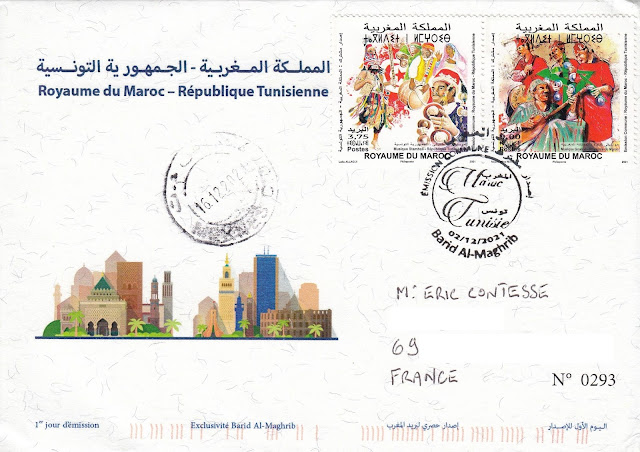
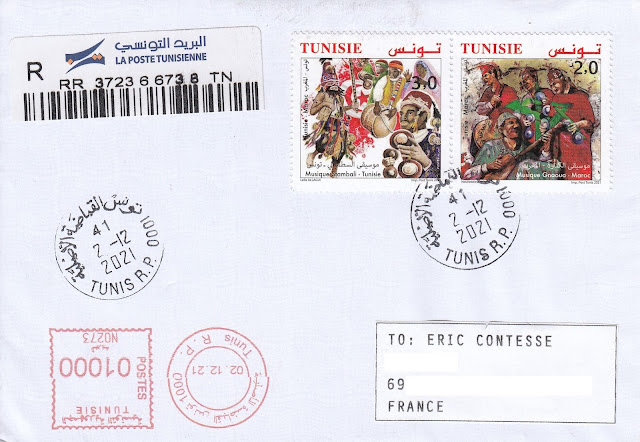
"Stambali and Gnaoua music" joint stamp set on FDCs from Morocco and Tunisia

Série commune "Musique Stambali et Gnaoua" sur FDCs du Maroc et Tunisie

Un peu plus d'un mois après une émission commune avec l'Algérie, la poste tunisienne a mis en circulation, le 2 décembre 2021, une très jolie série commune (2 timbres) avec la poste marocaine (Barid Al-Maghrib) cette fois, consacrée à la musique Gnaoua pour le Maroc et la musique Stambali pour la Tunisie, faisant partie de cette tradition musicale répandue par les routes tracées entre le Maghreb et l'Afrique subsaharienne.
Cet art témoigne de l'histoire commune de cette pratique ancestrale et de la richesse de ce patrimoine musical commun qui mêle musique, danses et chants durant lequel certains participants entrent en transe.
J'ai eu la chance de recevoir ces 2 plis Premier Jour du Maroc et de Tunisie concernant cette série commune. Merci beaucoup Pierre et Mourad !
Le FDC officiel numéroté de la poste marocaine ci-dessous illustre certains des monuments emblématiques des 2 pays : tour Hassan et Mausolée Mohammed V à Rabat, mosquée Zitouna à Tunis et amphithéâtre d'El Djem entre autres.
A little over a month after a joint issue with Algeria, the Tunisian Post put into circulation, on December 2, 2021, a very nice joint series (2 stamps) with the Moroccan Post (Barid Al-Maghrib) this time, devoted to Gnaoua music for Morocco and Stambali music for Tunisia, part of this musical tradition spread by the routes traced between the Maghreb and sub-Saharan Africa.
This art testifies to the common history of this ancestral practice and the richness of this common musical heritage which mixes music, dances and songs during which some participants go into a trance.
I was lucky enough to receive these two First Day Covers from Morocco and Tunisia concerning this joint series. Thank you very much Pierre and Mourad!
The official numbered FDC of the Moroccan Post below illustrates some of the emblematic monuments of the two countries: Hassan tower and Mausoleum Mohammed V in Rabat, Zitouna mosque in Tunis and amphitheater of El Djem among others.

 
Le timbre ci-dessus à droite (9 dirhams), conçu par Noureddine Noury, illustre la musique marocaine Gnaoua, inscrite en 2019 par l'UNESCO sur la Liste représentative du patrimoine culturel immatériel de l'humanité.
Le terme Gnaoua se rapporte à un ensemble de productions musicales, de performances, de pratiques confrériques et de rituels à vocation thérapeutique où le profane se mêle au sacré. Le Gnaoua est avant tout une musique confrérique soufie généralement associée à des paroles à caractère religieux, qui invoque les ancêtres et les esprits.
Pratiquée à l'origine par des groupes et des individus issus de l'esclavage et de la traite négrière remontant au moins au 16ème siècle, la culture Gnaoua fait aujourd'hui partie des multiples facettes de l'identité culturelle marocaine.
The stamp above right (9 dirhams), designed by Noureddine Noury, illustrates Moroccan Gnaoua music, inscribed in 2019 by UNESCO on the Representative List of the Intangible Cultural Heritage of Humanity.
Gnaoua refers to a set of musical events, performances, fraternal practices and therapeutic rituals mixing the secular with the sacred. Gnaoua is first and foremost a Sufi brotherhood music combined with lyrics with a generally religious content, invoking ancestors and spirits.
Originally practised by groups and individuals from slavery and the slave trade dating back to at least the 16th century, Gnaoua culture is now considered as part of Morocco's multifaceted culture and identity.
 
 
L'autre timbre de cette série commune (3 dinars, tirage : 50000, conception : Leila Allagui), ci-dessus à gauche sur cette lettre envoyée en recommandé depuis Tunis, est consacré au Stambali, un rite de possession musico-thérapeutique implanté dans certaines régions de Tunisie par des populations noires venues d'Afrique subsaharienne.
Il mêle musique, danses et chants durant lequel certains participants entrent en transe et incarnent des entités surnaturelles. Le terme désigne plus généralement la série de pratiques, dont le Stambali constitue la dernière étape, à vocation curative ou de conjuration du mauvais œil.
Cette musique se distingue par la diversité de ses instruments et de ses rythmes. Il y a les crotales, des plaques de métal avec une cloche en cuivre, qui renvoient au son des chaines en fer d'esclaves voyageant vers l'Afrique du nord, le Guembri, instrument rythmique à cordes qui guide les auditeurs aux confins des mélodies africaines envoutantes, et le tambour qui est présent en force pour libérer les âmes dansantes du poids et de l'anarchie du monde. 
The other stamp of this joint series (3 dinars, print run: 50,000, design: Leila Allagui), above on the left on this cover sent by registered mail from Tunis, is devoted to Stambali, a rite of musical-therapeutic possession implanted in certain regions of Tunisia by black populations from sub-Saharan Africa.
It mixes music, dances and songs during which some participants go into a trance and embody supernatural entities. The term more generally refers to the series of practices, of which the Stambali constitutes the last stage, with a curative vocation or to ward off the evil eye.
This music is distinguished by the diversity of its instruments and its rhythms. There are the crotales, metal plates with a copper bell, which refer to the sound of the iron chains of slaves traveling to North Africa, the Guembri, a rhythmic string instrument which guides listeners to the confines of melodies captivating African songs, and the drum which is present in force to free the dancing souls from the weight and anarchy of the world.
 

lundi 6 décembre 2021

"Wadi Madjerda" joint stamp on FDCs from Algeria and Tunisia

Timbre commun "Oued Madjerda" sur FDCs d'Algérie et de Tunisie

Après une 1ère émission commune en 2008 consacrée au 50ème anniversaire du bombardement de Sakiet Sidi Youssef, une opération menée par l'armée française dans le cadre de la guerre d'Algérie, sur le village tunisien de Sakiet Sidi Youssef (causant la mort de plus de 70 personnes), les administrations postales de Tunisie et d'Algérie ont mis en circulation, le 24 octobre 2021, un nouveau timbre commun évoquant cette fois le oued Madjerda.
Entre les rives de la vallée "Oued Madjerda" coule une rivière dont la source est située dans la région de Souk-Ahras, dans l'est de l'Algérie. La Madjerda se jette dans le golfe de Tunis en Mer Méditerranée. Long de plus de 460 kilomètres, une grande partie de cette vallée est située à l'intérieur du territoire tunisien. Sur son parcours, l'un des plus grands barrages de Tunisie a été érigé, le barrage de Sidi Salem. 
After a first joint issue in 2008 devoted to the 50th anniversary of the bombing of Sakiet Sidi Youssef, an operation carried out by the French army within the framework of the Algerian war, on the Tunisian village of Sakiet Sidi Youssef (causing the death of more of 70 people), the postal administrations of Tunisia and Algeria put into circulation, on October 24, 2021, a new joint stamp, this time evoking the wadi Madjerda.
Between the banks of the valley "Oued Madjerda" flows a river whose source is located in the region of Souk-Ahras, in eastern Algeria. Wadi Madjerda flows into the Gulf of Tunis in the Mediterranean Sea. Over 460 kilometers long, a large part of this valley is located inside Tunisian territory. On its route, one of the largest dams in Tunisia was erected, the Sidi Salem dam.

 
La vallée de la Madjerda est l'une des terres les plus fertiles de Tunisie et représente le douzième de ses ressources hydriques. La Madjerda est par ailleurs une voie d'eau cruciale pour l'irrigation et joue donc un rôle important pour l'agriculture régionale. Plus long cours d'eau de Tunisie, ce oued est menacé par la pollution et la qualité de ses eaux ne cesse de baisser.
La version algérienne de ce timbre (50 dinars, 43 x 29 mm), reproduisant une simple photographie de ce cours d'eau (conception : poste tunisienne), figure en 2 exemplaires sur le pli Premier Jour ci-dessus, avec TAD incluant les drapeaux des 2 pays. Merci beaucoup Zine ! 
The Madjerda valley is one of the most fertile lands in Tunisia and represents a twelfth of its water resources. The Madjerda is also a crucial waterway for irrigation and therefore plays an important role for regional agriculture. Longest river in Tunisia, this wadi is threatened by pollution and the quality of its water continues to decline.
The Algerian version of this stamp (50 dinars, 43 x 29 mm), reproducing a simple photograph of this watercourse (design: Tunisian Post), is present in two copies on the First Day cover above, with postmarks featuring the flags of the 2 countries. Thank you very much Zine!

 
Un grand merci également à Mourad pour cette lettre envoyée le 25 octobre 2021 depuis Tunis, affranchie avec 2 exemplaires du timbre tunisien (1,2 dinars, tirage : 150000), de format plus petit (41 x 28 mm) que le timbre algérien. 
Membres de l'Union du Maghreb arabe, de l'Union africaine et de la Ligue arabe, l'Algérie et la Tunisie ont toujours entretenu de bonnes relations politiques et économiques. La Tunisie a toujours soutenu l'Algérie pendant sa guerre de libération et elle fut le premier pays à signer un traité de fraternité et de concorde avec l'Algérie en 1983.
A big thank you also to Mourad for this letter sent on October 25, 2021 from Tunis, franked with 2 copies of the Tunisian stamp (1.2 dinars, print run: 150,000), smaller (41 x 28 mm) than the Algerian stamp.
Members of the Arab Maghreb Union, the African Union and the Arab League, Algeria and Tunisia have always maintained good political and economic relations. Tunisia has always supported Algeria during its war of liberation and it was the first country to sign a treaty of fraternity and concord with Algeria in 1983.
 

jeudi 2 décembre 2021

"Young people and exact sciences" stamp set on cover from Tunisia

Série "Jeunes et sciences exactes" sur lettre de Tunisie

Dans le cadre d'un concours de dessin organisé par la poste tunisienne pour illustrer la thématique "Jeunes et sciences exactes", les 4 lauréats ont eu le privilège de voir leurs dessins reproduits sur 4 timbres (tirage : 100000 chacun) mis en circulation le 30 septembre 2021.
Cette série complète a été utilisée sur la lettre ci-dessous envoyée en recommandé le 2 octobre 2021 depuis Tunis. Merci beaucoup Mourad !
L'objectif de la poste tunisienne avec cette série est de "contribuer au développement de la culture scientifique chez les jeunes et leur sensibilisation à l'importance des sciences exactes, en développant à leur profit des voies de recherche, de connaissance et de développement technologique, et en les aidant à établir des connaissances scientifiques et technologiques renouvelées". 
As part of a drawing contest organized by the Tunisian Post to illustrate the theme "Young people and exact sciences", the 4 winners had the privilege of seeing their drawings reproduced on 4 stamps (print run: 100,000 each) put into circulation on September 30, 2021.
This complete stamp set has been used on the letter below sent by registered mail on October 2, 2021 from Tunis. Thank you very much Mourad!
The objective of the Tunisian Post with this series is to "contribute to the development of scientific culture among young people and their awareness of the importance of the exact sciences, by developing for their benefit research approach, knowledge and technological development, and helping them to establish renewed scientific and technological knowledge".

 
La jeune artiste plasticienne Isslam Ouali a obtenu les 2 premiers prix de ce concours à travers des œuvres illustrant les sciences physiques (1,2 dinars) et le coding (4 dinars) avec un personnage avec mention "Future of code" en anglais.
Les 2 autres timbres illustrent les thématiques de la robotique (2,5 dinars) avec un dessin créé par Yassine Ghorbel et des mathématiques (0,75 dinar) avec un dessin conçu par Hèla Ben Cheikh.
Un fait intéressant concernant cette série, des femmes ou jeunes filles sont à l'honneur sur 3 de ces 4 timbres.
The young visual artist Isslam Ouali obtained the two first prizes of this competition through works illustrating the physical sciences (1.2 dinars) and coding (4 dinars) with a character with mention "Future of code" in English.
The other two stamps illustrate the themes of robotics (2.5 dinars) with a drawing created by Yassine Ghorbel and mathematics (0.75 dinar) with a drawing designed by Hèla Ben Cheikh.
An interesting fact about this issue, women or young girls are in the spotlight on 3 of these 4 stamps. 
 

mercredi 1 septembre 2021

Euromed Postal 2021 (Handicraft Jewelry in the Mediterranean) stamp set on cover from Tunisia

Série Euromed Postal 2021 (Bijoux artisanaux de la Méditerranée) sur lettre de Tunisie

Le 12 juillet 2021 a été retenu (à quelques exceptions près) comme date d'émission d'un timbre commun entre plusieurs pays méditerranéens (cela est le cas depuis 2014), intitulé "Euromed Postal" avec pour thème cette année les "Bijoux artisanaux de la Méditerranée".
Après la "Gastronomie traditionnelle de la Méditerranée" en 2020, les 16 administrations postales participantes (à date) ont émis cette année des timbres consacrés à différents types de bijoux traditionnels du pourtour de la mer Méditerranée.
Pour rappel, le 9 juillet 2007 a eu lieu la première convention internationale de la poste méditerranéenne signée à Marseille.
Depuis cette date, l'Union Postale pour la Méditerranée (PUMed), une union restreinte de l'UPU, a été créée le 11 mars 2011 et comprend actuellement les opérateurs postaux de 23 pays du bassin méditerranéen (incluant aussi le Portugal et la Mauritanie). 
July 12, 2021 was chosen (with some exceptions) as the date of issue of a joint stamp between several Mediterranean countries (it's the case since 2014), entitled "Euromed Postal" devoted to the theme of "Handicraft Jewelry in the Mediterranean" this year.
After the "Traditional Gastronomy in the Mediterranean" in 2020, the 16 participating postal administrations (to date) have this year issued stamps dedicated to different types of traditional jewelry from around the Mediterranean Sea.
As a reminder, on July 9, 2007, the first international Mediterranean postal convention was signed in Marseille.

Since that date, the Postal Union for the Mediterranean (PUMed), a restricted union of the UPU, was created on March 11, 2011 and currently includes postal operators from 23 countries of the Mediterranean basin (also including Portugal and Mauritania).

La poste tunisienne a mis en circulation, le 15 juillet 2021, 2 timbres (0,9 et 4 dinars - tirage : 200000 chacun) pour illustrer ce thème, conçus respectivement par Yassine Ghorbel et Assala Chouk.
Ces 2 timbres de forme ronde figurent sur cette jolie lettre envoyée le 16 juillet 2021 depuis Tunis. Merci beaucoup Mourad !
A noter la présence très discrète du logo Euromed Postal (un faucon stylisé) sur ces 2 timbres...
Les civilisations successives en Tunisie (puniques, romaines, byzantines, arabes, turques et andalouses) ont influencé cet artisanat depuis des siècles, à travers les formes ou les matériaux utilisés.
Le 1er timbre représente un collier "El Khomsa", composé de ce symbole de main protectrice en Afrique du nord et au Moyen-Orient, et de composants métalliques qui se composent d'un certain nombre d'anneaux imbriqués d'or et de corail, extrait en particulier sur les côtes du nord-ouest du pays, dans la région de Tabarka.
L'autre timbre est consacré à un collier "Tlila", composé de perles, de corail et rehaussée de fils d'or, porté par les femmes tunisiennes, notamment lors des fêtes et des mariages. Ce somptueux collier se compose en particulier d'une rosace centrale agrémentée de jolies perles, de corail, de grenat et d'hématite (Khamri). Ce collier est aussi orné d'un ensemble de disques d'or ou d'argent (Mahboub).
The Tunisian Post put into circulation, on July 15, 2021, two stamps (0.9 and 4 dinars - print run: 200,000 each) to illustrate this theme, designed respectively by Yassine Ghorbel and Assala Chouk.
These two round stamps are present on this pretty letter sent on July 16, 2021 from Tunis. Thank you very much Mourad!
To note the very discreet presence of the Euromed Postal logo (a stylized falcon) on these two stamps ...

Successive civilizations in Tunisia (Punic, Roman, Byzantine, Arab, Turkish and Andalusian) have influenced this craft for centuries, through the forms or materials used.
The first stamp represents an "El Khomsa" necklace, made up of this symbol of a protective hand in North Africa and the Middle East, and metallic components which consist of a number of interlocking rings of gold and coral, extracted in particular on the coasts of the north-west of the country, in the region of Tabarka.
The other stamp is dedicated to a "Tlila" necklace, composed of pearls, coral and enhanced with gold thread, worn by Tunisian women, especially at parties and weddings. This sumptuous necklace consists in particular of a central rosette embellished with pretty pearls, coral, garnet and hematite (Khamri). This necklace is also adorned with a set of gold or silver discs (Mahboub). 

mardi 13 juillet 2021

"Marine Biology" stamp set on FDC from Tunisia

Série "Biologie marine" sur FDC de Tunisie

Le 1er juin 2021, la poste tunisienne a mis en circulation une très jolie série (4 timbres, tirage : 200000 chacun) consacrée à la biologie marine en Tunisie, avec un focus sur des photographies sous-marines de Slim Medimegh, spécialiste reconnu de plongée et de photographie sous-marine.
Un grand merci Mourad pour ce joli FDC officiel ci-dessous concernant cette série complète (avec TAD Premier Jour "serran écriture"), avec TAD additionnel de Tunis !
Ces 4 timbres illustrent la diversité de la faune marine au large des côtes tunisienne, en particulier un poisson, le serran écriture ou perche de mer (Serranus scriba), proche du mérou, entrant dans la composition de la bouillabaisse et d'autres soupes de poissons, représenté sur le 1er timbre (0,25 dinar).
On June 1, 2021, the Tunisian Post put into circulation a very nice series (4 stamps, print run: 200,000 each) devoted to marine biology in Tunisia, with a focus on underwater photographs by Slim Medimegh, recognized specialist in diving and underwater photography.
A big thank you Mourad for this nice official FDC below regarding this complete stamp set (with "painted comber" First Day cancellation), with additional postmark from Tunis!
These four stamps illustrate the diversity of marine fauna off the Tunisian coast, in particular a fish, the painted comber (Serranus scriba), close to the grouper, used in the composition of bouillabaisse and other fish soups, depicted on the first stamp (0.25 dinar).

 
Une pieuvre commune ou poulpe commun (Octopus vulgaris), souvent étudiée pour son intelligence particulièrement élevée pour un invertébré, figure sur le timbre suivant (0,75 dinar).
Le timbre à 0,9 dinar représente une hervia pèlerine (Cratena peregrina), une espèce de mollusques nudibranches très commune en Méditerranée occidentale. La tête est bien marquée et présente des rhinophores (appendices sensoriels) orange vif et de longs tentacules buccaux blancs (souvent recourbés vers le haut, donnant l'allure de défenses d'éléphant), visibles sur le timbre.
Le 4ème timbre (1 dinar) est consacré au calmar commun (Loligo vulgaris), une espèce comestible, largement exploitée par les pêcheries commerciales. 
A common octopus (Octopus vulgaris), often studied for its particularly high intelligence for an invertebrate, appears on the following stamp (0.75 dinar).
The 0.9 dinar stamp depicts a pilgrim hervia (Cratena peregrina), a species of nudibranch molluscs, very common in the western Mediterranean. The head is well marked with bright orange rhinophores (sensory appendages) and long white mouth tentacles (often curved upwards, giving the appearance of elephant tusks), visible on the stamp.
The fourth stamp (1 dinar) is dedicated to the common squid (Loligo vulgaris), an edible species, widely exploited by commercial fisheries.

 
Un bloc-feuillet (tirage limité) comportant les 4 timbres (prix de vente : 3,5 dinars pour une valeur faciale de 2,9 dinars) a également été mis en circulation, utilisé sur cette splendide lettre ci-dessus envoyée également depuis Tunis le 1er jour d'émission.
A miniature sheet (limited print run) comprising the 4 stamps (sale price: 3.5 dinars for a nominal value of 2.9 dinars) was also put into circulation, used on this splendid cover above also sent from Tunis the first day of issue.
 

mardi 11 mai 2021

"Punic ports of Carthage" stamp on FDC from Tunisia

Timbre "Ports puniques de Carthage" sur FDC de Tunisie

Le 20 avril 2021, la poste tunisienne a mis en circulation un intéressant timbre consacré aux ports puniques et en particulier au port militaire et commercial de Carthage, mettant ainsi en valeur le grand patrimoine civilisationnel et culturel qui caractérise la Tunisie depuis plus de 3000 ans.
D'après un communiqué de la poste tunisienne, "le port militaire et commercial de Carthage a contribué à la construction de la force commerciale et militaire de Carthage et le renforcement de sa présence en Méditerranée".
Ce timbre (0,75 dinar, tirage : 500000), conçu par Héla Ben Cheikh, figure sur cette lettre envoyée le 1er jour d'émission depuis Tunis. Merci beaucoup Mourad !
A noter cette empreintes de machines à affranchir (EMA) additionnelle rouge, avec valeur 1,25 dinars, afin d'atteindre le tarif en vigueur (2 dinars) pour une lettre internationale jusqu'à 20g.
On April 20, 2021, the Tunisian Post put into circulation an interesting stamp dedicated to the Punic ports and in particular to the military and commercial port of Carthage, thus highlighting the great civilizational and cultural heritage that has characterized Tunisia for more than 3000 years.
According to a statement from the Tunisian Post, "the military and commercial port of Carthage has contributed to the construction of the commercial and military force of Carthage and the strengthening of its presence in the Mediterranean".
This stamp (0.75 dinar, print run: 500,000), designed by Héla Ben Cheikh, was used on this letter sent on the first day of issue from Tunis. Thank you very much Mourad!
To note this additional red meter cancellation, with a value of 1.25 dinars, in order to reach the current rate (2 dinars) for an international letter up to 20g.

 
Je n'avais encore jamais observé ce type d'EMA sur une lettre de Tunisie, ni cette oblitération mécanique de couleur noire avec un slogan incomplet (en arabe et français) semblant évoquer la préparation de la retraite à partir d'un produit d'épargne de la poste tunisienne...
Fondée dès le 9ème siècle avant J.-C. sur le golfe de Tunis, Carthage établit à partir du 6ème siècle un empire commercial s'étendant à une grande partie du monde méditerranéen et fut le siège d'une brillante civilisation. Au cours des longues guerres puniques, elle occupa des territoires de Rome, mais celle-ci la détruisit finalement en 146 avant J.-C. Une seconde Carthage, romaine, fut alors fondée sur ses ruines.
Ses ports antiques témoignent des échanges commerciaux et culturels de Carthage durant plus de dix siècles.
Sur ce timbre, on devine une une trière romaine en mer ainsi qu'une partie de ce port punique antique, constitué d'une lagune circulaire et d'une autre de forme rectangulaire, reliées toutes deux par un mince cordon.
Ce site archéologique de Carthage est classé au patrimoine mondial de l'UNESCO depuis 1979.
I had never before observed this type of meter cancellation on a cover from Tunisia, nor this mechanical cancellation of black color with an incomplete slogan (in Arabic and French) seeming to evoke the preparation for retirement from a savings product of the Tunisian Post ...
Founded in the 9th century BC on the Gulf of Tunis, Carthage established from the 6th century a commercial empire extending to a large part of the Mediterranean world and was the seat of a brilliant civilization. In the course of the long Punic wars, Carthage occupied territories belonging to Rome, which finally destroyed its rival in 146 B.C. A second – Roman – Carthage was then established on the ruins of the first.
Its antique ports bear witness to commercial and cultural exchanges over more than ten centuries.
On this stamp, we can see a Roman trireme at sea as well as part of this ancient Punic port, made up of a circular lagoon and another rectangular in shape, both connected by a thin cord.
This archaeological site of Carthage has been a UNESCO World Heritage Site since 1979.
 

samedi 10 avril 2021

Amnesty International, Arab League Summit, Gandhi and Mandela on cover from Tunisia

Amnesty International, Sommet de la Ligue arabe, Gandhi et Mandela sur lettre de Tunisie

Merci beaucoup Mourad pour cette nouvelle splendide lettre envoyée le 21 janvier 2021 depuis Le Bardo, ville située à quelques kilomètres à l'ouest de Tunis, célèbre pour son musée national !
Avec un an d'avance, la poste tunisienne avait commémoré le 5 novembre 2018 le 150ème anniversaire de la naissance du Mahatma Gandhi (1869-1948) en émettant un timbre (1 dinar, tirage : 300000) reproduisant un portrait souriant du "Père de la Nation" en Inde, pionnier du mouvement d'indépendance du pays, prônant la désobéissance, la non-violence et le concept du "swaraj" (autodétermination).
Ce timbre figure en haut à droite sur cette enveloppe, au dessus d'un timbre (0,5 dinar, tirage : 100000) émis le 18 juillet 2018, Journée internationale Nelson Mandela, à l'occasion du 100ème anniversaire de la naissance de "Madiba", Nelson Mandela (1918-2013)
Thank you very much Mourad for this new splendid letter sent on January 21, 2021 from Le Bardo, a city located a few kilometers west of Tunis, famous for its national museum!
One year in advance, the Tunisian Post commemorated on November 5, 2018 the 150th anniversary of the birth of Mahatma Gandhi (1869-1948) by issuing a stamp (1 dinar, print run: 300,000) reproducing a smiling portrait of the "Father of the Nation "in India, pioneer of the country's independence movement, advocating disobedience, non-violence and the concept of "swaraj" (self-determination).
This stamp is present at the top right on this envelope, above a stamp (0.5 dinar, print run: 100,000) issued on July 18, 2018, the Nelson Mandela International Day, on the occasion of the 100th anniversary of the birth of " Madiba ", Nelson Mandela (1918-2013).

 
Avec 12 autres pays africains (Algérie, Burkina Faso, République Centrafricaine, Djibouti, Gambie, Kenya, Liberia, Libye, Niger, Sierra Leone, Afrique du Sud, Togo), la Tunisie a participé à ce projet commun en 2018, initié par l'Union PanAfricaine des Postes (UPAP), consistant à émettre un timbre et/ou un bloc-feuillet commun consacré à Nelson Mandela, Prix Nobel de la Paix en 1993 pour avoir conjointement et pacifiquement mis fin au régime de l'apartheid et jeté les bases d'une nouvelle Afrique du Sud démocratique.
Le timbre à gauche (0,11 dinar, tirage : 1000000), émis le 12 avril 2018 et conçu par Yassine Ghorbel, est consacré au 30ème anniversaire de la création de la section tunisienne d'Amnesty International, cette organisation non gouvernementale internationale (créée en 1962) qui promeut la défense des droits de l'Homme et milite pour la libération des prisonniers d'opinion, le droit à la liberté d'expression, l'abolition de la peine de mort et de la torture ou l'arrêt des crimes politiques. 
La Tunisie est un des rares pays africains membres d'Amnesty International.
Le dernier timbre (0,5 dinar, tirage : 200000) a été émis le 31 mars 2019 à l'occasion du 30ème Sommet de la Ligue arabe, organisé à Tunis. Ce Sommet a eu lieu en pleine crise diplomatique entre l'Arabie Saoudite et le Qatar (absent à Tunis) et en pleine instabilité politique au Liban.
With 12 other African countries (Africa, Burkina Faso, Central African Republic, Djibouti, Gambia, Kenya, Liberia, Libya, Niger, Sierra Leone, South Africa, Togo), Tunisia participated in this joint project in 2018, initiated by the PanAfrican Postal Union (PAPU), to put into circulation a joint stamp and/or a souvenir sheet devoted to Nelson Mandela, Nobel Peace Prize in 1993 for jointly and peacefully ending the apartheid regime and laying the foundations for a new democratic South Africa.
The stamp on the left (0.11 dinar, print run: 1,000,000), issued on April 12, 2018 and designed by Yassine Ghorbel, is dedicated to the 30th anniversary of the creation of the Tunisian section of Amnesty International, this international non-governmental organization (created in 1962) which promotes the defense of human rights and campaigns for the release of prisoners of conscience, the right to freedom of expression, the abolition of the death penalty and torture or the end of political crimes.
Tunisia is one of the few African countries that are members of Amnesty International.
The last stamp (0.5 dinar, print run: 200,000) was issued on March 31, 2019 on the occasion of the 30th Arab League Summit, organized in Tunis. This Summit took place in the midst of the diplomatic crisis between Saudi Arabia and Qatar (absent in Tunis) and in the midst of political instability in Lebanon. 

samedi 20 mars 2021

"Abolition of slavery and servitude - 175th anniversary" stamp on FDC from Tunisia

Timbre "175 ans de l'abolition de l'esclavage et de la servitude" sur FDC de Tunisie

Le 23 janvier 2019, le Président de la République tunisienne, Béji Caied Essebsi, annonçait que cette journée, date anniversaire de l'abolition de l'esclavage en Tunisie en 1846, devenait à compter de cette année la "Fête de la Journée nationale de l'abolition de l'esclavage et de l'asservissement" dans le pays.
Suite à un décret du souverain tunisien Ahmed Bey 1er (1837-1855) publié le 23 janvier 1846, la Tunisie devenait en effet le premier pays musulman à abolir l'esclavage et à interdire la traite d'êtres humains, 2 ans avant la France ou 20 ans avant les États-Unis. 
A travers ce décret, Ahmed Bey 1er décidait d'abolir en particulier l'esclavage des noirs dans la régence de Tunis, sous souveraineté de l'empire ottoman, alors que la Tunisie recevait un millier d'esclaves noirs par an, à travers l'arrivée de caravanes chargées d’épices ou de poudre d'or.
On January 23, 2019, the President of the Tunisian Republic, Béji Caied Essebsi, announced that this day, the anniversary of the abolition of slavery in Tunisia in 1846, became from this year the "National Day of abolition of slavery and enslavement" in the country.
Following a decree from the Tunisian sovereign Ahmed Bey I (1837-1855) published on January 23, 1846, Tunisia indeed became the first Muslim country to abolish slavery and prohibit human trafficking, 2 years before France or 20 years before the United States.
Through this decree, Ahmed Bey I decided to abolish in particular black slavery in the regency of Tunis, under the sovereignty of the Ottoman Empire, while Tunisia received a thousand black slaves per year, through the arrival of caravans loaded with spices or gold dust.

 
Avec l'abolition de l'esclavage en 1846, ce sont près de 170000 esclaves, noirs et blancs, qui vont devenir citoyens tunisiens libres, du jour au lendemain.
L'expérience tunisienne d'abolition de l'esclavage a été inscrite au registre de la Mémoire du monde de l'UNESCO en 2017 sous le titre "L'abolition de l'Esclavage en Tunisie 1841-1846". Elle comprend le patrimoine documentaire, sous forme de collection d'archives constituées du décret d'Ahmed Bey, de circulaires, de correspondances, d'actes notariés et de registres fiscaux conservées aux Archives nationales de Tunisie. 
Le 23 janvier 2021, la poste tunisienne a mis en circulation un très joli timbre (2 dinars, conception : Ridha Zaafrane, tirage : 600000) consacré à ce 175ème anniversaire de l'abolition de l'esclavage et de la servitude en Tunisie.
Ce timbre figure sur le pli Premier Jour ci-dessus, l'illustration à gauche reproduisant ce décret d'Ahmed Bey 1er du 23 janvier 1846. Merci beaucoup Mourad !
With the abolition of slavery in 1846, nearly 170,000 slaves, black and white, were to become free Tunisian citizens overnight.
The Tunisian experience of the abolition of slavery was inscribed in the UNESCO Memory of the World register in 2017 under the title "The abolition of slavery in Tunisia 1841-1846". It includes documentary heritage, in the form of a collection of archives made up of the decree of Ahmed Bey I, circulars, correspondence, notarial deeds and tax registers kept at the National Archives of Tunisia.
On January 23, 2021, the Tunisian Post issued a very nice stamp (2 dinars, design: Ridha Zaafrane, print run: 600,000) dedicated to this 175th anniversary of the abolition of slavery and servitude in Tunisia.
This stamp is present on the First Day cover above, the illustration on the left reproducing this decree of Ahmed Bey I of January 23, 1846. Thank you very much Mourad!
 

vendredi 5 mars 2021

"Ksour and oasis of southern Tunisia" stamps on cover from Tunisia

Timbres "Ksour et oasis du sud tunisien" sur lettre de Tunisie

Le 5 novembre 2020, la poste tunisienne a mis en circulation un timbre (1 dinar) consacré aux ksour du sud tunisien, en particulier au ksar Ouled Soltane (gouvernorat de Tataouine).
Le terme ksar (pluriel : ksour) désigne un village fortifié typique de l'architecture berbère du sud de la Tunisie (région saharienne), composé de greniers et d'habitations, souvent construit sur les contreforts proches d'oasis afin de se protéger d'attaques venant de tribus nomades.
Parmi les 90 ksour recensés principalement dans le sud-est de la Tunisie, le ksar Ouled Soltane se caractérise par un grand nombre d'escaliers extérieurs collés à la maçonnerie et compte 287 ghorfas (le nom des cellules où les denrées sont entreposées) réparties sur trois à quatre étages.
Ce ksar, construit vers 1699 et restauré à partir de 1993, pourrait faire partie prochainement du patrimoine mondial de l'UNESCO (demande faite par le gouvernement tunisien début 2020). 
On November 5, 2020, the Tunisian Post issued a stamp (1 dinar) dedicated to the ksour of southern Tunisia, in particular the ksar Ouled Soltane (Tataouine governorate).
The term ksar (plural: ksour) designates a fortified village typical of Berber architecture in southern Tunisia (Saharan region), made up of granaries and dwellings, often built on the buttresses close to oases in order to protect itself from attacks from nomadic tribes.
Among the 90 ksour identified mainly in the south-east of Tunisia, the ksar Ouled Soltane is characterized by a large number of exterior stairs glued to the masonry and has 287 ghorfas (the name of the cells where foodstuffs are stored) spread over three to four floors.
This ksar, built around 1699 and restored from 1993, could soon become part of the UNESCO world heritage (request made by the Tunisian government in early 2020).

 
Ce timbre (tirage 200000), conçu par Lamia Boukhriss, a été utilisé en haut à droite sur cette jolie enveloppe illustrée envoyée le 6 novembre 2020 depuis Tunis. Merci beaucoup Mourad !
Ces ksour, en plus ou moins bon été de conservation, sont aujourd'hui des attractions touristiques dans cette région du sud tunisien, ce que la poste tunisienne nous rappelle à travers une autre série (4 timbres) émise le 22 mai 2002 intitulée "tourisme saharien". 
Les 2 autres timbres ci-dessus font partie de cette série, en particulier celui (390 millimes) représentant un ksar (non identifié ?) sur un fond de désert, avec des motifs traditionnels berbères (chameaux) sur la partie gauche.
L'autre timbre (600 millimes) est consacré à l'oasis de montagne de Tamerza (gouvernorat de Tozeur), un site occupé depuis l'Empire romain, célèbre aujourd'hui pour son ancien village abandonné en 1969 à la suite d'inondations meurtrières (plus de 400 morts). 
This stamp (print run: 200,000), designed by Lamia Boukhriss, was used at the top right on this pretty illustrated envelope sent on November 6, 2020 from Tunis. Thank you very much Mourad!
These ksour, in more or less good summer of conservation, are today tourist attractions in this region of southern Tunisia, what the Tunisian Post reminds us of through another series (4 stamps) issued on May 22, 2002 entitled "Saharan tourism".
The other 2 stamps above are part of this series, in particular the one (390 millimes) representing a ksar (not identified?) on a desert background, with traditional Berber motifs (camels) on the left side.
The other stamp (600 millimes) is dedicated to the mountain oasis of Tamerza (Tozeur governorate), a site occupied since the Roman Empire, famous today for its old village abandoned in 1969 following murderous floods (more than 400 dead).
 

dimanche 14 février 2021

Costumes, flora, tales, prehistory and calligraphy stamps on prepaid envelope from Tunisia

Costumes, flore, contes, préhistoire et calligraphie sur enveloppe pré-timbrée de Tunisie

Un grand merci Mourad pour cette très intéressante enveloppe pré-timbrée (390 millimes) envoyée le 31 décembre 2020 depuis Tunis !
Ce document philatélique est sans doute rare lorsqu'il est utilisé pour un envoi à l'étranger puisque ce type d'enveloppe pré-timbrée (12 existent avec des timbres pré-imprimés différents, tirage < 500000), mise en circulation entre 2005 et 2007, était spécifiquement destinées aux élèves qui devaient en début d'année fournir à leur établissement scolaire 5 enveloppes (3 pour l'envoi des bulletins, 2 pour les convocations des parents si besoin). 
Le timbre pré-imprimé sur cette enveloppe reprend le visuel du timbre (600 millimes), également présent sur cette enveloppe, consacré à un costume traditionnel féminin de Matmata, village situé dans le sud de la Tunisie, connu en particulier pour ses habitations troglodytiques datant de plus de 3000 ans.
Ce timbre, comme celui ci-dessous (390 millimes) représentant un costume de cérémonie "Tarf-Ras" (le tarf est une tapisserie brodée aux couleurs vives à dominante rouge) porté par les femmes de l'archipel des Kerkennah, fait partie d'une série (4 timbres) émise le 16 mars 2005, consacrée à la journée nationale de l'artisanat et de l'habit traditionnel
A big thank you Mourad for this very interesting prepaid envelope (390 millimes) sent on December 31, 2020 from Tunis!
This philatelic document is undoubtedly rare when it is used for a sending abroad since this type of prepaid envelope (12 exist with different pre-printed stamps, print run <500,000), put into circulation between 2005 and 2007, was specifically intended for students who had to provide their school with 5 envelopes at the start of the year (3 for sending reports, 2 for parents' convocations if necessary).
The pre-printed stamp on this envelope reproduced the design of the stamp (600 millimes), also present on this envelope, dedicated to a traditional female costume from Matmata, a village located in the south of Tunisia, known in particular for its troglodyte dwellings dating back to over 3000 years old.
This stamp, like the one below (390 millimes) representing a "Tarf-Ras" ceremonial costume (tarf is an embroidered tapestry in bright colors predominantly red) worn by the women of the Kerkennah archipelago, is part of a series (4 stamps) issued on March 16, 2005, dedicated to the National day of crafts and traditional clothing.

 
Le timbre en haut à gauche (30 millimes) fait partie d'une série (6 timbres) émise le 20 août 1983, consacrée à la préhistoire, une meule en pierre datant du Néolithique ici, découverte dans la région de Redeyef, dans le centre-ouest du pays.
Le petit timbre carré en bas à gauche (30 millimes) fait partie d'une série (4 timbres) émise le 29 décembre 1987, consacrée à la flore, des fleurs de narcisse à bouquet (Narcissus tazetta) ici.
Le timbre à côté (20 millimes) fait partie d'une série (3 timbres) émise le 22 octobre 1985, illustrant des costumes de mariage, un costume de Matmata à nouveau ici.
Le timbre à 5 millimes fait partie d'une jolie série (6 timbres) intitulée "Calligraphie, art et traditions" émise le 1er novembre 1978, représentant ici un cavalier de la confédération tribale des Zlass, vivant dans la vaste région de Kairouan.
Le dernier timbre (30 millimes) fait partie d'une série (6 timbres) émise le 20 novembre 1982 consacrée à des contes et comptines de Tunisie (je ne sais pas à quel conte fait référence ce timbre montrant une femme avec un balai...).
The stamp at the top left (30 millimes) is part of a series (6 stamps) issued on August 20, 1983, devoted to prehistory, a grindstone dating from the Neolithic here, discovered in the region of Redeyef, in the center-west of the country.
The small square stamp at the bottom left (30 millimes) is part of a series (4 stamps) issued on December 29, 1987, devoted to flora, bunch-flowered narcissus (Narcissus tazetta) here.
The stamp next to it (20 millimes) is part of a series (3 stamps) issued on October 22, 1985, illustrating wedding costumes, a costume from Matmata again here.
The 5 millimes stamp is part of a nice series (6 stamps) entitled "Calligraphy, art and traditions" issued on November 1, 1978, representing here a horse rider from the Zlass tribal confederation, living in the vast region of Kairouan.
The last stamp (30 millimes) is part of a series (6 stamps) issued on November 20, 1982 devoted to tales and nursery rhymes from Tunisia (I do not know which tale refers to this stamp showing a woman with a broom ...). 

Related Posts Plugin for WordPress, Blogger...