Affichage des articles dont le libellé est Austria (Autriche). Afficher tous les articles

vendredi 4 septembre 2026

"40 Years of the UNO City in Vienna" prepaid envelope from the United Nations (Vienna Office)

Enveloppe pré-timbrée "40 ans de la Cité de l'ONU à Vienne" des Nations Unies (bureau de Vienne) 

Le 24 août 2019, pour la toute première fois, l'Administration postale des Nations Unies (APNU) à Vienne a mis en circulation une enveloppe préaffranchie (0,90€), consacrée au 40ème anniversaire de la Cité de l'ONU et de l'administration postale de l'ONU à Vienne ("40 Jahre UNO-City und UNO-Postverwaltung Wien"). 
Un grand merci Tolga pour l'envoi de cette jolie enveloppe (conception : Kurt Regschek, tirage : 10000), le 21 juillet 2026 depuis Vienne!
Le Vienna International Centre, également connu sous le nom de Cité de l'ONU, est l'un des sièges des Nations Unies aux côtés de New York, Genève et Nairobi.
La Cité de l'ONU abrite de nombreuses organisations de l'ONU qui font avancer la paix, les droits de l'Homme et le développement durable de maintes façons. Leur objectif est d'assurer une utilisation pacifique de la technologie nucléaire et de l'espace, de mettre fin aux essais nucléaires, de stopper la pauvreté ainsi que de réduire les effets internationaux de la drogue, de la criminalité et du terrorisme. 
On August 24, 2019, for the very first time, the United Nations Postal Administration (UNPA) in Vienna issued a prepaid envelope (€0.90) commemorating the 40th anniversary of the UNO City and the UN Postal Administration in Vienna ("40 Jahre UNO-City und UNO-Postverwaltung Wien").
A big thank you Tolga for sending this lovely envelope (design: Kurt Regschek; print run: 10,000) from Vienna on July 21, 2026!
The Vienna International Centre—also known as the UNO City—is one of the United Nations' headquarters, alongside New York, Geneva, and Nairobi.
The UNO City houses numerous UN organizations that advance peace, human rights, and sustainable development in many ways. Their goal is to ensure the peaceful use of nuclear technology and outer space, end nuclear testing, eradicate poverty, and mitigate the international impact of drugs, crime, and terrorism. 
 

L'APNU a émis ses premiers timbres pour le bureau de New York en 1951. En 1968, elle a conclu un accord avec les autorités postales suisses et, le 4 octobre 1969, a commencé à émettre des timbres libellés en francs suisses pour le bureau de Genève. Un accord conclu avec l'Autriche en 1979 a abouti à l'émission de timbres similaires pour le bureau de Vienne.
Tolga a utilisé également 2 timbres faisant partie d'une série courante (4 timbres, tirage : 320000) émise le 28 janvier 2008, illustrant différentes statues emblématiques de Vienne et Salzbourg.
Le timbre à gauche (0,10€) représente le monument à Johann-Strauss à Vienne, situé près du Kursalon Hübner dans le Stadtpark. Ce monument (1921) est une arche blanche avec en son centre la statue dorée du compositeur Johann Strauss II (1825-1899) en train de jouer du violon.
L'autre timbre (0,15€) illustre un groupe sculpté situé au pied de la fontaine de Pallas Athéna à Vienne, en face du bâtiment du Parlement autrichien. Inauguré en 1902, cette fontaine comporte au centre une statue de Pallas Athéna, haute de 5,5 mètres, debout sur une colonne.
Le Danube en femme et l'Inn en homme barbu sont représentés sur le timbre. 
The UNPA issued its first stamps for the New York office in 1951. In 1968, it concluded an agreement with the Swiss postal authorities and, on October 4, 1969, began issuing stamps denominated in Swiss francs for the Geneva office. An agreement reached with Austria in 1979 led to the issue of similar stamps for the Vienna office.
Tolga also used two stamps from a definitive series (4 stamps, print run: 320,000) issued on January 28, 2008, featuring iconic statues from Vienna and Salzburg.
The stamp on the left (€0.10) depicts the Johann Strauss monument in Vienna, located near the Kursalon Hübner in the Stadtpark. This monument (1921) consists of a white arch framing a central gilded statue of the composer Johann Strauss II (1825-1899) playing the violin.
The other stamp (€0.15) illustrates a sculptural group at the base of the Pallas Athena Fountain in Vienna, opposite the Austrian Parliament building. Inaugurated in 1902, the fountain features a central 5.5-meter-tall statue of Pallas Athena standing atop a column.
The Danube, depicted as a woman, and the Inn, depicted as a bearded man, are shown on the stamp.
  

lundi 18 mai 2026

EUROPA 2026 (70th anniversary of the EUROPA stamps) stamp on FDC from Austria

Timbre EUROPA 2026 (70ème anniversaire des timbres EUROPA) sur FDC d'Autriche 

L'année 2026 marque le 70ème anniversaire des timbres EUROPA, une initiative philatélique lancée pour renforcer les relations entre les pays européens et promouvoir une paix et une unité durables.
Émis pour la première fois en 1956 par six nations – la Belgique, la France, l'Allemagne, l'Italie, le Luxembourg et les Pays-Bas, membres fondateurs de l'Union européenne – ce programme s'est étendu progressivement à 53 organisations postales participantes.
L'an dernier, le groupe de travail Timbres et Philatélie de PostEurop a organisé un concours interne pour choisir un motif commun sur le thème "70ème anniversaire du timbre EUROPA : Unis par...".
Guidés par des valeurs partagées telles que la communication, l'innovation, la coopération et des racines communes, les membres ont soumis 15 propositions créatives, chacune présentant une vision unique. 
Suite au vote de 50 organisations postales, ce concours a été remporté par la poste finlandaise (Posti), devant la poste de Bosnie-Herzégovine (Sarajevo) et la poste luxembourgeoise.
C'est donc le projet de l'artiste et graphiste Klaus Welp qui figure sur les timbres EUROPA émis en 2026. 
The year 2026 marks the 70th anniversary of the EUROPA stamps, a philatelic initiative launched to strengthen relations between European countries and promote lasting peace and unity.
First issued in 1956 by six nations – Belgium, France, Germany, Italy, Luxembourg, and the Netherlands, founding members of the European Union – this program has gradually expanded to include 53 participating postal organizations.
Last year, PostEurop's Stamps and Philately Working Group organized an internal competition to choose a common design on the theme "70th Anniversary of the EUROPA Stamp: United by...".
Guided by shared values ​​such as communication, innovation, cooperation, and common roots, the members submitted 15 creative proposals, each presenting a unique vision.
Following a vote by 50 postal organizations, the Finnish Post (Posti) won the competition, ahead of the Post of Bosnia & Herzegovina (Sarajevo) and the Post of Luxembourg.
The design by artist and graphic designer Klaus Welp will therefore be featured on the EUROPA stamps issued in 2026. 

Le 24 avril 2026, la poste autrichienne a mis en circulation un timbre EUROPA unique (1,25€, tirage : 150000) reproduisant le dessin conçu par Klaus Welp.
Ce timbre, imprimé (en France par Cartor Security Printers), a été utilisé sur la lettre ci-dessus avec TAD Premier Jour de la ville d'Eisenerz. Merci beaucoup Edna !
Je ne sais pas exactement pourquoi cette ville d'Eisenerz a été choisie pour ce Premier Jour, ville située en Styrie, dans le district de Leoben, déjà sélectionnée pour la prévente des timbres EUROPA en 2022 et 2024...
Ce timbre EUROPA allie éléments abstraits et symboliques. La ligne pointillée ascendante en diagonale représente à la fois la perforation du timbre et le travail progressif de PostEurop. Les sept points, reliés par une ligne droite, symbolisent soixante-dix ans d'efforts concertés des opérateurs postaux à travers le continent.
Les dégradés et les motifs pointillés en arrière-plan forment une surface harmonieuse et dynamique, reflétant le joyeux mélange de couleurs du drapeau européen et symbolisant l'unité de tous les États membres.
A noter que l'Autriche a émis son premier timbre EUROPA en 1959 
(un bâtiment en forme de "E"), année de la création de la CEPT, sans toutefois reproduire le dessin commun (six anneaux entrelacés par l'allemand Walter Brudi) choisi cette année-là.
On April 24, 2026, the Austrian Post issued a unique EUROPA stamp (€1.25, print run: 150,000) reproducing this design by Klaus Welp.
This stamp, printed in France by Cartor Security Printers, was used on the cover above with First Day cancellation from the town of Eisenerz. Thank you so much, Edna!
I don't know exactly why Eisenerz (Styria, Leoben district) was chosen for this First Day of Issue, already selected for the preview sale of the EUROPA stamps in 2022 and 2024... 
This EUROPA stamp combines abstract and symbolic elements. The diagonally ascending dotted line represents both the perforation of a stamp and the progressive work of the PostEurop. The seven dots, connected by a straight line, symbolize seventy years of unified effort by postal operators across the continent.
The blending gradients and dotted patterns in the background form a cohesive and vibrant surface, reflecting the joyful mix of colours from the European flag and symbolizing the unity of all member nations.

Note that Austria issued its first EUROPA stamp in 1959 (a "E" shaped building), the year of the creation of the CEPT, without however reproducing the common design (six interlaced rings by the German Walter Brudi) chosen that year.  

dimanche 25 janvier 2026

Christmas 2025 special cover transported by hot air balloon from Germany to Austria

Courrier de Noël 2025 transporté par montgolfière d'Allemagne en Autriche 

Un grand merci Jens pour cette lettre très spéciale envoyée le 8 décembre 2025 depuis le village de Christkindl (A-4411) en Haute-Autriche !
Depuis 1950, la poste autrichienne ouvre chaque année un bureau de poste de Noël dans ce village de Christkindl ("Enfant-Jésus" en allemand) qui dispose, depuis 1965, d'oblitérations spéciales, valables cette année du 28 novembre au 31 décembre 2025.
Cette enveloppe a voyagé le 7 décembre 2025 à bord d'une montgolfière à l'occasion de la 64ème édition du "Weihnachts Ballonpost" ("Ballon monté de Noël"), entre Sonthofen (Bavière), la ville située le plus au sud de l'Allemagne, et ce village de Christkindl.
A noter en haut à gauche le cachet spécial appliqué à bord de cette montgolfière immatriculée D-OLPP (pilote : Stefan Dolpp), représentant l'église de pèlerinage de Christkindl.
Many thanks Jens for this very special cover sent on December 8, 2025 from the village of Christkindl (A-4411) in Upper Austria!
Since 1950, the Austrian Post has opened a Christmas post office every year in this village of Christkindl ("Child Jesus" in German) which has, since 1965, some special postmarks valid this year from 
November 28 to December 31, 2025.
This envelope traveled on December 7, 2025 aboard a hot air balloon on the occasion of the 64th edition of the "Weihnachts Ballonpost" ("Christmas Balloon Post"), between Sonthofen (Bavaria), the southernmost town of Germany, and this village of Christkindl.
To note at the top left the special cachet applied on board this hot air balloon registered D-OLPP (pilot: Stefan Dolpp), featuring the pilgrimage church of Christkindl.  

Ce ballon a décollé de Sonthofen à 11h30 d'après le cachet rectangulaire vert appliqué en bas à gauche sur cette enveloppe, et a parcouru une distance de 12,7 km jusqu'à Kranzegg, à une altitude maximale de 1350 mètres.
A noter ce cachet noir évoquant cette 64ème édition "Weihnachts Ballonpost" avec ce ballon et Saint-Nicolas, et la mention "D'ici vers le monde entier" en allemand.
A noter aussi que cette opération postale, probablement l'une des plus anciennes campagnes caritatives philatéliques, permet de financer des dons pour le village d'enfants Pestalozzi à Wahlwies (nord-ouest du lac de Constance) et le village d'enfants SOS d'Ammersee-Lech.
Le TAD spécial de Christkindl (conception : Adolf Tuma) représente une scène de la Nativité, le timbre (1,20€, tirage : 1000000, conception : David Gruber), émis le 14 novembre 2025, étant l'un des 3 timbres de Noël émis cette année par la poste autrichienne. 
Ce timbre représente un vitrail gothique orné illustrant la Sainte Famille avec l'Enfant Jésus, situé dans l'église paroissiale et de pèlerinage Saint-Léonard de Bad St. Leonhard im Lavanttal, l'un des plus beaux édifices religieux gothiques de Carinthie.
Elle est réputée pour posséder la plus importante collection de vitraux gothiques de la province. Les quelque 140 précieux vitraux datant de la période 1340-1400 proviennent des ateliers Judenburg, célèbres pour leur savoir-faire, et représentent des scènes de la vie de Jésus et de saint Léonard. 
This hot balloon took off from Sonthofen at 11:30 a.m., according to the rectangular green inkmark in the lower left corner of the envelope, and traveled 12.7 km to Kranzegg, reaching a maximum altitude of 1350 meters.
To note the black cachet evoking this 64th edition of "Weihnachts Ballonpost", featuring the balloon and Saint Nicholas, and the inscription "From here to the whole world" in German.
Also note that this postal operation, probably one of the oldest philatelic charity campaigns, makes it possible to finance donations for the Pestalozzi children's village in Wahlwies (north-west of Lake Constance) and the SOS children's village in Ammersee-Lech.
The Christkindl special cancellation (design: Adolf Tuma) depicts a Nativity scene, the stamp (€1.20, print run: 1,000,000, design: David Gruber), issued on November 14, 2025, being one of three Christmas stamps issued this year by the Austrian Post. 
This stamp depicts an ornate Gothic stained glass window showing the Holy Family with the newborn baby Jesus, from the parish and pilgrimage church of St. Leonhard in Bad St. Leonhard im Lavanttal, one of the most beautiful Gothic religious buildings in Carinthia.
It is known for having the largest collection of Gothic stained glass windows in the province. The approximately 140 valuable glass paintings from the period between 1340 and 1400 originate from the Judenburg workshops, which were famous for their craftsmanship, and depict scenes from the lives of Jesus and St. Leonhard. 

lundi 1 décembre 2025

"30 years of Austrian EU membership" stamp on FDC from Austria

Timbre "30 ans d'adhésion de l'Autriche à l'UE" sur FDC d'Autriche 

La présentation de la demande d'adhésion à l'Union européenne (UE) par l'Autriche a lieu le 7 juillet 1989, le Conseil européen donne son accord pour lancer le processus d'adhésion le 28 juillet 1989 et les négociations officielles commencent le 1er février 1993.
Ces négociations aboutissent le 12 avril 1994 et à la suite de l'adoption d'une loi constitutionnelle fédérale par les deux chambres du Parlement autrichien, l'adhésion est soumise aux citoyens autrichiens par un référendum (approuvé à 66,58%) permettant à l'Autriche de signer le traité de Corfou, le 24 juin 1994 et d'intégrer l'UE le 1er janvier 1995 avec la Finlande et la Suède.
Le 19 septembre 2025, la poste autrichienne a mis en circulation un timbre consacré au 30ème anniversaire de l'adhésion de l'Autriche à l'Union européenne ("30 Jahre Österreich in der EU").  
Austria submitted its application for membership in the European Union (EU) on July 7, 1989. The European Council gave its approval to launch the accession process on July 28, 1989, and official negotiations began on February 1, 1993.
These negotiations concluded on April 12, 1994, and following the adoption of a federal constitutional law by both houses of the Austrian Parliament, membership was put to a referendum in Austria (approved by 66.58%), allowing Austria to sign the Treaty of Corfu on June 24, 1994, and join the EU on January 1, 1995, along with Finland and Sweden.
On September 19, 2025, the Austrian Post put into circulation a stamp commemorating the 30th anniversary of Austrian European Union membership ("30 Jahre Österreich in der EU").  

Ce timbre (1,55€, tirage : 200000), conçu par Theresa Radlingmaier et imprimé en Belgique par Bpost, a été utilisé sur la lettre ci-dessus avec TAD Premier Jour (12 étoiles du drapeau de l'UE) de Vienne. Merci beaucoup Edna !
Ce timbre célébrant ce 30ème anniversaire est conçu aux couleurs des drapeaux autrichien et européen, et le slogan "Ensemble vers l'avenir" ("Gemeinsam in die Zukunft") souligne l'importance de la coopération internationale.  
Avec l'adhésion de ces trois pays en 1995, l'UE comptait 15 états membres, elle en compte aujourd'hui 27. L'Union européenne, avec ses droits et valeurs fondamentaux, constitue le socle de la coexistence démocratique en Europe.
Depuis 1995, l'Autriche a présidé le Conseil de l'UE à 3 reprises (1998, 2006, 2018), le pays comptant 20 représentant au Parlement européen et le commissaire autrichien actuel est Magnus Brunner, en charge des affaires intérieures et de la migration. 
This stamp (€1.55, print run: 200,000), designed by Theresa Radlingmaier and printed in Belgium by Bpost, was used on the cover above with First Day cancellation (12 stars of the EU flag) from Vienna. Thank you so much, Edna!
This stamp, celebrating this 30th anniversary, is designed in the colors of the Austrian and European flags, and the slogan "Together into the future" ("Gemeinsam in die Zukunft") underscores the importance of international cooperation.
With the accession of these three countries in 1995, the EU grew to 15 member states; today, it comprises 27. The European Union, with its fundamental rights and values, provides the foundation for democratic coexistence in Europe.
Since 1995, Austria has chaired the Council of the EU three times (1998, 2006, 2018), the country has 20 representatives in the European Parliament and the current Austrian Commissioner is Magnus Brunner, in charge of internal affairs and migration.  

samedi 18 octobre 2025

"Tribute to Pope Francis (1936-2025)" stamp on FDC from Austria

Timbre "Hommage au pape François (1936-2025)" sur FDC d'Autriche 

Le pape François, né Jorge Mario Bergoglio à Buenos Aires, en Argentine, a été élu pape le 13 mars 2013 (premier jésuite et premier sud-américain à occuper cette fonction) suite à la démission du pape Benoît XVI. Il a choisi "François" comme nom pontifical en l'honneur de saint François d'Assise. 
Son pontificat fut marqué par l'humilité et la simplicité. Défenseur infatigable de la justice sociale et du dialogue interreligieux, il fut l'initiateur de vastes réformes.
Profondément engagé dans la protection de l'environnement, la promotion de la solidarité et la résolution pacifique des conflits, il laissa le souvenir d'un pape proche du peuple. 
Le pape François est décédé le lundi de Pâques 21 avril 2025, à l'âge de 88 ans, dans sa résidence de la Maison Sainte-Marthe, au Vatican. Il a été inhumé le 26 avril 2025 dans la basilique Sainte-Marie-Majeure à Rome.  
Au cours de son pontificat, le pape François a effectué 47 visites pastorales hors d'Italie, sans toutefois se rendre en Autriche. 
Pope Francis, born Jorge Mario Bergoglio in Buenos Aires, Argentina, was elected pope on March 13, 2013 (the first Jesuit and first South American to hold this office) following the resignation of Pope Benedict XVI. He chose "Francis" as his pontifical name in honor of Saint Francis of Assisi.
His pontificate was marked by humility and simplicity. A tireless advocate of social justice and interreligious dialogue, he initiated far-reaching reforms.
Deeply committed to environmental protection, the promotion of solidarity, and the peaceful resolution of conflicts, he was remembered as a pope close to the people.
Pope Francis died on Easter Monday, April 21, 2025, at the age of 88, at his residence in Santa Marta, Vatican City. He was buried on April 26, 2025, in the Basilica of Santa Maria Maggiore in Rome.
During his pontificate, Pope Francis made 47 pastoral visits outside Italy, although he did not visit Austria.  

Le 23 mai 2025, la poste autrichienne a toutefois mis en circulation un timbre "zum Gedenken" ("En Mémoire") rendant hommage au pape François.
Ce timbre (1,55€, tirage : 180000), conçu par Kirsten Lubach, a été utilisé sur la lettre ci-dessus avec TAD Premier Jour de Seiersberg (A-8056), près de Graz. Merci beaucoup Edna !
Ce timbre a été en effet mis en circulation à l'occasion de l'exposition "Marke und Münze" ("Timbres et monnaies") organisée du 23 au 25 mai 2025 par la municipalité de Seiersberg-Pirka. Le logo de cette exposition figure en haut à gauche sur le TAD.
Le pape François figurait déjà sur un bloc-feuillet autrichien "Noël et Lumière de la Paix de Bethléem" émis en 2020, conjointement avec la Cité du Vatican.
D'autres administrations postales (dont la Cité du Vatican bien sûr) ont émis des timbres en 2025 suite au décès du pape François : Malte, Philippines, Liechtenstein, Croatie, Argentine, Hongrie...
On May 23, 2025, the Austrian Post issued a "zum Gedenken" ("In Memory") stamp paying tribute to Pope Francis.
This stamp (€1.55, print run: 180,000), designed by Kirsten Lubach, was used on the above cover with First Day cancellation from Seiersberg (A-8056), near Graz. Many thanks, Edna!
This stamp was issued on the occasion of the "Marke und Münze" ("Stamps and Coins") exhibition organized from May 23 to 25, 2025, by the municipality of Seiersberg-Pirka. The logo of this exhibition appears in the top left corner of the stamp.
Pope Francis already appeared on an Austrian souvenir sheet "Christmas and the Peace Light of Bethlehem" issued in 2020, jointly with Vatican City.
Other postal administrations (including Vatican City, of course) have issued stamps in 2025 following the death of Pope Francis: Malta, Philippines, Liechtenstein, Croatia, Argentina, Hungary, etc. 

vendredi 10 octobre 2025

"Dove of Peace" joint embroidered stamp on FDC from Austria

Timbre brodé commun "Colombe de la Paix" sur FDC d'Autriche 

Si nous aspirons tous à vivre en paix, les conflits sont une réalité bien présente, que ce soit en nous-mêmes, au sein de nos communautés ou dans le monde. 
Le timbre brodé "Dove of Peace" ("Colombe de la Paix") s'inscrit dans le cadre d'une initiative internationale qui vise à envoyer un signal fort en faveur de la paix et de la cohésion.
La poste autrichienne fait partie de la dizaine d'administrations postales internationales (Åland, Arménie, Autriche, Barbade, Chypre, Groenland, îles Féroé, Liechtenstein, Luxembourg, Suisse) qui ont uni leurs forces pour concevoir un timbre exceptionnel, finement brodé avec du fil de polyester recyclé, en collaboration avec les Nations Unies (les 3 bureaux de New-York, Genève et Vienne), l'Union postale universelle (UPU) et le spécialiste autrichien de la broderie Hämmerle & Vogel GmbH & Co KG.   
We all wish to live in peace and yet we are often surrounded by conflict, in ourselves and our communities, or at the global level.
An international initiative is now sending a specific signal with the embroidered "Dove of Peace" stamp, to strengthen awareness of peace and solidarity. 
The Austrian Post is one of ten international postal administrations (Åland, Armenia, Austria, Barbados, Cyprus, Greenland, Faroe Islands, Liechtenstein, Luxembourg, Switzerland) that have joined forces to design an exceptional stamp, finely embroidered with recycled polyester yarn, in collaboration with the United Nations (the three offices in New York, Geneva and Vienna), the Universal Postal Union (UPU) and the Austrian embroidery manufacturer Hämmerle & Vogel GmbH & Co KG.

La version autrichienne de ce timbre (4,65€, tirage : 90000) a été utilisée sur la lettre ci-dessus, avec TAD Premier Jour de Vienne du 19 septembre 2025. Merci beaucoup Edna !
A noter cette mention "Gemeinsam Frieden schaffen" ("créer la paix ensemble") sur le TAD. 
A noter également que la poste autrichienne est spécialiste en timbres sur support innovants (cuir, bois, verre, papier toilette...) et a déjà émis de nombreux timbres brodés, le premier en 2005 (edelweiss). La poste suisse étant la première administration postale dans le monde à émettre un timbre brodé (Saint-Gall) en 2000.
La colombe, symbole universel de paix, d'espoir et de compréhension, a été délibérément choisie en tant que motif central pour transmettre un message clair par-delà les frontières.
Plus qu'un simple objet de collection en édition limitée, ce timbre se veut également un rappel symbolique : la paix ne va pas de soi, elle exige un effort quotidien et un engagement personnel comparables à la patience et au soin nécessaires à la conception de chaque timbre brodé.
Le timbre "Dove of Peace" envoie un message simple mais puissant, fédérateur au-delà des frontières : la paix commence à petite échelle, avec chaque individu.  
The Austrian version of this stamp (€4.65, print run: 90,000) was used on the cover above, with First Day cancellation from Vienna dated September 19, 2025. Thank you very much, Edna!
To note the mention "Gemeinsam Frieden schaffen" ("Creating peace together") on the postmark.
To note also that the Austrian Post specializes in stamps on innovative materials (leather, wood, glass, toilet paper, etc.) and has already issued numerous embroidered stamps, the first in 2005 (edelweiss). Swiss Post was the first postal administration in the world to issue an embroidered stamp (St. Gallen) in 2000.
The dove, a universal symbol of peace, hope, and understanding, was deliberately chosen as the central motif to convey a clear message across borders.
More than just a limited-edition collectible, this stamp is also intended as a symbolic reminder: peace is not self-evident; it requires daily effort and personal commitment comparable to the patience and care required to design each embroidered stamp.
The "Dove of Peace" stamp sends a simple yet powerful, unifying message across borders: peace begins with the small gestures made by each of us.   

mercredi 20 août 2025

"125th anniversary of the discovery of blood groups" stamp on FDC from Austria

Timbre "125 ans de la découverte des groupes sanguins" sur FDC d'Autriche 

La distinction entre les quatre groupes sanguins A, B, AB et O fut une découverte médicale révolutionnaire qui a sauvé d'innombrables vies.
Karl Landsteiner (1868-1943), médecin et immunologiste autrichien, découvrit en 1900 l'existence de différents groupes sanguins : A, B et C, ce dernier étant aujourd'hui le groupe sanguin O. Le groupe AB fut identifié peu après. Cette découverte aboutit au premier système de classement de ces groupes, le système ABO et permis de résoudre les incompatibilités de groupes sanguins entre donneurs et receveurs.
Aujourd'hui encore, les dons de sang sont irremplaçables : rien ne peut remplacer le sang humain. 
Le 14 juin 2025, la poste autrichienne a mis en circulation un timbre consacré au 125ème anniversaire de la découverte des groupes sanguins ("125 Jahre Entdeckung der Blutgruppen") par Karl Landsteiner.
Ce timbre (1€, tirage : 240000), conçu par Marion Füllerer et imprimé en France par Cartor Security Printers, a été utilisé sur la lettre ci-dessous, avec TAD Premier Jour de Vienne. Merci beaucoup Edna ! 
The distinction between the four blood groups A, B, AB, and O was a revolutionary medical discovery that saved countless lives.
Karl Landsteiner (1868-1943), an Austrian physician and immunologist, discovered in 1900 the existence of different blood groups: A, B, and C, the latter of which is now blood group O. Blood group AB was identified shortly thereafter. This discovery led to the first system for classifying these groups, the ABO system, and made it possible to resolve blood group incompatibilities between donors and recipients.
Even today, blood donations are irreplaceable: nothing can replace human blood.
On June 14, 2025, the Austrian Post issued a stamp dedicated to the 125th anniversary of the discovery of blood groups ("125 Jahre Entdeckung der Blutgruppen") by Karl Landsteiner.
This stamp (€1.00, print run: 240,000), designed by Marion Füllerer and printed in France by Cartor Security Printers, was used on the cover below, with First Day cancellations from Vienna. Thank you very much, Edna! 
 

Ce timbre présente les receveurs compatibles en haut et les donneurs potentiels à gauche, dans le système ABO, avec des globules rouges dans le fond.
En 1930, Landsteiner reçut le prix Nobel de physiologie ou médecine pour sa découverte des groupes sanguins. En 1940, il découvre avec Alexander Solomon Wiener le facteur Rhésus qui permettra de réaliser des transfusions sanguines de plus en plus sûres pour les receveurs. Il contribua également à la recherche sur la poliomyélite, la syphilis et le typhus.
Edna a ajouté 2 autres timbres autocollants, de roulette, (0,10€, conception : Anita Kern), émis le 1er octobre 2022, faisant partie d'une jolie série courante "Coutumes traditionnelles - accessoires et ornements", consacrés ici à un couvre-chef féminin orné en dentelle lamée, fabriquée à la main, typique de la région du lac de Constance.
Appelé "Bodensee-Radhaube", ce bonnet en forme de roue est unique en raison de ses ornements constitués de fils d'or et d'argent, généralement porté en combinaison avec une robe traditionnelle "Tracht" lors d'occasions telles que des spectacles de danse ou des festivals. 
This stamp shows the compatible recipients along the top edge, and the possible donors on the left, in the ABO system, with red blood cells in the background.
In 1930, Landsteiner received the Nobel Prize in Physiology or Medicine for his discovery of blood groups. In 1940, he and Alexander Solomon Wiener discovered the Rhesus factor, which led to increasingly safer blood transfusions for recipients. He also contributed to research on polio, syphilis, and typhus. 
Edna added two other self-adhesive roll stamps (€0.10, design: Anita Kern), issued on October 1, 2022, part of a nice definitive series "Traditional customs - accessories and ornaments", devoted here to a feminine headgear decorated with hand-made lamé lace, typical of the Lake Constance region.
Called "Bodensee-Radhaube", this wheel-shaped bonnet is unique due to its ornaments made of gold and silver thread, usually worn in combination with a traditional "Tracht" dress on occasions such as dance performances and festivals. 
 

mardi 3 juin 2025

EUROPA 2025 (National Archaeological Discoveries) stamp on FDC from Austria

Timbre EUROPA 2025 (Découvertes archéologiques nationales) sur FDC d'Autriche 

Le thème choisi par l'association PostEurop pour les timbres EUROPA 2025 est intitulé "Découvertes archéologiques nationales" ("Nationale archäologische Entdeckungen").
Dans le cadre de l'exposition "ÖVEBRIA 2025" (philatélique, numismatique) organisée du 1er au 3 mai 2025 à Hohenems (Vorarlberg), la poste autrichienne a mis en circulation son timbre EUROPA le  1er mai 2025.
Un grand merci Edna pour le pli Premier Jour ci-dessous concernant ce timbre EUROPA (1,20€, tirage : 200000, conception : Marion Füllerer) imprimé aux Pays-Bas par Joh. Enschedé Stamps B.V. ! 
Ce timbre est consacré au site archéologique de Hallstatt (Haute-Autriche) et en particulier sa nécropole préhistorique.
Cette nécropole de Hallstatt ("Gräberfeld von Hallstatt") est l'un des plus importants lieux funéraires de la Préhistoire. Entre 1000 et 500 avant J.-C., environ 4000 personnes y furent inhumées, et la richesse des objets funéraires découverts ici a donné à l'Âge du Fer ancien en Europe centrale le nom de "Période de Hallstatt".
The theme chosen by the PostEurop association for the EUROPA 2025 stamps is entitled "National Archaeological Discoveries" ("Nationale archäologische Entdeckungen").
As part of the "ÖVEBRIA 2025" exhibition (philatelics, numismatics) held from May 1 to 3, 2025, in Hohenems (Vorarlberg), the Austrian Post released its EUROPA stamp on May 1, 2025.
Many thanks Edna for the First Day Cover below with this EUROPA stamp (€1.20, print run: 200,000, design: Marion Füllerer) printed in the Netherlands by Joh. Enschedé Stamps B.V.!
This stamp is dedicated to the archaeological site of Hallstatt (Upper Austria) and in particular its prehistoric necropolis.
This Hallstatt 
necropolis ("Gräberfeld von Hallstatt") is one of the most important burial sites of prehistory. Between 1000 and 500 BC, around 4,000 people were buried here, and the wealth of grave goods discovered here gave the Early Iron Age in Central Europe the name "Hallstatt Period".  

Depuis, la "culture de Hallstatt" est devenue un terme clairement défini dans la recherche préhistorique, désignant la culture matérielle de la région alpine entre le 8ème et le 5ème siècle avant J.-C.   
Fouillé par l'ingénieur des mines de sel Johann Georg Ramsauer (1797-1876) entre 1846 et 1863, ce site a permis d'identifier 980 sépultures, méticuleusement documentées.
A partir de 1877, le Musée d'histoire naturelle de Vienne participe aux recherches et mène des investigations modernes depuis 1933. Des objets funéraires tels que des bijoux, des armes et des récipients en céramique, probablement remplis de nourriture et de boissons, ont également été découverts.
Le timbre EUROPA représente un vase décoré en bronze orné de figures animales (une vache et un veau) découvert sur ce site d'Hallstatt (tombe 671). Le fond du timbre reproduit un plan de ce site datant de l'époque de Johann Georg Ramsauer.
Since then, the "Hallstatt culture" has become a clearly defined term in prehistoric research, designating the material culture of the Alpine region between the 8th and 5th centuries BC.
Excavated by salt mining engineer Johann Georg Ramsauer (1797-1876) between 1846 and 1863, this site yielded 980 meticulously documented burials.
The Natural History Museum of Vienna participated in the research beginning in 1877 and has been conducting modern investigations since 1933. Grave goods such as jewelry, weapons, and ceramic vessels, likely filled with food and drink, have also been discovered.
The EUROPA stamp depicts a decorated bronze vase adorned with animal figures (a cow and a calf) discovered on this Hallstatt site (grave 671). The background of the stamp reproduces a plan of this site dating from the time of Johann Georg Ramsauer.  

mardi 31 décembre 2024

Christmas 2024 special cover transported by hot air balloon from Germany to Austria

Courrier de Noël 2024 transporté par montgolfière d'Allemagne en Autriche

Un grand merci Jens pour cette lettre très spéciale envoyée le 9 décembre 2024 depuis le village de Christkindl (A-4411) en Haute-Autriche !
Depuis 1950, la poste autrichienne ouvre chaque année un bureau de poste spécial dans ce village de Christkindl ("Enfant-Jésus" en allemand) qui dispose, depuis 1965, de deux oblitérations spéciales valables respectivement pour les fêtes de Noël (du 1er au 24 décembre) et pour les vœux de nouvelle année (du 27 décembre au 6 janvier).
Cette enveloppe a voyagé le 8 décembre 2024 à bord d'une montgolfière à l'occasion de la 63ème "Weihnachts Ballonpost" ("Ballon monté de Noël"), entre Sonthofen (Bavière), la ville située le plus au sud de l'Allemagne, et ce village de Christkindl.
A noter en haut à gauche le cachet spécial appliqué à bord de cette montgolfière immatriculée D-OLPP (pilote : Stefan Dolpp), représentant l'église de pèlerinage de Christkindl.
Many thanks Jens for this very special cover sent on December 9, 2024 from the village of Christkindl (A-4411) in Upper Austria!
Since 1950, the Austrian Post has opened a special post office each year in this village of Christkindl ("Child Jesus" in German) which has, since 1965, two special postmarks valid respectively for the Christmas holidays (from the
December 1 to the December 24) and for New Year's greetings (from December 27 to January 6).
This envelope traveled on December 8, 2024 aboard a hot air balloon on the occasion of the 63rd "Weihnachts Ballonpost" ("Christmas Balloon Post"), between Sonthofen (Bavaria), the southernmost town of Germany, and this village of Christkindl.
To note at the top left the special cachet applied on board this hot air balloon registered D-OLPP (pilot: Stefan Dolpp), featuring the pilgrimage church of Christkindl. 

Ce ballon a décollé de Sonthofen à 11h30 d'après le cachet rectangulaire vert appliqué en bas à gauche sur cette enveloppe, et a parcouru une distance de 10,8 km, à une altitude maximale de 900 mètres.
A noter ce cachet noir évoquant cette 63ème édition "Weihnachts Ballonpost" avec ce globe terrestre et la mention "De là vers le monde entier" en allemand.
A noter aussi que cette opération postale, probablement l'une des plus anciennes campagnes caritatives philatéliques, permet de financer des dons pour le village d'enfants Pestalozzi à Wahlwies (nord-ouest du lac de Constance) et le village d'enfants SOS d'Ammersee-Lech.
Le TAD spécial de Christkindl (conception : Adolf Tuma) représente une scène de la Nativité, le timbre (1,20€, tirage : 232500, conception : Marion Füllerer), émis le 14 novembre 2024, étant l'un des 4 timbres de Noël émis cette année par la poste autrichienne.
Ce timbre est consacré à la crèche de Traismauer (Basse-Autriche), un spectacle de marionnettes historique avec une représentation de la Sainte Famille ici. La crèche de Traismauer (42 personnages en bois) remonte à 1810 et est aujourd'hui l'un des derniers théâtres de marionnettes à tiges d'Autriche. Jusqu'à 30 personnes participent au spectacle, dont une chorale, des solistes vocaux, des musiciens, un animateur et un metteur en scène.
This balloon took off from Sonthofen at 11:30 am according to the green rectangular postmark applied at the bottom left on this envelope, and traveled a distance of 10.8 km, at a maximum altitude of 900 meters.
Note this black cachet evoking this 63rd "Weihnachts Ballonpost" edition with this globe and the words "From there to the whole world" in German.
Also note that this postal operation, probably one of the oldest philatelic charity campaigns, makes it possible to finance donations for the Pestalozzi children's village in Wahlwies (north-west of Lake Constance) and the SOS children's village in Ammersee-Lech.
The Christkindl special cancellation (design: Adolf Tuma) depicts a Nativity scene, the stamp (€1.20, print run: 232,500, design: Marion Füllerer), issued on November 14, 2024, being one of four Christmas stamps issued this year by the Austrian Post.
This stamp is dedicated to the Traismauer Nativity Scene (Lower Austria), a historical puppet show with a representation of the Holy Family here. The Traismauer Nativity Scene (42 wooden figures) dates back to 1810 and is today one of the last rod puppet theatres in Austria. Up to 30 people take part in the show, including a choir, vocal soloists, musicians, a host and a director. 

jeudi 26 décembre 2024

"150 years of the UPU 1874-2024" stamp on FDC from Austria

Timbre "150 ans de l'UPU 1874-2024" sur FDC d'Autriche

En 2024, l'Union Postale Universelle (UPU) célèbre son 150ème anniversaire. Le 9 octobre 1874, 22 pays (dont l'Empire austro-hongrois) se sont réunis pour signer le Traité de Berne, créant ainsi l'Union générale des postes, qui deviendra ensuite l'Union Postale Universelle (à partir de 1878).
150 ans plus tard, l'UPU unit à présent les réseaux postaux de 192 pays membres. Elle a ainsi concrétisé la vision de ses fondateurs, qui consistait à établir un territoire postal unique pour servir toutes les populations, où qu'elles se trouvent.
Avec le thème de ce 150ème anniversaire, "150 ans d'engagement pour la communication et le développement des peuples à travers le monde", l'UPU célèbre cette réalisation et renforce son engagement à servir les populations pour les années et siècles à venir.
Tout au long de cette année 2024, l'UPU organise une série d'événements et des campagnes visant à rendre hommage à la richesse de son passé, à la pertinence de son présent et aux promesses de son avenir, en utilisant en particulier le hashtag #UPU150 sur les réseaux sociaux.
In 2024, the Universal Postal Union (UPU) celebrates its 150th anniversary. On October 9, 1874, 22 countries (including the Austro-Hungarian Empire) gathered to sign the Treaty of Bern, creating the General Postal Union, which would later become known as the Universal Postal Union (from 1878).
150 years later, the UPU now unites the postal networks of 192 member countries, having realized its founders' vision of establishing a single postal territory to serve people everywhere.
The UPU's theme for its 150th year, "150 years of enabling communication and empowering peoples across nations", recognizes this accomplishment, and reinforces its commitment to serve peoples for the decades and centuries to come.
Throughout 2024, the UPU will roll out a series of events and campaigns in celebration of its rich past, dedicated present and promising future, in particular using the hashtag #UPU150 on social media.

L'UPU, institution spécialisée de l'ONU (depuis 1947) dont le siège se trouve à Berne (Suisse), est la seconde plus ancienne organisation internationale après l'Union Internationale des Télécommunications, et constitue le principal forum de coopération entre les acteurs mondiaux du secteur postal.
Le 23 octobre 2024, la poste autrichienne a mis en circulation un timbre consacré au 150ème anniversaire de l'UPU (150 Jahre Weltpostverein).
Ce timbre (3€, tirage : 180000), conçu par Marion Füllerer, a été utilisé sur la lettre ci-dessus, avec TAD Premier Jour de Vienne. Merci beaucoup Edna !
Ce timbre représente des illustrations de véhicules postaux datant de différentes époques (malle-poste, train à vapeur, minibus) créées par Heinrich Blechner pour un timbre non émis (1949) commémorant le 75ème anniversaire de l'Union postale universelle. 
The UPU, a specialized agency of the United Nations (since 1947) headquartered in Bern, Switzerland, is the second oldest international organization after the International Telecommunications Union, and constitutes the main forum for cooperation between global postal sector players.
On October 23, 2024, the Austrian Post put into circulation a stamp dedicated to the 150th anniversary of the UPU (150 Jahre Weltpostverein).
This stamp (€3.00, print run: 180,000), designed by Marion Füllerer, was used on the cover above, with First Day cancellation from Vienna. Many thanks Edna!
This stamp shows illustrations of postal vehicles from different eras (mail coach, steam train, minibus) created by Heinrich Blechner for an unissued stamp (1949) commemorating the 75th anniversary of the Universal Postal Union. 

Heinrich Blechner (1895-1983) est connu pour avoir conçu des timbres autrichiens à la fin des années 1940, en particulier une jolie série courante illustrant des avions survolant des paysages.
A noter que la poste autrichienne n'a pas reproduit sur ce timbre (ni sur le l'enveloppe Premier Jour officielle) le logo crée spécialement par l'UPU pour son 150ème anniversaire.
Un grand merci également Jens pour l'envoi de cette 2ème lettre ci-dessus, affranchie avec ce même timbre, envoyée le 29 octobre 2024 depuis la ville de Steyr (Haute-Autriche) !
Heinrich Blechner (1895-1983) is known for having designed Austrian stamps in the late 1940s, in particular a nice definitive series illustrating planes flying over landscapes.
To note that the Austrian Post did not reproduce on this stamp (nor on the official First Day Cover) the logo specially created by the UPU for its 150th anniversary.
A big thank you also to Jens for sending this 2nd cover above, with this same stamp, sent on October 29, 2024 from the city of Steyr (Upper Austria)! 

mercredi 15 mai 2024

EUROPA 2024 (Underwater Fauna and Flora) stamp on FDC from Austria

Timbre EUROPA 2024 (Faune et flore subaquatiques) sur FDC d'Autriche

Le 4 mai 2024, la poste autrichienne a mis en circulation un timbre EUROPA unique (1,20€, tirage : 200000) illustrant le thème choisi cette année par PostEurop, la faune et flore subaquatiques ("Unterwasser Fauna und Flora" en allemand).
Ce timbre, conçu par Marion Füllerer, a été utilisé sur la lettre ci-dessous, avec TAD Premier Jour de la ville d'Eisenerz. Merci beaucoup Edna !
Je ne sais pas exactement pourquoi cette ville d'Eisenerz a été choisie pour ce Premier Jour, ville située en Styrie ("Steiermark"), dans le district de Leoben, le "lac vert" représenté sur ce timbre étant également situé en Styrie, sur la localité de Tragöß - St. Katharein, mais dans le district voisin de Bruck-Mürzzuschlag...
Ce timbre a été conçu à partir d'une photographie prise par le plongeur et photographe sous-marin Heinz Toperczer (né en 1962), devenu célèbre pour sa photo d'un plongeur dans la gueule d'une baleine. 
On May 4, 2024, the Austrian Post put into circulation a unique EUROPA stamp (€1.20, print run: 200,000) illustrating the theme chosen this year by PostEurop, underwater fauna and flora ("Unterwasser Fauna und Flora" in German).
This stamp, designed by Marion Füllerer, was used on the cover below, with First Day cancellation from the town of Eisenerz. Thank you very much Edna!
I do not know exactly why this town of Eisenerz was chosen for this First Day, a town located in Styria ("Steiermark"), in the district of Leoben, the "Green Lake" represented on this stamp also being located in Styria, in the locality of Tragöß - St. Katharein, but in the neighboring district of Bruck-Mürzzuschlag...
This stamp was designed based on a photograph taken by diver and underwater photographer Heinz Toperczer (born 1962), who became famous for his photo of a diver in the mouth of a whale.

Le Lac Vert ("Grüner See"), célèbre pour sa couleur vert émeraude, est un lac karstique et est protégé en tant que réserve naturelle. À mesure que la neige fond, elle se remplit d'eau claire et glacée et atteint une profondeur pouvant atteindre 11 mètres au début de l'été, en fonction des précipitations hivernales.
Prairies, bancs, sentiers de randonnée et passerelles disparaissent alors sous le lac, mais sont encore visibles sous la surface de l'eau. Au cours de l'année, le niveau de l'eau baisse à nouveau et en hiver, le lac peut même s'assécher complètement. 
Ce timbre est très joli mais la faune et la flore présente dans ce lac n'est pas du tout mise en avant... dommage.
Edna a ajouté 2 autres timbres autocollants, de roulette, (0,10€, conception : Anita Kern), émis le 1er octobre 2022, faisant partie d'une jolie série courante "Coutumes traditionnelles - accessoires et ornements", consacrés ici à un couvre-chef féminin orné en dentelle lamée, fabriquée à la main, typique de la région du lac de Constance.
Appelé "Bodensee-Radhaube", ce bonnet en forme de roue est unique en raison de ses ornements constitués de fils d'or et d'argent, généralement porté en combinaison avec une robe traditionnelle "Tracht" lors d'occasions telles que des spectacles de danse ou des festivals.
A noter ce label "Priority" inhabituel en bas à gauche, incluant une sorte de QR-code que je n'arrive pas à lire... 
The Green Lake ("Grüner See"), famous for its emerald green color, is a karst lake and is protected as a nature reserve. As the snow melts, it fills with ice-cold, clear water and reaches a depth of up to eleven meters in early summer, depending on the winter's precipitation.
Meadows, benches, hiking trails, and footbridges disappear under the lake, but can still be seen beneath the water's surface. Over the course of the year, the water level drops again, and by winter, the lake can even dry out completely.
This stamp is very nice but the fauna and flora present in this lake are not highlighted at all... too bad.
Edna added two other self-adhesive roll stamps (€0.10, design: Anita Kern), issued on October 1, 2022, part of a nice definitive series "Traditional customs - accessories and ornaments", devoted here to a feminine headgear decorated with hand-made lamé lace, typical of the Lake Constance region.
Called "Bodensee-Radhaube", this wheel-shaped bonnet is unique due to its ornaments made of gold and silver thread, usually worn in combination with a traditional "Tracht" dress on occasions such as dance performances and festivals.
To note this unusual "Priority" label at the bottom left, including a kind of QR-code that I can't read... 

mercredi 27 décembre 2023

Christmas 2023 special cover transported by hot air balloon from Germany to Austria

Courrier de Noël 2023 transporté par montgolfière d'Allemagne en Autriche

Un grand merci Jens pour cette lettre très spéciale envoyée le 11 décembre 2023 depuis le village de Christkindl (A-4411) en Haute-Autriche !
Depuis 1950, la poste autrichienne ouvre chaque année un bureau de poste spécial dans ce village de Christkindl ("Enfant-Jésus" en allemand) qui dispose, depuis 1965, de deux oblitérations spéciales valables respectivement pour les fêtes de Noël (du 1er au 24 décembre) et pour les vœux de nouvelle année (du 27 décembre au 6 janvier).
Cette enveloppe a voyagé le 10 décembre 2023 à bord d'une montgolfière à l'occasion de la 62ème "Weihnachts Ballonpost" ("Ballon monté de Noël"), entre Sonthofen (Bavière), la ville située le plus au sud de l'Allemagne, et ce village de Christkindl.
A noter en haut à gauche ce cachet spécial vert appliqué à bord de cette montgolfière immatriculée D-OLPP (pilote : Stefan Dolpp), représentant l'église de pèlerinage de Christkindl.
Many thanks Jens for this very special cover sent on December 11, 2023 from the village of Christkindl (A-4411) in Upper Austria!
Since 1950, the Austrian Post has opened a special post office each year in this village of Christkindl ("Child Jesus" in German) which has, since 1965, two special postmarks valid respectively for the Christmas holidays (from the 1st to the 24th December) and for New Year's greetings (from December 27 to January 6).
This envelope traveled on December 10, 2023 aboard a hot air balloon on the occasion of the 62nd "Weihnachts Ballonpost" ("Christmas Balloon Post"), between Sonthofen (Bavaria), the southernmost town of Germany, and this village of Christkindl.
To note at the top left this special green cachet applied on board this hot air balloon registered D-OLPP (pilot: Stefan Dolpp), representing the pilgrimage church of Christkindl.

Ce ballon a décollé de Sonthofen à 11h30 d'après le cachet rectangulaire appliqué en bas à gauche sur cette enveloppe.
Le blason de cette ville allemande de Sonthofen figure sur le cachet noir en forme de montgolfière mentionnant ce voyage postal aérien spécial du 10 décembre 2023. 
A noter que cette opération postale, probablement l'une des plus anciennes campagnes caritatives philatéliques, permet de financer des dons pour le village d'enfants Pestalozzi à Wahlwies (nord-ouest du lac de Constance) et le village d'enfants SOS d'Ammersee-Lech.
Le TAD spécial de Christkindl représente une scène de la Nativité, le timbre (1,20€, tirage : 1000000, conception : Theresa Radlingmaier), émis le 17 novembre 2023, étant l'un des 4 timbres de Noël émis cette année par la poste autrichienne.
Ce timbre reproduit une partie d'une "Sainte Famille", une peinture à l'huile baroque du 17ème siècle (peintre inconnu du sud de l'Allemagne), située au-dessus de l'autel marial dans la nef latérale de l'église paroissiale gothique de Waldhausen im Strudengau (Haute-Autriche), dédiée à Saint Jean-Baptiste.
This hot air balloon took off from Sonthofen at 11:30 am according to the rectangular cachet applied at the bottom left of this envelope.
The coat of arms of this German town of Sonthofen appears on the black hot air ballon-shaped cachet mentioning this special airmail of December 10, 2023.
To note that this postal operation, probably one of the oldest philatelic charity campaigns, makes it possible to finance donations for the Pestalozzi children's village in Wahlwies (north-west of Lake Constance) and the SOS children's village in Ammersee-Lech.
Christkindl's special cancellation depicts a Nativity scene, the stamp (€1.20, print run: 1,000,000, design: Theresa Radlingmaier), issued on November 17, 2023, being one of 4 Christmas stamps issued this year by the Austrian Post.
This stamp reproduces part of a "Holy Family", a 17th century baroque oil painting (unknown southern German painter), located above the Marian altar in the side nave of the Gothic parish church of Waldhausen im Strudengau (Upper Austria), dedicated to Saint John the Baptist. 

lundi 4 décembre 2023

"Pope Benedict XVI (2005-2013)" miniature sheet on cover from Austria

Bloc-feuillet "Pape Benoît XVI (2005-2013)" sur lettre d'Autriche

A travers un bloc-feuillet mis en circulation le 4 mars 2023, la poste autrichienne rendait hommage au pape émérite Benoît XVI, décédé le 31 décembre 2022.
Joseph Ratzinger, futur pape, est né en Bavière en 1927. Après son ordination sacerdotale en 1951, il enseigne d'abord dans diverses universités. En 1977, le pape Paul VI le nomme évêque de Munich et Freising ainsi que cardinal. Le pape Jean-Paul II le nomma préfet de la Congrégation pour la doctrine de la foi et, en 2002, il devint doyen du Collège des cardinaux.
Après le décès de Jean-Paul II, il a été élu nouveau pape lors du conclave de 2005. Le nom qu'il a choisi, Benoît XVI, rappelle à la fois le fondateur de l'Ordre bénédictin et le pape Benoît XV, qui a fait campagne contre la guerre en tant que "pape de la paix" pendant la Première Guerre mondiale. 
A la surprise générale, le pape Benoît XVI a démissionné de ses fonctions en 2013 pour des raisons de santé et vécut jusqu'à sa mort au monastère Mater Ecclesiae dans les jardins du Vatican.  
Through a miniature sheet put into circulation on March 4, 2023, the Austrian Post commemorated Pope Emeritus Benedict XVI, who passed away on December 31, 2022.
Joseph Ratzinger, who was to become Pope, was born in Bavaria in 1927. After his ordination to the priesthood in 1951, he first taught at various universities. In 1977, Pope Paul VI appointed him Bishop of Munich and Freising as well as Cardinal. Pope John Paul II eventually made him Prefect of the Congregation for the Doctrine of the Faith, and in 2002 he became Dean of the College of Cardinals.
After the passing of John Paul II, he was elected the new Pope in the 2005 conclave. His chosen name, Benedict XVI, recalls both the founder of the Benedictine Order and Pope Benedict XV, who campaigned against war as the "Pope of Peace" during World War I.
Surprisingly, Pope Benedict XVI resigned from his office in 2013 for health reasons and lived in the Mater Ecclesiae monastery in the Vatican Gardens until his death.

Ce bloc-feuillet (1,90€, tirage : 120000), conçu par Kirsten Lubach, a été utilisé sur cette jolie lettre envoyée en recommandé le 21 novembre 2023 depuis la commune d'Oberpullendorf (Burgenland), située non loin de la frontière avec la Hongrie. Merci beaucoup Janos !
On y voit le pape saluer la foule avec ses armoiries dans la marge à gauche et la basilique Saint-Pierre au Vatican dans le fond.
Un timbre extrait de ce même bloc-feuillet figure aussi à droite sur cette enveloppe ainsi qu'une version en noir et blanc, non dentelée (tirage limité, prix de vente : 2,60€), n'ayant toutefois aucun pouvoir d'affranchissement. 
Janos a enfin utilisé 2 timbres (0,68€) faisant partie d'un feuillet (8 timbres) émis le 30 novembre 2017, illustrant différentes statues d'anges et personnages ailés. Je n'ai pas réussi à identifier précisément ces statues. Ces timbres sont des sortes de timbres pré-personnalisés ("Marken.Edition 8") et ne font pas partie du programme philatélique officiel de la poste autrichienne.
This miniature sheet (€1.90, print run: 120,000), designed by Kirsten Lubach, was used on this pretty cover sent by registered mail on November 21, 2023 from the town of Oberpullendorf (Burgenland), located not far from the border with Hungary. Thank you very much Janos!
We see the Pope greeting the crowd with his coat of arms in the left margin and St. Peter's Basilica in the Vatican City in the background.
A stamp taken from this same miniature sheet also appears on the right on this envelope as well as a black and white version, imperforated (limited edition, sale price: €2.60), however being not a valid postage stamp.
Janos finally used two stamps (€0.68) part of a sheet (8 stamps) issued on November 30, 2017, illustrating different statues of angels and winged characters. I was unable to precisely identify these statues. These stamps are a kind of pre-personalized stamps ("Marken.Edition 8") and are not part of the official philatelic program of the Austrian Post. 

mardi 16 mai 2023

EUROPA 2023 (Peace - the highest value of humanity) stamp on FDC from Austria

Timbre EUROPA 2023 (La Paix - la valeur humaine la plus importante) sur FDC d'Autriche

Sur proposition de la poste ukrainienne, le thème choisi par l'organisation PostEurop pour les timbres EUROPA 2023 est "La Paix - la valeur humaine la plus importante" ("Frieden - das höchste Gut der Menschheit" en allemand), en écho à l'agression du pays par la Russie débutée il y a plus d'un an.
Ce choix sonne comme un rappel de la volonté qui avait présidé en 1950 à la création de l'Union européenne après la 2ème Guerre mondiale, résumée par Robert Schuman en une formule désormais célèbre : faire l'Europe pour faire la Paix.
Pour illustrer ce thème 2023, PostEurop a organisé un concours au sein des pays membres et c'est le projet "Nœud de la paix" de la poste luxembourgeoise (auteurs : Linda Bos et Runa Egilsdottir - A Designers' Collective) qui a été choisi, parmi 29 propositions.
Ce projet représente des cœurs entrelacés, et des mains aux doigts entremêlés, inspirés des nœuds d'amour celtiques. Les différentes couleurs renvoient à tous les pays du monde, unis par ce nouveau symbole de paix, une sorte de société fondée sur la coopération, dans laquelle les individus sont solidaires.
On the proposal of the Ukrainian Post, the theme chosen by the PostEurop organization for the EUROPA 2023 stamps is "Peace - the highest value of humanity" ("Frieden - das höchste Gut der Menschheit" in German), echoing the aggression of the country by Russia which began more than one year ago.
This choice sounds like a reminder of the will that presided over the creation of the European Union in 1950 after the Second World War, summed up by Robert Schuman in a now famous formula: make Europe to make Peace.
To illustrate this 2023 theme, PostEurop organized a competition within the member countries and the Luxembourg Post's "Peace Knot" project (authors: Linda Bos and Runa Egilsdottir - A Designers' Collective) was chosen from among 29 proposals.
This project represents intertwined hearts, and hands with intertwined fingers, inspired by Celtic love knots. The different colors refer to all the countries of the world, united by this new symbol of peace, a kind of society based on cooperation, in which individuals stand together. 

Dans le cadre de l'exposition "ÖVEBRIA 2023" (philatélique, numismatique) organisée du 5 au 7 mai 2023 à Seiersberg (Land de Styrie), la poste autrichienne a mis en circulation son timbre EUROPA le 5 mai 2023.
Un grand merci Edna pour ce splendide pli Premier Jour concernant ce timbre EUROPA (1,20€, tirage : 190000, mise en page : Marion Füllerer) imprimé aux Pays-Bas par Joh. Enschedé Stamps B.V. !
En plus du "Nœud de la paix" commun et du logo EUROPA, le logo d'ÖVEBRIA 2023 figure également sur le TAD.
Edna a ajouté un timbre (0,05€, conception : Anita Kern), émis le 3 octobre 2022, faisant partie d'une jolie série courante "Coutumes traditionnelles - accessoires et ornements", consacré ici à un couvre-chef en laine d'agneau Karakul (Astrakan) de la région de Seewinkel (Land du Burgenland, est du pays, frontière avec la Hongrie).
As part of the "ÖVEBRIA 2023" exhibition (stamps, coins) organized from May 5 to 7, 2023 in Seiersberg (Land of Styria), the Austrian Post put its EUROPA stamp into circulation on May 5, 2023.
A big thank you Edna for this splendid First Day Cover about this EUROPA stamp (€1.20, print run: 190,000, layout: Marion Füllerer) printed in the Netherlands by Joh. Enschedé Stamps B.V.!
In addition to the common "Peace Knot" and the EUROPA logo, the logo of "ÖVEBRIA 2023" also appears on the postmark.
Edna added a stamp (€0.05, design: Anita Kern), issued on October 3, 2022, part of a nice definitive series "Traditional customs - accessories and ornaments", dedicated here to an Astrakhan (wool of Qaraqul lamb) fur hat from the Seewinkel region (Land of Burgenland, east of the country, border with Hungary). 

lundi 14 novembre 2022

"150th anniversary of the Feldkirch-Schaan-Buchs railway" joint m/s (Switzerland, Austria, Liechtenstein) on FDC

Bloc-feuillet "150 ans de la ligne ferroviaire Feldkirch-Schaan-Buchs" commun (Suisse, Autriche, Liechtenstein) sur FDC

Depuis 150 ans, cette ligne de chemin de fer transfrontalière relie l'Autriche, le Liechtenstein et la Suisse. Elle relie Feldkirch dans le Vorarlberg (Autriche) via Schaan-Vaduz (Liechtenstein) jusqu'à Buchs dans le canton suisse de Saint-Gall.
Le 9 septembre 2022, les 3 administrations postales d'Autriche, du Liechtenstein et de Suisse ont mis en circulation un intéressant bloc-feuillet commun consacré au 150ème anniversaire de cette ligne ferroviaire Feldkirch-Schaan-Buchs.
Dans chacun des 3 pays, seule la marque locale est perforée sur le bloc-feuillet avec la valeur nominale correspondante (en euros pour le timbre autrichien, en francs suisses pour les 2 autres).
A noter qu'une version de ce bloc-feuillet incluant les 3 timbres perforés a également été mise en circulation (tirage global inconnu), présente sur le FDC officiel ci-dessous avec les TAD Premier Jour des 3 pays. 
For 150 years, this cross-border railway line has connected Austria, Liechtenstein and Switzerland. It connects Feldkirch in Vorarlberg (Austria) via Schaan-Vaduz (Liechtenstein) to Buchs in the Swiss canton of St. Gallen.
On September 9, 2022, the three postal administrations of Austria, Liechtenstein and Switzerland put into circulation an interesting joint miniature sheet dedicated to the 150th anniversary of this Feldkirch-Schaan-Buchs railway line.

In each country, only that country's own stamp is perforated on the miniature sheet and shows the respective nominal value (in euros for the Austrian stamp, in Swiss francs for the other two ones).
To note that a version of this miniature sheet including the 3 perforated stamps was also put into circulation (unknown global print run), present on the official FDC below with the First Day postmarks of the 3 countries.  

 
De gauche à droite, TAD autrichien de la ville de Feldkirch (locomotive à vapeur série 77), TAD liechtensteinois de la ville de Vaduz (gare de Schaan-Vaduz) et TAD suisse de la ville de Buchs (pont ferroviaire sur le Rhin alpin, entre la Suisse et le Liechtenstein).
Cette ligne à voie unique de 18,5 kilomètres de long à écartement standard a été ouverte le 24 octobre 1872. Ce chemin de fer est exploité par ÖBB (Chemins de fer fédéraux autrichiens) et est la seule liaison ferroviaire au Liechtenstein, la durée totale du trajet étant d'environ 20 minutes.
Cette petite ligne est stratégique car elle permet le transport de presque la totalité des marchandises et passagers entre la Suisse et l'Autriche.
Une locomotive à vapeur série 77 construite en 1927 est représentée sur le timbre autrichien, le motif du Liechtenstein montrant un autorail série 4024 TALENT de l'ÖBB de 2004, la Suisse ayant choisi une locomotive électrique série Re 4/4II (Re 420), l'une des séries d'unités de traction les plus courantes en Suisse, qui a été construite entre 1964 et 1985.
From left to right, Austrian postmark from the city of Feldkirch (class 77 steam locomotive), Liechtenstein postmark from the city of Vaduz (Schaan-Vaduz railway station) and Swiss postmark from the city of Buchs (railway bridge over the Alpine Rhine, between Switzerland and Liechtenstein).
This 18.5 kilometer long single-track line with standard gauge was opened on October 24, 1872. This railway is operated by ÖBB (Austrian Federal Railways) and is the only railway line in Liechtenstein, the total duration of the trip being about 20 minutes.
This small railway line is strategic because it allows the transport of almost all goods and passengers between Switzerland and Austria.
A class 77 steam locomotive built in 1927 is depicted on the Austrian stamp, the Liechtenstein motif featuring an ÖBB class 4024 TALENT railcar from 2004, Switzerland having chosen a class Re 4/4II (Re 420) electric locomotive, one of the most common traction unit series in Switzerland, which was built between 1964 and 1985.
 

jeudi 27 octobre 2022

"150th anniversary of the Feldkirch-Schaan-Buchs railway" joint m/s with Switzerland and Austria, on FDC from Liechtenstein

Bloc-feuillet "150 ans de la ligne ferroviaire Feldkirch-Schaan-Buchs", commun avec la Suisse et l'Autriche, sur FDC du Liechtenstein

Depuis 150 ans, cette ligne de chemin de fer transfrontalière relie l'Autriche, le Liechtenstein et la Suisse. Elle relie Feldkirch dans le Vorarlberg (Autriche) via Schaan-Vaduz (Liechtenstein) jusqu'à Buchs dans le canton suisse de Saint-Gall.
Le 9 septembre 2022, les 3 administrations postales d'Autriche, du Liechtenstein et de Suisse ont mis en circulation un intéressant bloc-feuillet commun consacré au 150ème anniversaire de cette ligne ferroviaire Feldkirch-Schaan-Buchs.
La version liechtensteinoise de ce bloc-feuillet (1,80 CHF, tirage : 34000), conçu par David Gruber / Marion Füllerer et imprimé au Liechtenstein par Gutenberg AG, figure sur ce FDC officiel, avec TAD de Vaduz (gare de Schaan-Vaduz).
Schaan-Vaduz est l'un des 3 arrêts effectués par ces trains régionaux au Liechtenstein, avec Forst-Hilti et Nendeln.
Dans chacun des 3 pays, seule la marque locale est perforée sur le bloc-feuillet avec la valeur nominale correspondante (en euros pour le timbre autrichien, en francs suisses pour les 2 autres).
For 150 years, this cross-border railway line has connected Austria, Liechtenstein and Switzerland. It connects Feldkirch in Vorarlberg (Austria) via Schaan-Vaduz (Liechtenstein) to Buchs in the Swiss canton of St. Gallen.
On September 9, 2022, the three postal administrations of Austria, Liechtenstein and Switzerland put into circulation an interesting joint miniature sheet dedicated to the 150th anniversary of this Feldkirch-Schaan-Buchs railway line.
The Liechtenstein version of this souvenir sheet (CHF 1.80, print run: 34,000), designed by David Gruber / Marion Füllerer and printed in Liechtenstein by Gutenberg AG, is present on this official FDC, with postmark from Vaduz (Schaan-Vaduz station).
Schaan-Vaduz is one of the 3 stops made by these regional trains in Liechtenstein, along with Forst-Hilti and Nendeln.
In each country, only that country's own stamp is perforated on the miniature sheet and shows the respective nominal value (in euros for the Austrian stamp, in Swiss francs for the other two ones).  

 
A noter qu'une version de ce bloc-feuillet incluant les 3 timbres perforés a également été mise en circulation (tirage global inconnu).
Cette ligne à voie unique de 18,5 kilomètres de long à écartement standard a été ouverte le 24 octobre 1872. Ce chemin de fer est exploité par ÖBB (Chemins de fer fédéraux autrichiens) et est la seule liaison ferroviaire au Liechtenstein, la durée totale du trajet étant d'environ 20 minutes.
Cette petite ligne est stratégique car elle permet le transport de presque la totalité des marchandises et passagers entre la Suisse et l'Autriche.
Une locomotive à vapeur série 77 construite en 1927 est représentée sur le timbre autrichien, le motif du Liechtenstein montrant un autorail série 4024 TALENT de l'ÖBB de 2004, la Suisse ayant choisi une locomotive électrique série Re 4/4II (Re 420), l'une des séries d'unités de traction les plus courantes en Suisse, qui a été construite entre 1964 et 1985.
To note that a version of this miniature sheet including the three perforated stamps was also put into circulation (unknown total print run).
This 18.5 kilometer long single-track line with standard gauge was opened on October 24, 1872. This railway is operated by ÖBB (Austrian Federal Railways) and is the only railway line in Liechtenstein, the total duration of the trip being about 20 minutes.

This small railway line is strategic because it allows the transport of almost all goods and passengers between Switzerland and Austria.
A class 77 steam locomotive built in 1927 is depicted on the Austrian stamp, the Liechtenstein motif featuring an ÖBB class 4024 TALENT railcar from 2004, Switzerland having chosen a class Re 4/4II (Re 420) electric locomotive, one of the most common traction unit series in Switzerland, which was built between 1964 and 1985.
 

mardi 18 octobre 2022

"150th anniversary of the Feldkirch-Schaan-Buchs railway" joint m/s with Liechtenstein and Austria, on cover from Switzerland

Bloc-feuillet "150 ans de la ligne ferroviaire Feldkirch-Schaan-Buchs", commun avec le Liechtenstein et l'Autriche, sur lettre de Suisse

Depuis 150 ans, cette ligne de chemin de fer transfrontalière relie l'Autriche, le Liechtenstein et la Suisse. Elle relie Feldkirch dans le Vorarlberg (Autriche) via Schaan-Vaduz (Liechtenstein) jusqu'à Buchs dans le canton suisse de Saint-Gall.
Le 9 septembre 2022, les 3 administrations postales d'Autriche, du Liechtenstein et de Suisse ont mis en circulation un intéressant bloc-feuillet commun consacré au 150ème anniversaire de cette ligne ferroviaire Feldkirch-Schaan-Buchs.
La version suisse de ce bloc-feuillet (1,80 CHF), conçu par David Gruber / Marion Füllerer et imprimé au Liechtenstein par Gutenberg AG, figure sur cette jolie lettre envoyée le 29 septembre 2022 depuis Genève. Merci beaucoup Jürgen!
Dans chacun des 3 pays, seule la marque locale est perforée sur le bloc-feuillet avec la valeur nominale correspondante (en euros pour le timbre autrichien, en francs suisses pour les 2 autres).
For 150 years, this cross-border railway line has connected Austria, Liechtenstein and Switzerland. It connects Feldkirch in Vorarlberg (Austria) via Schaan-Vaduz (Liechtenstein) to Buchs in the Swiss canton of St. Gallen.
On September 9, 2022, the three postal administrations of Austria, Liechtenstein and Switzerland put into circulation an interesting joint miniature sheet dedicated to the 150th anniversary of this Feldkirch-Schaan-Buchs railway line.
The Swiss version of this miniature sheet (CHF 1.80), designed by David Gruber / Marion Füllerer and printed in Liechtenstein by Gutenberg AG, was used on this nice cover sent on September 29, 2022 from Geneva. Thank you very much Jurgen!
In each country, only that country's own stamp is perforated on the miniature sheet and shows the respective nominal value (in euros for the Austrian stamp, in Swiss francs for the other two ones).

 
A noter qu'une version de ce bloc-feuillet incluant les 3 timbres perforés a également été mise en circulation (tirage global inconnu).
Cette ligne à voie unique de 18,5 kilomètres de long à écartement standard a été ouverte le 24 octobre 1872. Ce chemin de fer est exploité par ÖBB (Chemins de fer fédéraux autrichiens) et est la seule liaison ferroviaire au Liechtenstein, la durée totale du trajet étant d'environ 20 minutes.
Cette petite ligne est stratégique car elle permet le transport de presque la totalité des marchandises et passagers entre la Suisse et l'Autriche.
Une locomotive à vapeur série 77 construite en 1927 est représentée sur le timbre autrichien, le motif du Liechtenstein montrant un autorail série 4024 TALENT de l'ÖBB de 2004, la Suisse ayant choisi une locomotive électrique série Re 4/4II (Re 420), l'une des séries d'unités de traction les plus courantes en Suisse, qui a été construite entre 1964 et 1985.
To note that a version of this miniature sheet including the three perforated stamps was also put into circulation (unknown total print run).
This 18.5 kilometer long single-track line with standard gauge was opened on October 24, 1872. This railway is operated by ÖBB (Austrian Federal Railways) and is the only railway line in Liechtenstein, the total duration of the trip being about 20 minutes.
This small railway line is strategic because it allows the transport of almost all goods and passengers between Switzerland and Austria.
A class 77 steam locomotive built in 1927 is depicted on the Austrian stamp, the Liechtenstein motif featuring an ÖBB class 4024 TALENT railcar from 2004, Switzerland having chosen a class Re 4/4II (Re 420) electric locomotive, one of the most common traction unit series in Switzerland, which was built between 1964 and 1985.

mercredi 5 octobre 2022

"150th anniversary of the Feldkirch-Schaan-Buchs railway" joint m/s with Liechtenstein and Switzerland, on FDC from Austria

Bloc-feuillet "150 ans de la ligne ferroviaire Feldkirch-Schaan-Buchs", commun avec le Liechtenstein et la Suisse, sur FDC d'Autriche

Depuis 150 ans, cette ligne de chemin de fer transfrontalière relie l'Autriche, le Liechtenstein et la Suisse. Elle relie Feldkirch dans le Vorarlberg (Autriche) via Schaan-Vaduz (Liechtenstein) jusqu'à Buchs dans le canton suisse de Saint-Gall.
Le 9 septembre 2022, les 3 administrations postales d'Autriche, du Liechtenstein et de Suisse ont mis en circulation un intéressant bloc-feuillet commun consacré au 150ème anniversaire de cette ligne ferroviaire Feldkirch-Schaan-Buchs.
La version autrichienne de ce bloc-feuillet (1€, tirage : 130000), conçu par David Gruber / Marion Füllerer et imprimé au Liechtenstein par Gutenberg AG, figure sur cette jolie lettre avec TAD Premier Jour de Feldkirch. Merci beaucoup Edna !
Dans chacun des 3 pays, seule la marque locale est perforée sur le bloc-feuillet avec la valeur nominale correspondante (en euros pour le timbre autrichien, en francs suisses pour les 2 autres).
For 150 years, this cross-border railway line has connected Austria, Liechtenstein and Switzerland. It connects Feldkirch in Vorarlberg (Austria) via Schaan-Vaduz (Liechtenstein) to Buchs in the Swiss canton of St. Gallen.
On September 9, 2022, the three postal administrations of Austria, Liechtenstein and Switzerland put into circulation an interesting joint miniature sheet dedicated to the 150th anniversary of this Feldkirch-Schaan-Buchs railway line.
The Austrian version of this miniature sheet (€1.00, print run: 130,000), designed by David Gruber / Marion Füllerer and printed in Liechtenstein by Gutenberg AG, is present on this pretty cover with First Day cancellation from Feldkirch. Thank you very much Edna!
In each country, only that country's own stamp is perforated on the miniature sheet and shows the respective face value (in euros for the Austrian stamp, in Swiss francs for the other 2 ones).

 
A noter qu'une version de ce bloc-feuillet incluant les 3 timbres perforés a également été mise en circulation (tirage global inconnu).
Cette ligne à voie unique de 18,5 kilomètres de long à écartement standard a été ouverte le 24 octobre 1872. Ce chemin de fer est exploité par ÖBB (Chemins de fer fédéraux autrichiens) et est la seule liaison ferroviaire au Liechtenstein, la durée totale du trajet étant d'environ 20 minutes.
Cette petite ligne est stratégique car elle permet le transport de presque la totalité des marchandises et passagers entre la Suisse et l'Autriche.
Une locomotive à vapeur série 77 construite en 1927 est représentée sur le timbre autrichien, le motif du Liechtenstein étant un autorail série 4024 TALENT de l'ÖBB de 2004, la Suisse ayant choisi une locomotive électrique série Re 4/4II (Re 420), l'une des séries d'unités de traction les plus courantes en Suisse, qui a été construite entre 1964 et 1985.
To note that a version of this miniature sheet including the three perforated stamps was also put into circulation (unknown total print run).
This 18.5 kilometer long single-track line with standard gauge was opened on October 24, 1872. This railway is operated by ÖBB (Austrian Federal Railways) and is the only railway line in Liechtenstein, the total duration of the trip being about 20 minutes.
This small line is strategic because it allows the transport of almost all goods and passengers between Switzerland and Austria.
A class 77 steam locomotive built in 1927 is depicted on the Austrian stamp, the Liechtenstein motif being an ÖBB class 4024 TALENT railcar from 2004, Switzerland having chosen a class Re 4/4II (Re 420) electric locomotive, one of the most common traction unit series in Switzerland, which was built between 1964 and 1985.
 

vendredi 10 juin 2022

EUROPA 2022 (Stories and Myths) stamp on FDC from Austria

Timbre EUROPA 2022 (Mythes et légendes) sur FDC d'Autriche

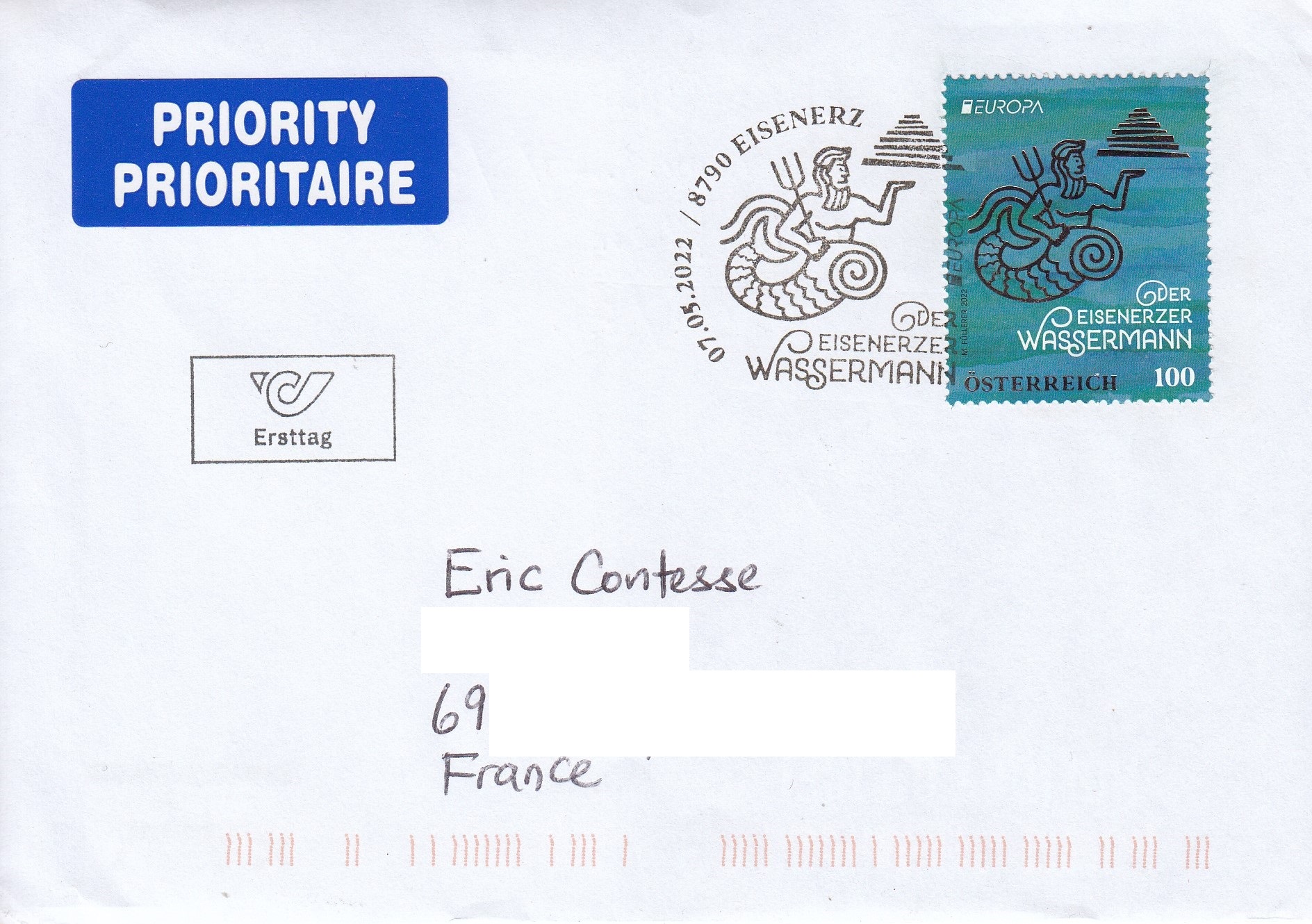
Comme de coutume, la poste autrichienne n'a mis en circulation, le 7 mai 2022, qu'un seul timbre EUROPA, consacré cette année aux mythes et légendes ("Geschichten und Mythen" en allemand).
Ce timbre (1€, tirage : 200000), imprimé aux Pays-Bas par Joh. Enschedé Stamps B.V. (offset + dorure à chaud) et conçu par Marion Füllerer, est consacré à la légende du Waterman d'Eisenerz.
Un grand merci Edna pour l'envoi de ce pli Premier Jour, avec TAD de cette localité d'Eisenerz (A-8790), une ville minière située dans le land de Styrie (centre-est du pays), concernant ce timbre ! 
As usual, the Austrian Post put into circulation, on May 7, 2022, only one EUROPA stamp, dedicated this year to Stories and myths ("Geschichten und Mythen" in German).
This stamp (€1.00, print run: 200,000), printed in the Netherlands by Joh. Enschedé Stamps B.V. (offset + hot foil printing) and designed by Marion Füllerer, is dedicated to the legend of the Waterman from Eisenerz.
A big thank you Edna for sending this First Day Cover, with postmark from this locality of Eisenerz (A-8790), a mining town located in the Land of Styria (center-east of the country), regarding this stamp!

 
Cette légende raconte que les habitants ont capturé un Waterman (ou Wassermann = "verseau") qui vivait dans le lac de montagne de Leopoldsteiner, près de la ville actuelle d'Eisenerz.
Cette créature était connue pour posséder d'énormes trésors. En échange de sa liberté, le prisonnier a promis "de l'or pour dix ans, de l'argent pour cent ans ou du minerai de fer pour toujours".
Les habitants d'Eisenerz ("minerai de fer") ont alors choisi le fer, et depuis lors, le minerai de fer a été extrait sur la montagne Erzberg. Les couches typiques de la montagne témoignent de l'exploitation à ciel ouvert du minerai de fer.
La source karstique dans laquelle le Waterman est censé avoir disparu s'appelle aujourd'hui "Wassermannsloch".
This legend tells that the locals captured a Waterman (or Wassermann = "Aquarius") who lived in the Leopoldsteiner mountain lake, near the present town of Eisenerz.
This creature was known to possess huge treasures. In exchange for his liberty, the prisoner promised "gold for ten years, silver for a hundred years, or iron ore forever".
People from Eisenerz ("Iron Ore") chose iron, and since back then iron ore has been mined on Erzberg Mountain. The typical layers on the mountain are testimony to open-pit iron ore mining.
The karst spring into which the Waterman is supposed to have disappeared is called today "Wassermannsloch".
 
Related Posts Plugin for WordPress, Blogger...