Affichage des articles dont le libellé est Greece (Grèce). Afficher tous les articles

mercredi 26 août 2026

Euromed Postal 2026 (Traditional Mosaics in the Mediterranean) stamp set on FDC from Greece

Série Euromed Postal 2026 (Mosaïques traditionnelles en Méditerranée) sur FDC de Grèce 

Pour rappel, le 9 juillet 2007 a eu lieu la première convention internationale de la poste méditerranéenne signée à Marseille. Depuis cette date, l'Union Postale pour la Méditerranée (PUMed), une union restreinte de l'UPU, a été créée le 11 mars 2011 et comprend actuellement les opérateurs postaux de 23 pays du bassin méditerranéen (incluant aussi le Portugal et la Mauritanie).
Depuis 2014, certains de ces pays émettent chaque année des timbres "Euromed Postal" illustrant un thème commun, les mosaïques traditionnelles en Méditerranée ("Παραδοσιακά Ψηφιδωτά στη Μεσόγειο" en grec) en 2026.
Sauf erreur, 14 pays ont émis à ce jour des timbres "Euromed Postal" en 2026, dont la Grèce avec une jolie série (4 timbres, conception : Theano Venieri) mise en circulation le 13 juillet 2026, illustrant des mosaïques antiques découvertes dans différentes régions du pays. 
Ces 4 timbres ont été imprimés sous plusieurs formes : feuille de 16 timbres (tirage : 25000 pour chaque timbre), bloc-feuillet composé des 4 timbres (tirage : 5000) et carnet composé des 4 timbres (avec uniquement des dentelures verticales, tirage : 3000 carnets).  
As a reminder, the first international Mediterranean postal convention was signed in Marseille on July 9, 2007. Subsequently, the Postal Union for the Mediterranean (PUMed)—a restricted union of the UPU—was established on March 11, 2011; it currently comprises postal operators from 23 countries in the Mediterranean basin (including Portugal and Mauritania).
Since 2014, some of these countries have annually issued "Euromed Postal" stamps featuring a common theme; the theme for 2026 is Traditional Mosaics in the Mediterranean (*Παραδοσιακά Ψηφιδωτά στη Μεσόγειο* in Greek).
To date, 14 countries have issued "Euromed Postal" stamps for 2026, including Greece, which released a lovely series (4 stamps, designed by Theano Venieri) on July 13, 2026, depicting ancient mosaics discovered in various regions of the country.
These four stamps were produced in several formats: a sheet of 16 stamps (print run: 25,000 per stamp), a souvenir sheet containing all four stamps (print run: 5,000), and a booklet containing all four stamps (featuring only vertical perforations; print run: 3,000 booklets).  

Ces 4 timbres ont été utilisés sur la jolie lettre ci-dessus, avec TAD Premier Jour d'Athènes. Merci beaucoup Alqi!
Comme de coutume, le logo Euromed Postal (un faucon stylisé) est présent sur ces 4 timbres.
Les 4 timbres illustrent respectivement :

  • une mosaïque représentant Dionysos chevauchant une panthère (0,50€, fin du IVème siècle avant J.-C.), provenant de la salle de banquet de la Maison de Dionysos (Musée archéologique de Pella, nord du pays)
  • une mosaïque représentant Orphée jouant de la lyre et charmant les animaux - mammifères, oiseaux et reptiles - (1,20€, début du IVème siècle après J.-C.), exposée dans la Maison des mosaïques du Musée de Sparte
  • une mosaïque représentant une Néréide chevauchant un hippocampe, encadrée par des bandes décoratives à double méandre et rinceaux de lierre (2€, seconde moitié du IIIème siècle après J.-C.), provenant de l'île de Kos et exposée aujourd'hui dans le Palais des Grands Maîtres de Rhodes
  • le détail d'un sol en mosaïque représentant la déesse Aphrodite se regardant dans un miroir (3€, IIème–IIIème siècle après J.-C.), provenant d'une villa romaine et exposée dans le Musée archéologique de Patras.

These four stamps have been used on the lovely cover above, with First Day cancellation from Athens. Thank you very much, Alqi!
As is customary, the Euromed Postal logo (a stylized falcon) appears on all four stamps.
The four stamps depict the following:

  • a mosaic showing Dionysus riding a panther (€0.50, late 4th century BC), from the banquet hall of the House of Dionysus (Archaeological Museum of Pella, in the north of the country)
  • a mosaic depicting Orpheus playing the lyre and charming animals—mammals, birds, and reptiles—(€1.20, early 4th century AD), on display in the House of Mosaics at the Archaeological Museum of Sparta
  • a mosaic depicting a Nereid riding a sea-horse, framed by decorative bands featuring a double meander pattern and ivy scrolls (€2.00, second half of the 3rd century AD); it originated on the island of Kos and is now displayed in the Palace of the Grand Master of the Knights of Rhodes
  • a detail of a mosaic floor depicting the goddess Aphrodite looking at herself in a mirror (€3.00, 2nd–3rd century AD), from a Roman villa and on display in the Archaeological Museum of Patras.  

lundi 20 juillet 2026

"100 Years of the FIP - Fédération Internationale de Philatélie" stamps on FDC from Greece

Timbres "100 ans de la FIP - Fédération Internationale de Philatélie" sur FDC de Grèce 

La Fédération Internationale de Philatélie (FIP) a été créée le 18 juin 1926 à Paris par les représentants de 6 pays : Allemagne, Autriche, Belgique, France, Pays-Bas et Suisse.
Dès le début, la FIP a œuvré pour promouvoir la collection de timbres et la philatélie, favoriser l'amitié entre les peuples, entretenir des liens avec le secteur philatélique et les administrations postales, et soutenir les expositions philatéliques par son patronage et sa reconnaissance.
Aujourd’hui, la FIP regroupe 90 fédérations nationales avec lesquelles elle organise des conférences, des séminaires pour les futurs jurés lors de ses expositions et structure l'évolution de la façon de collectionner et d'exposer en introduisant de nouvelles classes de compétition.
Enfin, elle parraine et co-organise avec les fédérations nationales les expositions mondiales (générales et spécialisées) qui sont de véritable "jeux olympiques" de la philatélie.  
The Fédération Internationale de Philatélie (FIP - International Federation of Philately) was founded on June 18, 1926, in Paris by representatives from six countries: Germany, Austria, Belgium, France, the Netherlands, and Switzerland. 
From the outset, the FIP has worked to promote stamp collecting and philately, foster friendship among nations, maintain ties with the philatelic sector and postal administrations, and support philatelic exhibitions through its patronage and recognition.
Today, the FIP brings together 90 national federations; with them, it organizes conferences and seminars for aspiring jurors during its exhibitions and shapes the evolution of collecting and exhibiting practices by introducing new competitive classes.
Finally, it sponsors and co-organizes—alongside national federations—world exhibitions (both general and specialized) that serve as the true "Olympic Games" of philately. 

La FIP célèbre donc le 100ème anniversaire de sa création en 2026 et un certain nombre d'administrations postales ont émis ou vont émettre des timbres sur ce thème, la plupart en reproduisant le logo officiel de ces 100 ans : Belarus, Monaco, République dominicaine, Serbie, Thaïlande, Bulgarie, Russie, Slovénie, Roumanie, Brésil, Uruguay, Israël, Chypre, Jordanie, Pakistan, Espagne, Bosnie-Herzégovine (Sarajevo), Émirats Arabes Unis, Saint-Pierre-et-Miquelon, Grèce...
Le 22 avril 2026, la poste grecque a mis en circulation une série (3 timbres) illustrant différents évènements et anniversaires, dont un (2€, tirage : 35000) consacré au 100ème anniversaire de la FIP.
Ce timbre (conception : Theano Venieri) a été utilisé en 2 exemplaires sur la lettre ci-dessus avec TAD Premier Jour, envoyée le 27 mai 2026 depuis Athènes. Merci beaucoup Alqi !
L'emblème de la FIP associé au logo de ce 100ème anniversaire sont simplement reproduits sur ce timbre (imprimés avec une encre dorée).
La Fédération philatélique hellénique, fondée en 1947, est membre de la Fédération européenne des associations philatéliques (FEPA) et de la Fédération internationale de philatélie (FIP). 
The FIP is thus celebrating its 100th anniversary in 2026, and a number of postal administrations have issued - or will issue - stamps on this theme, most featuring the official 100th-anniversary logo: Belarus, Monaco, Dominican Republic, Serbia, Thailand, Bulgaria, Russia, Slovenia, Romania, Brazil, Uruguay, Israel, Cyprus, Jordan, Pakistan, Spain, Bosnia and Herzegovina (Sarajevo), United Arab Emirates, Saint Pierre and Miquelon, Greece, and others. 
On April 22, 2026, the Greek Post issued a set of three stamps depicting various events and anniversaries, including one (€2.00, print run: 35,000) dedicated to the FIP's 100th anniversary.
This stamp (designed by Theano Venieri) was used in two copies on the cover above, with First Day cancellation, sent from Athens on May 27, 2026. Many thanks, Alqi!
The FIP emblem, combined with the 100th-anniversary logo, is reproduced on the stamp (printed in gold ink).
The Hellenic Philatelic Federation, founded in 1947, is a member of the Federation of European Philatelic Associations (FEPA) and the International Federation of Philately (FIP).  

lundi 6 juillet 2026

"Centenary of the Academy of Athens" stamp set on cover from Greece

Série "100 ans de l'Académie d'Athènes" sur lettre de Grèce 

La création de l'Académie d'Athènes en 1926 a marqué l'aboutissement d'efforts longs et inlassables, s'étendant sur près d'un siècle, pour fonder une académie grecque.
Son nom fait référence à l'Académie de Platon et au rayonnement intellectuel de l'Athènes antique, ville que Thucydide qualifiait de centre éducatif de la Grèce. La première tentative de création d'une académie remonte à 1824, en pleine guerre d'indépendance grecque.
Le traumatisme sociétal de la catastrophe d'Asie Mineure (guerre gréco-turque entre 1919 et 1922) attise le besoin de créer une académie à Athènes afin de sauvegarder le patrimoine culturel grec et de cultiver la conscience nationale. 
L'Académie d'Athènes a été fondée le 18 mars 1926 sous le nom d'Académie des Sciences, Humanités et Beaux-Arts. L'institution a pour objectif de cultiver et de promouvoir les sciences, les lettres et les beaux-arts. Son siège, partie de la "trilogie néoclassique" (avec l'Université d'Athènes et la Bibliothèque nationale) des architectes danois Christian et Theophil Hansen, constitue aujourd'hui l'un des monuments modernes emblématiques d'Athènes. 
The establishment of the Academy of Athens in 1926 marked the culmination of long and tireless efforts, spanning nearly a century, to found a Greek academy.
Its name alludes to Plato's Academy and the intellectual renown of ancient Athens—a city Thucydides described as the educational center of Greece. The first attempt to create such an academy dates back to 1824, in the midst of the Greek War of Independence.
The societal trauma caused by the Asia Minor Catastrophe (Greco-Turkish War of 1919-1922) fueled the need to establish an academy in Athens to safeguard Greek cultural heritage and foster national consciousness.
The Academy of Athens was founded on March 18, 1926, under the name "Academy of Sciences, Humanities, and Fine Arts." The institution’s mission is to cultivate and promote the sciences, letters, and fine arts. Its headquarters—part of the "Neoclassical Trilogy" designed by Danish architects Christian and Theophil Hansen, alongside the University of Athens and the National Library—stands today as one of Athens' iconic modern landmarks.  

Le 18 mars 2026, la poste grecque Elta a mis en circulation une très jolie série (4 timbres, conception : Eleni Apostolou) consacrée au 100ème anniversaire (jour pour jour) de la création de l'Académie d'Athènes.
Cette série complète a été utilisée sur la lettre ci-dessus envoyée le 12 mai 2026 depuis Athènes. Merci beaucoup Alqi !
Theophil Hansen a opté pour une architecture néoclassique de style ionique, entièrement en marbre blanc du Pentélique et pierres du Pirée. Le sculpteur grec Leonídas Dróssis, artiste reconnu à l'époque qui enseignera d'ailleurs la sculpture dans cette même Académie, a réalisé l'ensemble sculptural du fronton principal sur le thème de la naissance d'Athéna ainsi que les 2 très hautes colonnes (19 mètres de haut), surmontées de statues représentant Athéna et Apollon, encadrant l'édifice principal.
Cet édifice (achevé en 1887) est représenté sur le timbre à 2€ (tirage : 30000), la tête de la statue d'Athéna (1882), représenté en déesse en armes d'après le modèle de l'Athéna Promachos de Phidias, figurant sur le timbre en haut à droite (1,20€, tirage : 20000).
Les 2 autres timbres reproduisent des détails des fresques par le peintre germano-autrichien Christian Griepenkerl, situées dans la salle de conférences de l'Académie d'Athènes : "Athéna et Prométhée aux portes célestes de la lumière" (0,50€, tirage : 30000) et "Prométhée introduit sur l'Olympe" (1,20€, tirage : 20000).
On March 18, 2026, the Greek Post (ELTA) issued a beautiful series (4 stamps, designed by Eleni Apostolou) commemorating the 100th anniversary—to the day—of the founding of the Academy of Athens.
This complete set was used on the cover above, sent from Athens on May 12, 2026. Many thanks, Alqi!
Theophil Hansen chose a Neoclassical architectural style with Ionic features, constructed entirely from white Pentelic marble and stone from Piraeus. The Greek sculptor Leonidas Drossis—a renowned artist of the time who would later teach sculpture at the Academy itself—created the main pediment's sculptural group depicting the birth of Athena, as well as the two towering columns (19 meters high) topped by statues of Athena and Apollo that flank the main building.
This building (completed in 1887) is depicted on the €2.00 stamp (print run: 30,000), while the head of the Athena statue (1882)—portrayed as an armed goddess based on the model of Phidias's *Athena Promachos*—appears on the stamp in the top right corner (€1.20, print run: 20,000).
The other two stamps reproduce details from frescoes by the German-Austrian painter Christian Griepenkerl, located in the Academy of Athens' conference hall: "Athena and Prometheus at the heavenly gates of light" (€0.50, print run: 30,000) and "Prometheus Introduced to Olympus" (€1.20, print run: 20,000).  

samedi 30 mai 2026

EUROPA 2026 (70th anniversary of the EUROPA stamps) stamps on FDC from Greece

Timbres EUROPA 2026 (70ème anniversaire des timbres EUROPA) sur FDC de Grèce 

L'année 2026 marque le 70ème anniversaire des timbres EUROPA, une initiative philatélique lancée pour renforcer les relations entre les pays européens et promouvoir une paix et une unité durables.
Émis pour la première fois en 1956 par six nations – la Belgique, la France, l'Allemagne, l'Italie, le Luxembourg et les Pays-Bas, membres fondateurs de l'Union européenne – ce programme s'est étendu progressivement à 53 organisations postales participantes.
L'an dernier, le groupe de travail Timbres et Philatélie de PostEurop a organisé un concours interne pour choisir un motif commun sur le thème "70ème anniversaire du timbre EUROPA : Unis par...".
Guidés par des valeurs partagées telles que la communication, l'innovation, la coopération et des racines communes, les membres ont soumis 15 propositions créatives, chacune présentant une vision unique. 
Suite au vote de 50 organisations postales, ce concours a été remporté par la poste finlandaise (Posti), devant la poste de Bosnie-Herzégovine (Sarajevo) et la poste luxembourgeoise.
C'est donc le projet de l'artiste et graphiste Klaus Welp qui figure sur les timbres EUROPA émis en 2026. 
The year 2026 marks the 70th anniversary of the EUROPA stamps, a philatelic initiative launched to strengthen relations between European countries and promote lasting peace and unity.
First issued in 1956 by six nations – Belgium, France, Germany, Italy, Luxembourg, and the Netherlands, founding members of the European Union – this program has gradually expanded to include 53 participating postal organizations.
Last year, PostEurop's Stamps and Philately Working Group organized an internal competition to choose a common design on the theme "70th Anniversary of the EUROPA Stamp: United by...".
Guided by shared values ​​such as communication, innovation, cooperation, and common roots, the members submitted 15 creative proposals, each presenting a unique vision.
Following a vote by 50 postal organizations, the Finnish Post (Posti) won the competition, ahead of the Post of Bosnia & Herzegovina (Sarajevo) and the Post of Luxembourg.
The design by artist and graphic designer Klaus Welp will therefore be featured on the EUROPA stamps issued in 2026.

Le 8 mai 2026, la poste grecque Elta a mis en circulation un timbre EUROPA unique (3€, tirage : 100000, mise en page : Anthoula Lygka) reproduisant le dessin conçu par Klaus Welp.  
Ce timbre a été imprimé dans un feuillet de 8 timbres ainsi que dans un carnet numéroté (tirage : 4000) composé de 2 timbres (sans dentelures horizontales).
Les 2 versions de ce timbre EUROPA ont été utilisées sur la lettre ci-dessus avec TAD Premier Jour d'Athènes. Merci beaucoup Alqi !
Ce timbre EUROPA allie éléments abstraits et symboliques. La ligne pointillée ascendante en diagonale représente à la fois la perforation du timbre et le travail progressif de PostEurop. Les sept points, reliés par une ligne droite, symbolisent soixante-dix ans d'efforts concertés des opérateurs postaux à travers le continent.
Les dégradés et les motifs pointillés en arrière-plan forment une surface harmonieuse et dynamique, reflétant le joyeux mélange de couleurs du drapeau européen et symbolisant l'unité de tous les États membres.
A noter que la Grèce a émis son premier timbre EUROPA en 1960, reproduisant un dessin commun (par le finlandais Pentti Rahikainen) représentant une roue de char romain à 19 rayons, un pour chacun des membres de la CEPT (créée en 1959), incluse dans la lettre O du mot "EUROPA". 
On May 8, 2026, the Greek Post Elta put into circulation a unique EUROPA stamp (€3.00, print run: 100,000, layout by Anthoula Lygka) reproducing the design by Klaus Welp.
This stamp was printed in a sheetlet of 8 stamps as well as in a numbered booklet (print run: 4,000) containing 2 stamps (without horizontal perforations).
Both versions of this EUROPA stamp have been used on the cover above with First Day cancellation from Athens. Thank you very much, Alqi!
This EUROPA stamp combines abstract and symbolic elements. The diagonally ascending dotted line represents both the perforation of a stamp and the progressive work of the PostEurop. The seven dots, connected by a straight line, symbolize seventy years of unified effort by postal operators across the continent.
The blending gradients and dotted patterns in the background form a cohesive and vibrant surface, reflecting the joyful mix of colours from the European flag and symbolizing the unity of all member nations.
It is worth noting that Greece issued its first EUROPA stamp in 1960, reproducing a common design (by the Finnish artist Pentti Rahikainen) depicting a 19-spoke Roman chariot wheel, one spoke for each member of the CEPT (established in 1959), incorporated into the letter O of the word "EUROPA".  

mardi 24 février 2026

"80th anniversary of the United Nations" postmark on cover from Greece

TAD "80ème anniversaire des Nations Unies" sur lettre de Grèce 

De nombreuses administrations postales (Wallis-et-Futuna, Tunisie, Slovénie, Saint-Marin, Kazakhstan, Moldavie, Nations Unies, Philippines, Namibie, Inde, Émirats Arabes Unis, Belarus, Maroc, Serbie, Monaco, Pérou, Slovaquie, Pakistan, Algérie...) ont émis des timbres en 2025 consacrés au 80ème anniversaire de la création des Nations Unies, reproduisant le logo officiel de cet anniversaire (pour certaines) et parfois son slogan associé, "Construisons notre avenir ensemble". 
Pour rappel, 51 pays ont fondé l'Organisation des Nations Unies en 1945 suite à la ratification de la Charte des Nations Unies à San Francisco le le 24 octobre 1945. 
Le 24 octobre 2025, la poste grecque a mis en circulation un TAD spécial consacré à ce 80ème anniversaire des Nations Unies ("80 Χρόνια ΟΗΕ").
Ce TAD a été appliqué par le bureau de poste situé sur la place Sýntagma à Athènes sur la lettre ci-dessous. Merci beaucoup Tolga ! 
Several postal administrations (Wallis & Futuna, Tunisia, Slovenia, San Marino, Kazakhstan, Moldova, the United Nations, the Philippines, Namibia, India, the United Arab Emirates, Belarus, Morocco, Serbia, Monaco, Peru, Slovakia, Pakistan, Algeria, etc.) issued stamps in 2025 commemorating the 80th anniversary of the founding of the United Nations.
These stamps reproduced the official anniversary logo (for some) and sometimes its associated slogan, "Building our future together."
As a reminder, 51 countries founded the United Nations in 1945 following the ratification of the UN Charter in San Francisco on October 24, 1945.

On October 24, 2025, the Greek Post put into circulation a special postmark commemorating this 80th anniversary of the United Nations ("80 Χρόνια ΟΗΕ").
This postmark was applied by the post office located in Syntagma Square in Athens to the cover below. Thank you very much, Tolga!  

La Grèce est devenue membre des Nations Unies le 25 octobre 1945 et siège actuellement au Conseil de Sécurité pour la période 2025-2026 en tant que membre non permanent, avec le dialogue, la diplomatie et la démocratie pour priorité.
Aujourd'hui, l'ONU compte 193 états membres. Ses principaux organes sont l'Assemblée générale, le Conseil de sécurité, le Conseil économique et social, le Conseil de tutelle, la Cour internationale de Justice et le Secrétariat, dirigé par le Secrétaire général.  
Tolga a utilisé un des 4 timbres (2€, tirage : 25000) d'une série (conception : Marina Lasithiotaki) émise le 17 septembre 2025, consacrée à des itinéraires architecturaux urbains, illustrant des quartiers d'Athènes de différentes périodes en particulier.
Ce timbre illustre le nouveau musée de l'Acropole (conçu par l'architecte franco-suisse Bernard Tschumi) construit entre 2003 et 2009, l'un des principaux musées archéologiques du pays. 
Le musée abrite les objets provenant des monuments et des fouilles sur l'Acropole : bas-reliefs, statues et céramiques allant de la Préhistoire à l'antiquité tardive. Le musée se tourne entièrement vers la colline de l'Acropole par plusieurs moyens : baies vitrées et larges fenêtres - pour une contemplation optimale de ce chef-d'œuvre de l'humanité.
Greece became a member of the United Nations on October 25, 1945, and currently serves on the Security Council for the 2025-2026 term as a non-permanent member, prioritizing dialogue, diplomacy, and democracy.
Today, the UN has 193 member states. Its main organs are the General Assembly, the Security Council, the Economic and Social Council, the Trusteeship Council, the International Court of Justice, and the Secretariat, headed by the Secretary-General. 
Tolga used one of the four stamps (€2.00, print run: 25,000) from a series (designed by Marina Lasithiotaki) issued on September 17, 2025, dedicated to urban architectural routes, illustrating neighborhoods of Athens from different periods.
This stamp depicts the new Acropolis Museum (designed by the Franco-Swiss architect Bernard Tschumi), built between 2003 and 2009, one of the country's leading archaeological museums.
The museum houses artifacts from the monuments and excavations on the Acropolis: bas-reliefs, statues, and ceramics dating from prehistory to late antiquity. The museum is entirely oriented towards the Acropolis hill through various means: glass walls and large windows – allowing for optimal contemplation of this masterpiece of humanity. 

mardi 19 août 2025

Euromed Postal 2025 (Resources of the Mediterranean) stamp set on FDC from Greece

Série Euromed Postal 2025 (Ressources de Méditerranée) sur FDC de Grèce 

Pour rappel, le 9 juillet 2007 a eu lieu la première convention internationale de la poste méditerranéenne signée à Marseille. Depuis cette date, l'Union Postale pour la Méditerranée (PUMed), une union restreinte de l'UPU, a été créée le 11 mars 2011 et comprend actuellement les opérateurs postaux de 23 pays du bassin méditerranéen (incluant aussi le Portugal et la Mauritanie).
Depuis 2014, certains de ces pays émettent chaque année des timbres "Euromed Postal" illustrant un thème commun, les ressources de Méditerranée ("Πόροι της Μεσογείου" en grec) en 2025.
Sauf erreur, 14 pays ont émis à ce jour des timbres "Euromed Postal" en 2025, dont la Grèce avec une jolie série (2 timbres, conception : Eleni Apostolou) mise en circulation le 7 juillet 2025, illustrant différents types d'éponges naturelles.  
As a reminder, on July 9, 2007, the first international Mediterranean postal convention was signed in Marseille. Since that date, the Postal Union for the Mediterranean (PUMed), a restricted union of the UPU, was created on March 11, 2011 and currently includes postal operators from 23 countries in the Mediterranean basin (also including Portugal and Mauritania).
Since 2014, some of these countries have issued "Euromed Postal" stamps every year illustrating a common theme, the 
Resources of the Mediterranean ("Πόροι της Μεσογείου" in Greek) in 2025.
Unless I am mistaken, 14 countries have issued "Euromed Postal" stamps in 2025  to date, including Greece with a nice series (2 stamps, design: Eleni Apostolou) put into circulation on July 7, 2025, illustrating different types of natural sponges.

Ces 2 timbres ont été imprimés sous plusieurs formes : feuille de 16 timbres (8 de chaque, tirage : 50000 pour chaque timbre), bloc-feuillet composé de 4 timbres (2 de chaque, tirage : 5000) et carnet composé de 4 timbres (2 de chaque, avec uniquement des dentelures verticales, tirage : 5000 carnets).
Ces 2 timbres ont été utilisés sur la jolie lettre ci-dessus, avec TAD Premier Jour d'Athènes. Merci beaucoup Alqi!
Comme de coutume, le logo Euromed Postal (un faucon stylisé) est présent sur ces 2 timbres illustrant respectivement un type d'éponge naturelle "Spongia mollissima" (2€) et plusieurs types différents trouvés en Méditerranée (3€). 
Les éponges (ou spongiaires) sont utilisées depuis plusieurs millénaires comme éponges naturelles avec une importante activité de pêche remontant à l'Antiquité dans les îles grecques du Dodécanèse et notamment à Kalymnos, "l'île des pêcheurs d'éponges".
Cette pêche se pratique essentiellement en Méditerranée, mais aussi en mer Rouge, le long des côtes d'Amérique centrale et en Australie. Une fois remontées, les éponges sont lavées à grande eau et pressées pour débarrasser le squelette de spongine de toutes les parties vivantes.
Selon la mythologie grecque, le dieu Glaucos aurait été, à l'époque où il était encore mortel, le premier pêcheur d'éponges et aurait même créé un véritable centre de pêche à l'éponge en mer Égée. 
These two stamps have been printed in several forms: sheet of 16 stamps (8 of each, print run: 50,000 for each stamp), souvenir sheet composed of 4 stamps (2 of each, print run: 5,000) and booklet composed of 4 stamps (2 of each, with only vertical perforations, print run: 5,000 booklets). 
These two stamps were used on the lovely cover above, with First Day cancellation from Athens. Thank you very much, Alqi!
As usual, the Euromed Postal logo (a stylized falcon) is present on these two stamps, illustrating respectively a type of natural sponge "Spongia mollissima" (€2.00) and several different types found in the Mediterranean (€3.00).
Sponges (or spongia) have been used for thousands of years as natural sponges, with significant fishing activity dating back to antiquity in the Greek Dodecanese Islands, particularly on Kalymnos, "the island of sponge fishermen".
This fishing is practiced mainly in the Mediterranean, but also in the Red Sea, along the coasts of Central America, and in Australia. Once hauled up, the sponges are washed thoroughly and squeezed to remove all living parts from the spongina skeleton.
According to Greek mythology, the god Glaucus, while still mortal, was the first sponge fisherman and even created a veritable sponge fishing center in the Aegean Sea. 

mercredi 28 mai 2025

EUROPA 2025 (National Archaeological Discoveries) stamp set on FDC from Greece

Série EUROPA 2025 (Découvertes archéologiques nationales) sur FDC de Grèce 

Le thème choisi par l'association PostEurop pour les timbres EUROPA 2025 est intitulé "Découvertes archéologiques nationales" ("Εθνικές Αρχαιολογικές Ανακαλύψεις").
Le 7 mai 2025, la poste grecque Elta a mis en circulation une très jolie série (2 timbres) illustrant ce thème, en particulier des représentations antiques de Philippe II de Macédoine et de son célèbre fils, Alexandre le Grand.
Ces 2 timbres (2,00€ et 3,00€) ont été imprimés dans une même feuille de 16 timbres (8 timbres de chaque) ainsi que dans un carnet numéroté (tirage : 6000) composé de 2 paires de timbres (sans dentelures horizontales).  
Conçus par Myrsini Vardopoulou, ces 2 timbres (tirage : 50000 chacun) ont été utilisés sur la lettre ci-dessous envoyée le Premier Jour d'émission depuis Athènes (bureau de poste situé sur la place Sýntagma). Merci beaucoup Alqi !
The theme chosen by the PostEurop association for the EUROPA 2025 stamps is entitled "National Archaeological Discoveries" ("Εθνικές Αρχαιολογικές Ανακαλύψεις").
On May 7, 2025, the Greek Post Elta released a very attractive set (2 stamps) illustrating this theme, in particular ancient representations of Philip II of Macedon and his famous son, Alexander the Great.
These two stamps (€2.00 and €3.00) have been printed in a same sheet of 16 stamps (8 stamps of each) as well as in a numbered booklet (print run: 6000) composed of two pairs of stamps (without horizontal perforations).
Designed by Myrsini Vardopoulou, these two stamps (print run: 50,000 each) have been used on the cover below sent on the First Day of Issue from Athens (post office located on Syntagma Square). Thank you very much, Alqi!  

À proximité de Vergina, dans le nord de la Grèce, fut découvert au 19ème siècle l'ancienne Aigai, première capitale du royaume de Macédoine (site classé au patrimoine mondial de l'UNESCO en 1996). Les plus importants vestiges sont le palais monumental et la nécropole renfermant plus de trois cents tumulus dont certains remontent au 11ème siècle avant J.-C. Parmi ces tombes royales figurerait celle de Philippe II de Macédoine qui conquit l'ensemble des cités grecques, ouvrant la voie à son fils Alexandre le Grand et à l'expansion du monde hellénistique. 
Le timbre à gauche représente une tête en ivoire de Philippe II, faisant partie de la grande frise du lit d'or et d'ivoire de la chambre funéraire du roi à Vergina, datant de 336 avant J.-C. (Musée polycentrique d'Aigai).
L'autre timbre montre un portrait d'Alexandre le Grand sur un statère d'or (monnaie de l'Antiquité vers 300 avant J.-C.) frappé par Lysimaque de Thrace, un général macédonien et l'un des Diadoques d'Alexandre le Grand. Il est représenté déifié, avec la corne de Zeus Ammon et le diadème royal, symboles de la royauté divine et de l'influence durable (musée numismatique d'Athènes).
Near Vergina, in northern Greece, ancient Aigai, the first capital of the Kingdom of Macedonia (a UNESCO World Heritage Site since 1996), was discovered in the 19th century. The most important remains are the monumental palace and the necropolis, containing more than three hundred burial tumuli, some dating back to the 11th century BC. Among these royal tombs is believed to be that of Philip II of Macedon, who conquered all the Greek cities, paving the way for his son Alexander the Great and the expansion of the Hellenistic world.
The stamp on the left depicts an ivory head of Philip II, part of the large frieze on the gold and ivory couch in the chamber of the King's tomb in Vergina, dating from 336 BC (Polycentric Museum of Aigai).
The other stamp shows a portrait of Alexander the Great on a gold stater (ancient coin) minted around 300 BC by Lysimachus of Thrace, a Thessalian officer and successor of Alexander the Great. He is depicted deified, with the horn of Ammon Zeus and the royal diadem, symbols of divine kingship and lasting influence (Athens Numismatic Museum).  

lundi 28 octobre 2024

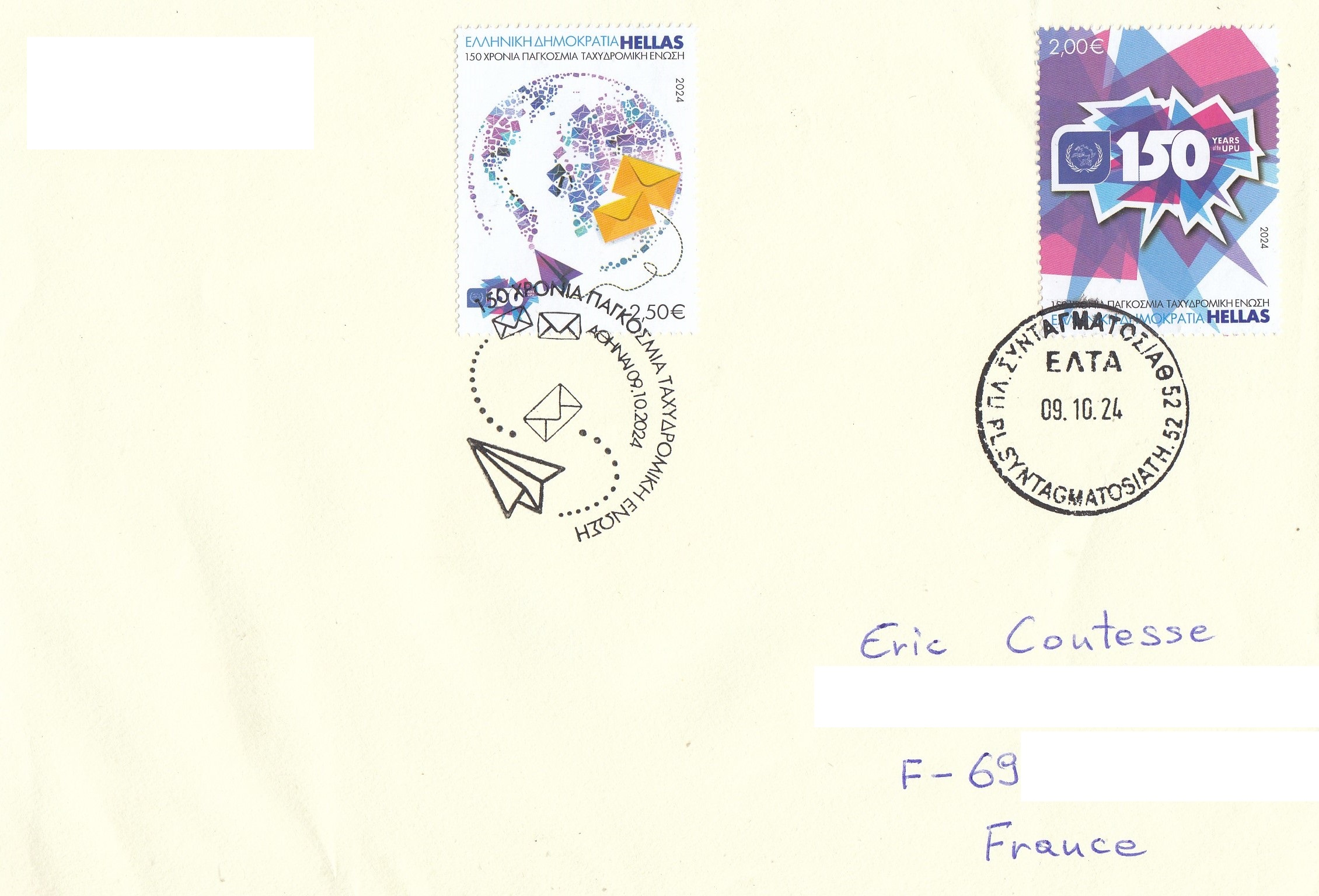
"150 Years of the UPU 1874-2024" stamp set on FDC from Greece

Série "150 ans de l'UPU 1874-2024" sur FDC de Grèce

En 2024, l'Union Postale Universelle (UPU) célèbre son 150ème anniversaire. Le 9 octobre 1874, 22 pays se sont réunis pour signer le Traité de Berne, créant ainsi l'Union générale des postes, qui deviendra ensuite l'Union Postale Universelle (à partir de 1878).
150 ans plus tard, l'UPU unit à présent les réseaux postaux de 192 pays membres. Elle a ainsi concrétisé la vision de ses fondateurs, qui consistait à établir un territoire postal unique pour servir toutes les populations, où qu'elles se trouvent.
Avec le thème de ce 150ème anniversaire, "150 ans d'engagement pour la communication et le développement des peuples à travers le monde", l'UPU célèbre cette réalisation et renforce son engagement à servir les populations pour les années et siècles à venir.
Tout au long de cette année 2024, l'UPU organise une série d'événements et des campagnes visant à rendre hommage à la richesse de son passé, à la pertinence de son présent et aux promesses de son avenir, en utilisant en particulier le hashtag #UPU150 sur les réseaux sociaux.
In 2024, the Universal Postal Union (UPU) celebrates its 150th anniversary. On October 9, 1874, 22 countries gathered to sign the Treaty of Bern, creating the General Postal Union, which would later become known as the Universal Postal Union (from 1878).
150 years later, the UPU now unites the postal networks of 192 member countries, having realized its founders' vision of establishing a single postal territory to serve people everywhere.
The UPU's theme for its 150th year, "150 years of enabling communication and empowering peoples across nations", recognizes this accomplishment, and reinforces its commitment to serve peoples for the decades and centuries to come.
Throughout 2024, the UPU will roll out a series of events and campaigns in celebration of its rich past, dedicated present and promising future, in particular using the hashtag #UPU150 on social media.  

L'UPU, institution spécialisée de l'ONU (depuis 1947) dont le siège se trouve à Berne (Suisse), est la seconde plus ancienne organisation internationale après l'Union Internationale des Télécommunications, et constitue le principal forum de coopération entre les acteurs mondiaux du secteur postal.
Le 9 octobre 2024, Journée mondiale de la poste, la poste grecque a mis en circulation une jolie série (2 timbres) consacrée au 150ème anniversaire de l'UPU.
Conçus par Eleni Apostolou, ces 2 timbres (tirage : 50000 chacun) ont été utilisés sur la lettre ci-dessus envoyée le 9 octobre 2024 depuis Athènes (bureau de poste situé sur la place Sýntagma). Merci beaucoup Alqi !
A noter l'application également du TAD Premier Jour sur le timbre à gauche (2,50€) intitulé "150 ans de communication entre les nations", avec les continents (l'Europe en particulier) d'un globe terrestre constitués d'enveloppes.
Le logo officiel de ce 150ème anniversaire est présent en bas à gauche sur ce timbre et constitue le motif principal du 2ème timbre (2€). 
The UPU, a specialized agency of the United Nations (since 1947) headquartered in Bern, Switzerland, is the second oldest international organization after the International Telecommunications Union, and constitutes the main forum for cooperation between global postal sector players. 
On October 9, 2024, World Post Day, the Greek Post put into circulation a nice set (two stamps) dedicated to the 150th anniversary of the UPU.
Designed by Eleni Apostolou, these two stamps (print run: 50,000 each) have been used on the cover above sent on October 9, 2024 from Athens (post office located on Sýntagma Square). Thank you very much Alqi!
To note also the application of the First Day cancellation on the stamp on the left (€2.50) entitled "150 Years enabling Communication across Nations", with the continents (Europe in particular) of a terrestrial globe made up of envelopes.
The official logo of this 150th anniversary is present at the bottom left on this stamp and constitutes the main motif of the 2nd stamp (€2.00).  

dimanche 8 septembre 2024

"Olympic Games Athens 2004" souvenir sheet on cover from Greece

Bloc-feuillet "Jeux olympiques Athènes 2004" sur lettre de Grèce

Après 1896 (1ère édition), la Grèce organisait pour la 2ème fois une édition moderne des jeux olympiques d'été, à Athènes du 13 au 29 août 2004.
Afin de célébrer et annoncer cet évènement, la poste grecque a mis en circulation de nombreuses séries de timbres, en particulier un intéressant bloc-feuillet (5€), émis le 15 mars 2002, consacré au site d'Olympie, qui a accueilli les Jeux olympiques durant l'Antiquité, et où encore aujourd'hui, la flamme olympique est allumée quelques mois avant la cérémonie d'ouverture des jeux olympiques modernes.
Ce bloc-feuillet numéroté a été utilisé sur la lettre ci-dessous, envoyée en recommandé depuis Athènes le 16 mai 2024.
Le timbre de ce bloc-feuillet représente en particulier la crypte ou tunnel (couvert à l'époque), qui permettait aux athlètes de se diriger vers le stade d'Olympie depuis le sanctuaire des dieux.
Ce stade antique d'Olympie, où des épreuves des jeux olympiques antiques furent organisées entre 776 avant JC et 393 après JC, a accueilli les épreuves de poids lors des jeux de 2004.
After 1896 (first edition), Greece organized for the 2nd time a modern edition of the Summer Olympic Games, in Athens from August 13 to 29, 2004.
In order to celebrate and announce this event, the Greek Post put into circulation many series of stamps, in particular an interesting souvenir sheet (€5.00), issued on March 15, 2002, dedicated to the site of Olympia, which hosted the Olympic Games during Antiquity, and where even today, the Olympic flame is lit a few months before the opening ceremony of the modern Olympic Games.
This numbered souvenir sheet was used on the cover below, sent by registered mail from Athens on May 16, 2024.
The stamp of this souvenir sheet represents in particular a part of the crypt or tunnel (covered at the time), which allowed the athletes to head towards the stadium of Olympia from the sanctuary of the gods.
This ancient stadium in Olympia, where events of the ancient Olympic games were held between 776 BC and 393 AD, hosted the shot put events at the 2004 games.

L'emblème de ces jeux olympiques d'Athènes 2004, représentant une couronne d'olivier sur fond bleu (création de Rodanthi Senduka), figure dans la marge de ce bloc-feuillet. Le rameau d'olivier (ou kotinos) est lié à l'histoire de la Grèce et de l'Olympisme puisqu'il récompensait les vainqueurs des jeux olympiques antiques. Le kotinos est par ailleurs l'arbre sacré de la ville d'Athènes. Les couleurs représentatives de la Grèce, le bleu et le blanc, symbolisent le drapeau et les paysages du pays.
D'autres timbres ont été utilisés sur cette lettre, en particulier la série EUROPA (2 timbres, conception : Anthoula Lygka, tirage : 80000) émise le 9 mai 2013, illustrant le thème des véhicules postaux, une bicyclette (3,28€) et un véhicule utilitaire (0,78€) aux couleurs de la poste grecque.
Le 4ème timbre ci-dessus (0,45€) fait partie d'une jolie série (21 timbres) émise le 2 janvier 2002, consacrée à différentes danses traditionnelles, le kochari ici, une danse d'origine arménienne, pratiquée encore aujourd'hui par les Pontiques, les descendants des populations hellénophones du pourtour de la mer Noire (environ 2,5 millions de personnes). 
The emblem of these Athens 2004 Olympic Games, representing an olive crown on a blue background (design by Rodanthi Senduka), is featured in the margin of this souvenir sheet. The olive branch (or kotinos) is linked to the history of Greece and Olympism since it rewarded the winners of the ancient Olympic Games. The kotinos is also the sacred tree of the city of Athens. The representative colors of Greece, blue and white, symbolize the flag and the landscapes of the country.
Other stamps were used on this envelope, in particular the EUROPA series (2 stamps, design: Anthoula Lygka, print run: 80,000) issued on May 9, 2013, illustrating the theme of postal vehicles, a bicycle (€3.28) and a utility vehicle (€0.78) bearing the colors of the Greek Post.
The 4th stamp above (€0.45) is part of a nice series (21 stamps) issued on January 2, 2002, dedicated to different traditional dances, kochari here, a dance of Armenian origin, still practiced today by the Pontic Greeks, the descendants of the Greek-speaking populations around the Black Sea (around 2.5 million people). 

mardi 3 septembre 2024

Euromed Postal 2024 (Sports in the Mediterranean) stamp set on FDC from Greece

Série Euromed Postal 2024 (Sports de Méditerranée) sur FDC de Grèce

Pour rappel, le 9 juillet 2007 a eu lieu la première convention internationale de la poste méditerranéenne signée à Marseille. Depuis cette date, l'Union Postale pour la Méditerranée (PUMed), une union restreinte de l'UPU, a été créée le 11 mars 2011 et comprend actuellement les opérateurs postaux de 23 pays du bassin méditerranéen (incluant aussi le Portugal et la Mauritanie).
Depuis 2014, certains de ces pays émettent chaque année des timbres "Euromed Postal" illustrant un thème commun, les sports de la Méditerranée ("Αθλήματα σστη Μεσόγειο" en grec) en 2024.
Sauf erreur, 14 pays ont émis à ce jour des timbres "Euromed Postal" en 2024, dont la Grèce avec une jolie série (2 timbres, conception : Anthoula Lygka) mise en circulation le 8 juillet 2024, illustrant 2 disciplines sportives aquatiques, l'aviron et le water-polo.  
As a reminder, on July 9, 2007, the first international Mediterranean postal convention was signed in Marseille. Since that date, the Postal Union for the Mediterranean (PUMed), a restricted union of the UPU, was created on March 11, 2011 and currently includes postal operators from 23 countries in the Mediterranean basin (also including Portugal and Mauritania).
Since 2014, some of these countries have issued "Euromed Postal" stamps every year illustrating a common theme, the 
Sports in the Mediterranean ("Αθλήματα σστη Μεσόγειο" in Greek) in 2024.
Unless I am mistaken, 14 countries have issued "Euromed Postal" stamps in 2024 to date, including Greece with a nice series (2 stamps, design: Anthoula Lygka) put into circulation on July 8, 2024, illustrating two water sports disciplines, rowing and water polo.

Ces 2 timbres ont été imprimés sous plusieurs formes : feuille de 16 timbres (8 de chaque, tirage : 50000 pour chaque timbre), bloc-feuillet composé de 4 timbres (2 de chaque, tirage : 5000) et carnet composé de 4 timbres (2 de chaque, avec uniquement des dentelures verticales, tirage : 5000 carnets).
Ces 2 timbres ont été utilisés sur la jolie lettre ci-dessus envoyée le 17 juillet 2024, avec TAD Premier Jour (water-polo) d'Athènes. Merci beaucoup Alqi !
Comme de coutume, le logo Euromed Postal (un faucon stylisé) est présent sur ces 2 timbres, illustrant des sports dans lesquels les athlètes grecs ont obtenu de bons résultats lors des dernières éditions des jeux olympiques : 3 médailles (dont une en or) en aviron lors des jeux de 2020 et 2024, médaille d'argent pour l'équipe masculine de water-polo en 2020 (les 2 équipes masculine et féminine étaient qualifiées à Paris en 2024, échouant toutes les 2 en quarts de finale). 
These two stamps have been printed in several forms: sheet of 16 stamps (8 of each, print run: 50,000 for each stamp), souvenir sheet composed of 4 stamps (2 of each, print run: 5,000) and booklet composed of 4 stamps (2 of each, with only vertical perforations, print run: 5,000 booklets).
These two stamps were used on the lovely cover above sent on July 17, 2024, with First Day cancellation (water polo) from Athens. Thank you very much Alqi!
As usual, the Euromed Postal logo (a stylized falcon) is present on these two stamps, illustrating sports in which Greek athletes have achieved good results during the last editions of the Olympic Games: 3 medals (including one gold) in rowing at the 2020 and 2024 games, silver medal for the men's water polo team in 2020 (both men's and women's teams qualified for Paris in 2024, both failing in the quarter-finals). 

mardi 23 juillet 2024

"Paris 2024 Olympic Games" stamp set on FDC from Greece

Série "Jeux olympiques Paris 2024" sur FDC de Grèce

Le 12 juin 2024, la poste grecque a mis en circulation une jolie série (2 timbres) consacrée aux jeux olympiques de Paris 2024 (33ème olympiade) organisés du 26 juillet au 11 août 2024.
Avec la Suisse, la France, l'Australie et la Grande-Bretagne, la Grèce fait partie des 5 pays ayant engagés des athlètes à chaque édition des jeux olympiques d'été modernes depuis 1896.
Lors de ces jeux de Paris 2024, la Grèce sera représentée par 101 athlètes (59 hommes, 42 femmes) engagés dans 16 sports, avec des chances de médailles en athlétisme, aviron, natation et water-polo principalement.
Pour la première fois dans l'histoire, autant de femmes que d'hommes (environ 10500 athlètes au total) participeront à ces jeux de Paris 2024. 
On June 12, 2024, the Greek Post put into circulation a nice series (2 stamps) dedicated to the Paris 2024 Olympic Games (33rd Olympiad) organized from July 26 to August 11, 2024.
Along with Switzerland, France, Australia and Great Britain, Greece is one of the 5 countries having entered athletes in each edition of the modern Summer Olympic Games since 1896.
During these Paris 2024 games, Greece will be represented by 101 athletes (59 men, 42 women) engaged in 16 sports, with chances of medals mainly in athletics, rowing, swimming and water polo.
For the first time in history, as many women as men (around 10,500 athletes in total) will participate in these Paris 2024 games.

Conçus par Myrsini Vardopoulou, ces 2 timbres (tirage : 100000 chacun) ont été utilisés sur la lettre ci-dessus envoyée le 26 juin 2024 depuis Athènes (bureau de poste situé sur la place Sýntagma). Merci beaucoup Alqi !
A noter l'application également du TAD Premier Jour (inspiré par la Tour Eiffel) sur le timbre à gauche (2€) intitulé "Paris 2024 : nouveaux sports à découvrir", illustrant en particulier le breakdance (1ère apparition) et le skateboard (2ème apparition aux jeux après Tokyo en 2021). Des morceaux des anneaux olympiques sont également représentés (avec la silhouette de la Tour Eiffel dans le fond).
L'autre timbre (1,20€) est intitulé "Histoire des olympiades à Paris" avec une représentation de la Tour Eiffel et les mentions des 3 jeux olympiques organisés à Paris, en 1900, 1924 et 2024.
L'emblème de l'équipe nationale olympique grecque "Team Hellas" figure enfin sur ces 2 timbres.
Des timbres grecs ont été émis en 1896 à l'occasion de la 1ère olympiade moderne à Athènes, puis pratiquement pour chaque édition des jeux olympiques d'été à partir de 1960.
Designed by Myrsini Vardopoulou, these two stamps (print run: 100,000 each) have been used on the cover above sent on June 26, 2024 from Athens (post office located on Sýntagma Square). Thank you very much Alqi!
To note also the application of the First Day postmark (inspired by the Eiffel Tower) on the stamp on the left (€2.00) entitled "Paris 2024: new sports to discover", illustrating in particular breakdancing (1st appearance) and skateboarding (2nd appearance at the games after Tokyo in 2021). Pieces of the Olympic rings are also depicted (with the silhouette of the Eiffel Tower in the background).
The other stamp (€1.20) is entitled "History of the Olympiads in Paris" with a representation of the Eiffel Tower and mentions of the three Olympic Games organized in Paris, in 1900, 1924 and 2024.
The emblem of the Greek Olympic national team "Team Hellas" finally appears on these two stamps.
Greek stamps were issued in 1896 on the occasion of the first modern Olympiad in Athens, then practically for each edition of the Summer Olympic Games from 1960. 

lundi 10 juin 2024

EUROPA 2024 (Underwater Fauna and Flora) stamp set on FDC from Greece

Série EUROPA 2024 (Faune et flore subaquatiques) sur FDC de Grèce

Pour rappel, le thème choisi par l'association PostEurop pour les timbres EUROPA émis en 2024, la faune et flore subaquatiques met en lumière la biodiversité des eaux européennes qui souffrent de la surpêche, de la pollution et du changement climatique et qui doivent être protégées pour les générations futures. 
Le 15 mai 2024, la poste grecque a mis en circulation une jolie série (2 timbres) illustrant ce thème et en particulier des espèces de coquillages vivant en mer Méditerranée.
Ces 2 timbres (2,00€ et 3,00€), incluant des parties avec un vernis spécial, ont été imprimés dans une même feuille de 16 timbres (8 timbres de chaque) ainsi que dans un carnet numéroté (tirage : 6000) composé de 2 paires de timbres (sans dentelures horizontales). 
As a reminder, the theme chosen by the PostEurop association for the EUROPA stamps issued in 2024, underwater fauna and flora highlights the biodiversity of European waters which suffer from overfishing, pollution and climate change and which have to be protected for future generations.
On May 15, 2024, the Greek Post put into circulation a nice series (2 stamps) illustrating this theme and in particular species of seashells living in the Mediterranean Sea.
These two stamps (€2.00 and €3.00), including parts with a special varnish, have been printed in the same sheet of 16 stamps (8 stamps of each) as well as in a numbered booklet (print run: 6,000) composed of two pairs of stamps (without horizontal perforations).

 
Conçus par Anthoula Lyngka, ces 2 timbres (tirage : 50000 chacun) ont été utilisés sur la lettre ci-dessus envoyée en recommandé le Premier Jour d'émission depuis Athènes (bureau de poste situé sur la place Sýntagma). Merci beaucoup Alqi !
J'aime beaucoup le TAD Premier Jour appliqué sur le timbre à gauche, incluant ce gros logo EUROPA.
Les timbres illustrent les coquilles d'espèces appelées Argonauta argo (argonaute voilier), un mollusque céphalopode vivant dans toutes les mers chaudes, et Pseudotorinia architae, un gastéropode marin. 
Designed by Anthoula Lyngka, these two stamps (print run: 50,000 each) were used on the cover above sent by registered mail on the First Day of issue from Athens (post office located on Sýntagma Square). Thank you very much Alqi!
I really love the First Day cancellation applied to the stamp on the left, including this big EUROPA logo.
The stamps depict the shells of species called Argonauta argo (greater argonaut), a cephalopod mollusk found throughout warm seas, and Pseudotorinia architae, a marine gastropod. 
 

lundi 8 janvier 2024

"Maria Callas (1923-1977)" miniature sheet on cover from Greece

Bloc-feuillet "Maria Callas (1923-1977)" sur lettre de Grèce

Comme les administrations postales de Monaco, du Portugal et de France, la poste grecque a mis en circulation, le 12 octobre 2023, un élégant bloc-feuillet (1 timbre) consacré à Maria Callas (1923-1977) à l'occasion du 100ème anniversaire de sa naissance.
Monstre sacré de son vivant, Maria Callas reste à jamais cette diva, surnommée "La Divina", qui imposa sur la scène lyrique une voix  de soprano au registre étendu, un phrasé unique et un tempérament de tragédienne. Née en 1923 à New  York, cette fille d’immigrés grecs connut un destin aussi exceptionnel que romanesque, tant dans sa vie d'artiste lyrique que dans sa vie privée.
Ce bloc-feuillet numéroté (4,50€, tirage : 30000), imprimé avec certaines mentions incluant une encre dorée, a été utilisé sur cette lettre envoyée le 7 novembre 2023 depuis Athènes (bureau de poste situé sur la place Sýntagma). Merci beaucoup Alqi ! 
Maria Callas continue de fasciner en tant que diva qui a changé l'histoire de l'opéra mais aussi en tant que femme. Sa force, c'était la puissance tragique de ses incarnations.
Like the postal administrations of Monaco, Portugal and France, the Greek Post put into circulation, on October 12, 2023, an elegant miniature sheet (1 stamp) dedicated to Maria Callas (1923-1977) on the occasion of the 100th anniversary of her birth.
A sacred monster during her lifetime, Maria Callas remains forever this diva, nicknamed "La Divina", who imposed on the opera stage a soprano voice with an extended register, unique phrasing and the temperament of a tragedian. Born in 1923 in New York, this daughter of Greek immigrants had a destiny as exceptional as it was romantic, both in her life as a lyrical artist and in her private life.
This numbered miniature sheet (€4.50, print run: 30,000), printed with certain mentions including gold ink, was used on this cover sent on November 7, 2023 from Athens (post office located on Sýntagma Square). Thank you very much Alqi!
Maria Callas continues to fascinate as a diva who changed the history of opera but also as a woman. Her strength was the tragic power of her incarnations. 

Ce bloc-feuillet a été conçu à partir d'une photographie de Maria Callas prise en 1955 lors d'une représentation de La Traviata de Verdi (rôle de la dame aux camélias) à la Scala de Milan.
La mention dorée dans la marge à gauche rappelle que ce 100ème anniversaire de la naissance de Maria Callas en 2023 était soutenu par l'UNESCO, suite à une proposition du gouvernement grec, soutenue par l'Italie et la France.
Depuis 1956, l'UNESCO participe aux célébrations nationales d'anniversaires historiques et de personnalités célèbres pour leur donner une portée internationale.
Unique en son genre, grâce à son jeu d'actrice exceptionnel, jusqu'alors relégué au second plan, Maria Callas avait un don pour insuffler la vie aux héroïnes d'opéra, un sens dramatique inné et une présence scénique magnétique. Ce talent de tragédienne lui a permis d'incarner des personnages, avec une rare intensité, comme Norma (Casta Diva, Bellini), Carmen (Bizet), Violetta (La traviata, Verdi)...
This miniature sheet was designed from a photograph of Maria Callas taken in 1955 during a performance of Verdi's La Traviata (role of the Lady of the camellias) at La Scala in Milan.
The golden mention in the left margin recalls that this 100th anniversary of the birth of Maria Callas in 2023 was supported by UNESCO, following a proposal from the Greek government, supported by Italy and France.
Since 1956, UNESCO has participated in national celebrations of historic anniversaries and famous personalities to give them an international relevance.
Unique in her kind, thanks to her exceptional acting, until then relegated to the background, Maria Callas had a gift for breathing life into opera heroines, an innate sense of drama and a magnetic stage presence. This talent as a tragedian allowed her to embody characters, with rare intensity, such as Norma (Casta Diva, Bellini), Carmen (Bizet), Violetta (La traviata, Verdi)... 

dimanche 26 novembre 2023

"350 years since the renovation of Petraki Monastery" stamp set on FDC from Greece

Série "350 ans de la rénovation du monastère de Petrákis" sur FDC de Grèce

Le 28 septembre 2023, la poste grecque a mis en circulation une intéressante série (4 timbres) consacrée au 350ème anniversaire de la rénovation du monastère de Petrákis ("350 Χρόνια Ιερά Μονή Ασωμάτων - Πετράκη") - connu aussi sous le nom de monastère des Asomates Taxiarques - situé dans le quartier de Kolonáki, dans le centre d'Athènes, qui fut l'un des plus grands centres religieux et spirituels de Grèce.
Cette série, conçue par Eleni Apostolou, a été utilisée sur cette lettre incluant le TAD Premier Jour, envoyée en recommandé le 2 novembre 2023 depuis Athènes (bureau de poste situé sur la place Sýntagma). Merci beaucoup Alqi !
Une première communauté fut probablement fondée sur ce site dans la première moitié du 10ème siècle. Le monastère connut une période d'abandon à partir de 1500.
En 1673, le lieu bénéficia d'une rénovation d'ampleur par Parthénios Petrákis, hiéromoine et médecin de Dimitsána. 
On September 28, 2023, the Greek Post put into circulation an interesting series (4 stamps) dedicated to the 350th anniversary of the renovation of the Petráki Monastery ("350 Χρόνια Ιερά Μονή Ασωμάτων - Πετράκη") - also known as the Monastery of the Holy Incorporeal Taxiarchs - located in the Kolonáki district of central Athens, which was one of the greatest religious and spiritual centers in Greece.
This series, designed by Eleni Apostolou, was used on this cover including the First Day cancellation, sent by registered mail on November 2, 2023 from Athens (post office located on Sýntagma Square). Thank you very much Alqi!
A first community was probably founded on this site in the first half of the 10th century. The monastery experienced a period of abandonment from 1500.
In 1673, the place benefited from a major renovation by Parthénios Petrákis, hieromonk and doctor of Dimitsána.


Au cours de la guerre d'indépendance grecque (1821-1829) et dans les décennies qui suivirent, l'institution joua un rôle social important de soutien à la population et d'instruction publique.
D'importants travaux de restauration de l'architecture originelle d'époque byzantine furent menés dans les années 1960. Les fresques furent notamment reprises et les ajouts modernes du milieu du 19ème siècle retirés.
Les timbres de cette série représentent respectivement une dalle de fermeture en marbre incluant une croix, exposée aujourd'hui au musée byzantin et chrétien d'Athènes (0,20€, tirage : 200000), une vue du catholicon du monastère (1,20€, tirage : 500000), une fresque représentant les archanges Michel et Gabriel (2€, tirage : 500000) et un chapiteau en haut d'une colonne (2,80€, tirage : 200000).
During the Greek War of Independence (1821-1829) and in the decades that followed, the institution played an important social role in supporting the population and providing public education.
Major restoration work on the original Byzantine-era architecture was carried out in the 1960s. The frescoes were notably reworked and the modern additions from the mid-19th century removed.
The stamps in this series represent respectively a marble closure slab including a cross, exhibited today at the Byzantine and Christian Museum of Athens (€0.20, print run: 200,000), a view of the monastery's Catholicon (€1.20, print run: 500,000), a fresco representing the archangels Michael and Gabriel (€2.00, print run: 500,000) and a capital at the top of a column (€2.80, print run: 200,000). 

Alqi a utilisé un 5ème timbre sur l'autre côté de son enveloppe ci-dessus, faisant partie d'une série (2 timbres, conception : Anthoula Lygka) émise le 2 novembre 2023, consacrée aux festivités chrétiennes de Noël ("Χριστούγεννα").
Ce timbre (2€, tirage : 250000) représente les 3 Rois mages qui, selon l'Évangile selon Matthieu, ayant appris la naissance de Jésus à Bethléem, vinrent guidés par l'Étoile de Bethléem, pour lui rendre hommage et lui apporter des présents.
Cette Étoile de Bethléem est représentée sur le TAD Premier Jour d'Athènes ci-dessus, avec également la Sainte famille (Jésus de Nazareth, Marie, Joseph).
Alqi used a 5th stamp on the other side of his envelope above, part of a series (2 stamps, design: Anthoula Lygka) issued on November 2, 2023, dedicated to the Christian Christmas ("Χριστούγεννα") celebration.
This stamp (€2.00, print run: 250,000) represents the 3 Wise Men who, according to the Gospel of Matthew, having learned of the birth of Jesus in Bethlehem, came guided by the Star of Bethlehem, to pay him homage and bring him gifts.
This Star of Bethlehem is depicted on the First Day postmark from Athens above, also with the Holy Family (Jesus of Nazareth, Mary, Joseph). 

lundi 25 septembre 2023

"Elefsína - European Capital of Culture 2023" stamp set on FDC from Greece

Série "Elefsína - Capitale européenne de la culture 2023" sur FDC de Grèce

Avec Timișoara (Roumanie) et Veszprém-Balaton (Hongrie), la ville grecque d'Elefsína a été désignée Capitale européenne de la culture pour l'année 2023.
D'une grande importance historique et mythologique, Elefsína (ou Éleusis), située à environ 20 km d'Athènes, regroupe aujourd'hui des activités industrielles, portuaires et commerciales.
Dans l'Antiquité classique, elle était une circonscription grecque rattachée à Athènes et le siège renommé du sanctuaire des Mystères d'Eleusis, qui faisaient partie d'un culte à mystères, de nature ésotérique, effectué dans le temple de Déméter.
Le programme artistique de la ville pour l'année 2023 s'appelle les '"Mystères de la Transition".
Le 27 mai 2023, la poste grecque a mis en circulation une intéressante série (4 timbres, conception : Theano Venieri) consacrée à cette ville d'Elefsína, Capitale européenne de la culture ("Πολιτιστική Πρωτεύουσα της Ευρώπης"), utilisée sur cette enveloppe envoyée le 20 juillet 2023 depuis Athènes. Merci beaucoup Alqi !
A noter aussi l'application du TAD Premier Jour d'Elefsína en bas à gauche. 
Along with Timișoara (Romania) and Veszprém-Balaton (Hungary), the Greek city of Elefsína has been designated European Capital of Culture for the year 2023.
Of great historical and mythological importance, Elefsína (or Eleusis), located approximately 20 km from Athens, today brings together industrial, port and commercial activities.
In classical antiquity, it was a Greek district attached to Athens and the renowned seat of the sanctuary of the Eleusinian Mysteries, which were part of a mystery cult, of an esoteric nature, carried out in the temple of Demeter.
The city's artistic programme for the year 2023 is called the "Mysteries of Transition".
On May 27, 2023, the Greek Post put into circulation an interesting series (4 stamps, design: Theano Venieri) dedicated to this city of Elefsína, European Capital of Culture ("Πολιτιστική Πρωτεύουσα της Ευρώπης"), used on this envelope sent on July 20, 2023 from Athens. Thank you very much Alqi!
To note also the application of the Elefsína First Day cancellation at the bottom left.

Le 1er timbre (0,50€, tirage : 200000) reproduit la grande stèle des mystères d'Éleusis (1,52 m x 2,20 m), une stèle cultuelle découverte à Éleusis en 1859, conservée au Musée national archéologique d'Athènes.Datée de 440/430 av. J.-C., elle présente, selon l'interprétation traditionnelle, Déméter, sa fille Perséphone (ou Coré) et le jeune roi d'Éleusis Triptolème qui se prépare à enseigner l'agriculture aux hommes selon les instructions de la déesse.
Le timbre suivant (1€, tirage : 300000) représente l'immense statue d'une cistophore, l'une des deux cariatides qui soutenaient le toit des Petits Propylées, conservée dans le musée archéologique d'Elefsína qui a rouvert en février 2023. A noter que le TAD Premier Jour a été conçu à partir de la boucle d'oreille de cette cistophore.
Le timbre à 2€ (tirage : 200000) représente la petite église d'Hagios Zacharias d'après une gravure sur cuivre de G. Cooke (d'après un dessin de William Gell, 1833, musée Benaki à Athènes). Cet édifice témoigne des débuts de la christianisme en Grèce et fut l'un des rares bâtiments de la ville à ne pas être complétement détruit pendant la guerre d'indépendance (entre 1821 et 1829).
Le dernier timbre (tarif B domestique 20g, tirage : 300000) montre le bâtiment de la distillerie "Kronos" érigé en 1922 à Elefsína, qui a cessé ses activités en 1986. Depuis le début des années 2000, ce site est exploité pour des expositions, pièces de théâtres ou concerts.
The first stamp (€0.50, print run: 200,000) reproduces the big relief of the Eleusinian Mysteries (1.52 m x 2.20 m), a cultic stele discovered in Eleusis in 1859, preserved at the National Archaeological Museum of Athens.
Dated 440/430 BC, it presents, according to the traditional interpretation, Demeter, her daughter Persephone (or Korah) and the young king of Eleusis Triptolemus who is preparing to teach agriculture to men according to the instructions of the goddess.
The following stamp (€1.00, print run: 300,000) represents the immense statue of a cistophora, one of the two caryatids which supported the roof of the Lesser Propylaea, exhibited in the archaeological museum of Elefsína which reopened in February 2023. To note that the First Day postmark was designed from the earring of this cistophora.
The €2.00 stamp (print run: 200,000) represents the small church of Hagios Zacharias from a copper engraving by G. Cooke (from a drawing by William Gell, 1833, Benaki Museum in Athens). This building bears witness to the beginnings of Christianity in Greece and was one of the rare buildings in the city not to be completely destroyed during the War of Independence (between 1821 and 1829).
The last stamp (B domestic 20g rate, print run: 300,000) shows the building of the "Kronos" distillery erected in 1922 in Elefsína, which ceased operations in 1986. Since the early 2000s, this site has been used for exhibitions, plays or concerts.  

lundi 11 septembre 2023

Euromed Postal 2023 (Mediterranean Festivals) stamp set on FDC from Greece

Série Euromed Postal 2023 (Festivals de la Méditerranée) sur FDC de Grèce

Pour rappel, le 9 juillet 2007 a eu lieu la première convention internationale de la poste méditerranéenne signée à Marseille. Depuis cette date, l'Union Postale pour la Méditerranée (PUMed), une union restreinte de l'UPU, a été créée le 11 mars 2011 et comprend actuellement les opérateurs postaux de 23 pays du bassin méditerranéen (incluant aussi le Portugal et la Mauritanie).
Depuis 2014, certains de ces pays émettent chaque année des timbres "Euromed Postal" illustrant un thème commun, les festivals de la Méditerranée ("Φεστιβάλ της Μεσογείου" en grec) en 2023.
Sauf erreur, 12 pays ont émis à ce jour des timbres "Euromed Postal" en 2023, dont la Grèce avec une jolie série (2 timbres, conception : Anthoula Lyngka) mise en circulation le 10 juillet 2023, consacrée au Festival de Danse de Kalamata (KDF).
Ce Festival de Danse de Kalamata, ville située dans le sud du Péloponnèse, au fond du golfe de Messénie, est synonyme de l'épanouissement de la danse contemporaine en Grèce. Créé en 1995, il propose au public des œuvres dédiées à la poésie du corps humain, accueillant des créateurs qui écrivent l'histoire même de la danse contemporaine. 
As a reminder, on July 9, 2007, the first international Mediterranean postal convention was signed in Marseille. Since that date, the Postal Union for the Mediterranean (PUMed), a restricted union of the UPU, was created on March 11, 2011 and currently includes postal operators from 23 countries in the Mediterranean basin (also including Portugal and Mauritania).
Since 2014, some of these countries have issued "Euromed Postal" stamps every year illustrating a common theme, the Mediterranean Festivals
("Φεστιβάλ της Μεσογείου" in Greek) in 2023.
Unless I am mistaken, 12 countries have so far issued "Euromed Postal" stamps in 2023, including Greece with a nice series (2 stamps, design: Anthoula Lyngka) put into circulation on July 10, 2023, dedicated to the Kalamata Dance Festival (KDF).
This Dance Festival in Kalamata, a city located in the south of the Peloponnese, at the bottom of the Gulf of Messinia, is synonymous with the development of contemporary dance in Greece. Created in 1995, it offers the public works dedicated to the poetry of the human body, welcoming creators who write the very history of contemporary dance.

Ces 2 timbres ont été imprimés sous plusieurs formes : feuille de 16 timbres (8 de chaque, tirage : 50000 pour chaque timbre), bloc-feuillet composé de 4 timbres (2 de chaque) et carnet composé de 4 timbres (2 de chaque, avec uniquement des dentelures verticales, tirage : 5000 carnets).
Deux timbres extraits du carnet ont été utilisés sur cette jolie lettre avec TAD Premier Jour d'Athènes. Merci beaucoup Alqi!
Comme de coutume, le logo Euromed Postal (un faucon stylisé) est présent sur ces 2 timbres, illustrant des performances lors de récentes éditions de ce Festival de Danse de Kalamata, en particulier celle du duo de danseuses "Fine Lines" (Madeleine Månsson en fauteuil roulant et Anna Borràs Picó) par la chorégraphe Roser López Espinosa pour la compagnie suédoise Skånes Dansteater, laissant émerger les limites des relations - ce qui nous rapproche et ce qui nous sépare (2€).
L'autre timbre (3€) évoque "Sonoma" par Marcos Morau, qui dirige depuis 2005 la compagnie "La Veronal" (basée à Barcelone) en tant que metteur en scène et chorégraphe, un chef-d'œuvre virtuose sur les identités collectives féminines, évoquant des images de religion, de tradition et d'histoire. Un chœur de neuf femmes vêtues de robes folkloriques stylisées créent des images puissantes d'archétypes féminins.
These two stamps were printed in several forms: sheet of 16 stamps (8 of each, print run: 50,000 for each stamp), souvenir sheet composed of 4 stamps (2 of each) and booklet composed of 4 stamps (2 of each, with only vertical perforations, print run: 5,000 booklets).
Two stamps taken from the booklet were used on this pretty cover with First Day cancellation from Athens. Thank you very much Alqi!
As usual, the Euromed Postal logo (a stylized falcon) is present on these two stamps, illustrating performances during recent editions of this Kalamata Dance Festival, in particular that of the dancing duo "Fine Lines" (Madeleine Månsson in wheelchair and Anna Borràs Picó) by choreographer Roser López Espinosa for the Swedish company Skånes Dansteater, revealing the limits of relationships - what brings us together and what separates us (€2.00).
The other stamp (€3.00) evokes "Sonoma" by Marcos Morau, who since 2005 has directed the company "La Veronal" (based in Barcelona) as director and choreographer, a virtuoso masterpiece on female collective identities, evoking images of religion, tradition and history. A chorus of nine women dressed in stylized folk dresses create powerful images of female archetypes. 

lundi 28 août 2023

"Reunite Parthenon" and "Epicurus" stamps on cover from Greece

Timbres "Réunir le Parthénon" et "Épicure" sur lettre de Grèce

Un grand merci Olivier pour cette intéressante lettre envoyée le 12 juin 2023 depuis Megísti, principale ville de l'île de Kastellórizo, située à moins de 7 kilomètres de la ville de Kaş, sur la côte sud de la Turquie.
Olivier a utilisé 2 timbres dont un (1€, tirage : 250000) faisant partie d'une jolie série (4 timbres) intitulée "Réunir le Parthénon", émise le 19 mai 2022 en partenariat avec le musée de l'Acropole d'Athènes.
Cette série conçue par Myrsini Vardopoulou est consacrée à différents fragments en marbre du Parthénon conservés dans ce musée, présentés au public avec des compléments en plâtre, qui sont eux exposés aujourd'hui dans le British Museum à Londres.
Ces complément originaux ("Elgin Marbles") sont les sculptures de marbre du Parthénon que Lord Elgin, ambassadeur britannique à Constantinople, fit envoyer à Londres en 1801-1802. Cet ensemble de sculptures, comprenant l'essentiel de la frise, des frontons et des métopes du Parthénon, constitue l'une des pièces maîtresses du British Museum. 
A big thank you Olivier for this interesting cover sent on June 12, 2023 from Megísti, the main town of the island of Kastellórizo, located less than 7 kilometers from the city of Kaş, on the southern coast of Turkey.
Olivier used two stamps, one of which (€1.00, print run: 250,000) is part of a nice series (4 stamps) entitled "Reunite Parthenon", issued on May 19, 2022 in partnership with the Acropolis Museum in Athens.
This series designed by Myrsini Vardopoulou is devoted to various marble fragments of the Parthenon preserved in this museum, presented to the public with plaster complements, which are now on display in the British Museum in London.
These original complements ("Elgin Marbles") are the marble sculptures of the Parthenon that Lord Elgin, British Ambassador in Constantinople, had sent to London in 1801-1802. This set of sculptures, comprising most of the frieze, pediments and metopes of the Parthenon, is one of the key pieces of the British Museum.

La Grèce réclame depuis 1983 le rapatriement de ces marbres conservés au British Museum, sans succès.
Ce timbre représente en particulier le bloc 27 de la frise nord du Parthénon ou "frise des Panathénées", une frise ionique en marbre du Pentélique de 160 mètres de long représentant 378 figures humaines et 245 animaux, probablement sculptée sous la direction de Phidias entre 442 et 438 avant J.-C.
Ce bloc 27 serait tombé au sol suite à une attaque vénitienne à la fin du 17ème siècle. Deux parties de ce bloc (en haut à gauche et en haut à droite) sont retrouvées et exposées à Londres à partir de 1816. 
En 1833, la partie inférieure du bloc est retrouvée lors de fouilles grecques et est aujourd'hui exposée dans le musée de l'Acropole, la partie supérieure étant "comblée" par une sculpture en plâtre.
L'autre timbre ci-dessus (0,05€, tirage : 2000000) fait partie d'une série (5 timbres, conception : Mirsini Vardopoulo et Iannis Gourzis) émise le 15 mars 2019, consacrée à la littérature de la Grèce antique, en particulier à de grands philosophes, comme Épicure ici, fondateur de l'épicurisme.
L'épicurisme est un courant ayant pour objectif principal l'atteinte du bonheur par la satisfaction des seuls désirs "naturels et nécessaires". 
Greece has been asking since 1983 for the repatriation of these marbles kept at the British Museum, without success.
This stamp depicts in particular the Block 27 of the North Frieze of the Parthenon or "Panathenean Frieze", an Ionic frieze in Pentelic marble 160 meters long representing 378 human figures and 245 animals, probably carved under the direction of Phidias between 442 and 438 BC.
This block 27 would have fallen to the ground following a Venetian attack at the end of the 17th century. Two parts of this block (top left and top right) were found and exhibited in London from 1816.
In 1833, the lower part of the block was found during Greek excavations and is now on display in the Acropolis Museum, the upper part being "filled in" by a plaster cast.
The other stamp above (€0.05, print run: 2,000,000) is part of a series (5 stamps, design: Mirsini Vardopoulo and Iannis Gourzis) issued on March 15, 2019, devoted to the literature of ancient Greece, in particular to great philosophers, like Epicurus here, founder of Epicureanism.
Epicureanism is a current whose main objective is the achievement of happiness by the satisfaction of only "natural and necessary" desires. 

vendredi 18 août 2023

"World Post Day - Postcards" stamp set on FDC from Greece

Série "Journée mondiale de la poste - cartes postales" sur FDC de Grèce

La Journée mondiale de la poste est célébrée chaque année le 9 octobre, une décision du Congrès postal universel en 1969 à Tokyo afin de marquer l'anniversaire de la création de l'Union Postale Universelle (UPU) en 1874.
L'objectif de la Journée mondiale de la poste est de faire prendre conscience du rôle de la poste dans la vie quotidienne des personnes et des entreprises, ainsi que de sa contribution au développement social et économique mondial. En conséquence, les 192 pays membres de l'UPU sont encouragés à organiser leurs propres activités nationales pour célébrer l'événement, allant de l'introduction ou de la promotion de nouveaux produits et services postaux à l'organisation de journées portes ouvertes dans les bureaux de poste, les centres de courrier et les musées postaux...
Le 6 octobre 2022, la poste grecque a mis en circulation une jolie série (4 timbres) consacrée à cette Journée mondiale de la poste et en particulier au voyage d'une carte postale à travers le monde ("Παγκόσμια Ημέρα Ταχυδρομείων - καρτ ποστάλ"). 
World Post Day is celebrated annually on October 9, a decision of the Universal Postal Congress in 1969 in Tokyo to mark the anniversary of the establishment of the Universal Postal Union (UPU) in 1874.
The objective of World Post Day is to raise awareness of the role of the post in the daily lives of people and businesses, as well as its contribution to global social and economic development. Accordingly, the 192 UPU member countries are encouraged to organize their own national activities to celebrate the event, ranging from introducing or promoting new postal products and services to organizing open days in post offices, mail centers and postal museums...
On October 6, 2022, the Greek Post put into circulation a nice series (4 stamps) dedicated to this World Post Day and in particular to the journey of a postcard around the world ("
Παγκόσμια Ημέρα Ταχυδρομείων - καρτ ποστάλ" ).

 
Cette série complète (tarif "Carte postale internationale" - 1€) a été utilisée sur cette jolie lettre envoyée le 6 juillet 2023 depuis Athènes (bureau de poste situé sur la place Sýntagma). Merci beaucoup Alqi ! 
A noter également la présence du TAD Premier Jour d'Athènes (bicyclette du facteur).
Ces 4 timbres (tirage : 250000), conçus par Anthoula Lygka et imprimés chacun en feuillet de 25 timbres, illustrent respectivement l'écriture d'une carte postale (illustrée par le Parthénon) par une jeune fille, sa mise dans une boîte aux lettres de la poste grecque, son voyage autour du monde et sa réception par un jeune garçon.
Ces 4 timbres sont probablement largement utilisés par des adeptes grecs de Postcrossing même s'ils ne comportent pas le mention de ce projet en ligne qui consiste à envoyer des cartes postales à des inconnus partout dans le monde et à en recevoir d'eux.
A noter que ces 4 timbres ont également été imprimés dans un même feuillet, en version autocollante (tirage : 100000 feuillets).
This complete series ("International Postcard" rate - €1.00) was used on this pretty envelope sent on July 6, 2023 from Athens (post office located on Sýntagma square). Thank you very much Alqi!
Also note the presence of the First Day cancellation from Athens (postman's bicycle).
These four stamps (print run: 250,000), designed by Anthoula Lygka and each printed in a sheet of 25 stamps, illustrate respectively the writing of a postcard (illustrated by the Parthenon) by a young girl, putting it in a mailbox of the Greek Post, its trip around the world and its receipt by a young boy.
These four stamps are probably widely used by Greek followers of Postcrossing even if they do not include the mention of this online project which consists of sending a postcard and receiving a postcard back from a random person somewhere in the world.
To note that these four stamps were also printed in the same sheetlet, in self-adhesive version (print run: 100,000 sheetlets). 
 
Related Posts Plugin for WordPress, Blogger...