Affichage des articles dont le libellé est Greenland (Groenland). Afficher tous les articles

lundi 3 novembre 2025

"MS Hamburg Cruise" cachets on cover from Greenland

Cachets "Croisière du MS Hamburg" sur lettre du Groenland 

Un grand merci Jens pour cette lettre très spéciale envoyée le 11 août 2025 depuis la localité de Kangerlussuaq située sur la côte ouest du Groenland.
Cette lettre a été envoyée dans le cadre d'une croisière ("Kreuzfahrten") à bord du navire "MS Hamburg" (420 passagers), entre Hambourg et le Groenland via l'Islande, organisée du 16 juillet au 2 août 2025.
A noter ces différents cachets appliqués sur cette enveloppe évoquant cette croisière et ce navire "MS Hamburg", avec en particulier des empreintes avec signatures du "Master" (le commandant de bord ?) et du directeur de la croisière. 
A noter le timbre à droite (27 DKK), abîmé malheureusement, faisant partie d'un bloc-feuillet (2 timbres + 1 vignette), émis le 27 octobre 2017, une série commune avec les TAAF (Terres Australes et Antarctiques Françaises) consacrée à différentes espèces d'oiseaux des régions arctiques et antarctiques
Many thanks, Jens, for this very special cover sent on August 11, 2025, from the town of Kangerlussuaq on the west coast of Greenland.
This cover was sent as part of a cruise ("Kreuzfahrten") aboard the ship "MS Hamburg" (420 passengers), from Hamburg to Greenland via Iceland, which took place from July 16 to August 2, 2025.
To note these various cachets applied on the envelope, which refer to this cruise and the ship "MS Hamburg," including, in particular, the signatures and imprints of the "Master" (the captain?) and the cruise director.
To note the stamp on the right (27 DKK), unfortunately damaged, which is part of a souvenir sheet (2 stamps + 1 label), issued on October 27, 2017, a joint series with the TAAF (French Southern and Antarctic Lands) dedicated to different species of birds from the Arctic and Antarctic regions.  

Ce timbre représente un pygargue à queue blanche (Haliaeetus albicilla), une espèce de rapace de grande taille vivant en particulier dans le sud-ouest du Groenland.
L'autre timbre (1 DKK) fait partie d'une série "Aviation" (3 timbres) émise le 13 mai 2015, en particulier un de Havilland Canada DHC-7 (aussi connu sous le nom de Dash 7), un avion civil doté de quatre turbopropulseurs, mis en marché de 1978 à 1988.
Parmi les 114 avions fabriqués, une quarantaine est encore en activité, dont certains exploités par la compagnie Air Greenland.
This stamp depicts a white-tailed eagle (Haliaeetus albicilla), a large bird of prey species found primarily in southwestern Greenland.
The other stamp (1 DKK) is part of an "Aviation" series (3 stamps) issued on May 13, 2015, specifically featuring a de Havilland Canada DHC-7 (also known as Dash 7), a four-engine turboprop airliner produced from 1978 to 1988.
Among the 114 aircraft manufactured, approximately 40 are still in operation, some of which are operated by Air Greenland. 

A noter l'application de 2 autres cachet sur l'autre côté de l'enveloppe ci-dessus dont un à gauche évoquant le chercheur polaire indépendant Volker Strecke DL8JDX, qui a participé à plusieurs expéditions en Antarctique entre 1988 et 1994.
A noter sa signature, Volker Strecke étant conférencier dans le cadre de cette croisière du MS Hamburg.
L'autre cachet noir à droite évoque l'exploration approfondie du Groenland, notamment la baie de Disko, dans la continuité de cette croisière, du 2 au 11 août 2025. 
To note the application of two other cachets on the other side of the envelope above, one on the left mentioning the independent polar researcher Volker Strecke DL8JDX, who participated in several Antarctic expeditions between 1988 and 1994.
Also note his signature, as Volker Strecke was a lecturer on this MS Hamburg cruise.
The other black cachet on the right refers to the in-depth exploration of Greenland, particularly Disko Bay, as a continuation of this cruise, from August 2nd to 11th, 2025.  

lundi 6 octobre 2025

"Dove of Peace" joint embroidered stamp on FDC from Greenland

Timbre brodé commun "Colombe de la Paix" sur FDC du Groenland 

Si nous aspirons tous à vivre en paix, les conflits sont une réalité bien présente, que ce soit en nous-mêmes, au sein de nos communautés ou dans le monde. 
Le timbre brodé "Dove of Peace" ("Colombe de la Paix") s'inscrit dans le cadre d'une initiative internationale qui vise à envoyer un signal fort en faveur de la paix et de la cohésion.
La poste du Groenland (Tusass) fait partie de la dizaine d'administrations postales internationales (Åland, Arménie, Autriche, Barbade, Chypre, Groenland, îles Féroé, Liechtenstein, Luxembourg, Suisse) qui ont uni leurs forces pour concevoir un timbre exceptionnel, finement brodé avec du fil de polyester recyclé, en collaboration avec les Nations Unies (les 3 bureaux de New-York, Genève et Vienne), l'Union postale universelle (UPU) et le spécialiste autrichien de la broderie Hämmerle & Vogel GmbH & Co KG.   
We all wish to live in peace and yet we are often surrounded by conflict, in ourselves and our communities, or at the global level.
An international initiative is now sending a specific signal with the embroidered "Dove of Peace" stamp, to strengthen awareness of peace and solidarity. 
The Greenland Post (Tusass) is one of ten international postal administrations (Åland, Armenia, Austria, Barbados, Cyprus, Greenland, Faroe Islands, Liechtenstein, Luxembourg, Switzerland) that have joined forces to design an exceptional stamp, finely embroidered with recycled polyester yarn, in collaboration with the United Nations (the three offices in New York, Geneva and Vienna), the Universal Postal Union (UPU) and the Austrian embroidery manufacturer Hämmerle & Vogel GmbH & Co KG.

La version groenlandaise de ce timbre (75 DKK, tirage inconnu) figure sur le FDC officiel ci-dessus avec TAD de Sisimiut, ville située sur la côte centre-ouest de l'île, du 12 septembre 2025 (présentation du timbre lors de l'exposition philatélique Nordia à Malmö).
A noter qu'il s'agit du premier timbre brodé émis par la poste du Groenland et que la mention "Grønland" ("Groenland" en danois) est absente sur ce timbre, par manque de place...
La colombe, symbole universel de paix, d'espoir et de compréhension, a été délibérément choisie en tant que motif central pour transmettre un message clair par-delà les frontières.
Plus qu'un simple objet de collection en édition limitée, ce timbre se veut également un rappel symbolique : la paix ne va pas de soi, elle exige un effort quotidien et un engagement personnel comparables à la patience et au soin nécessaires à la conception de chaque timbre brodé.
Le timbre "Dove of Peace" envoie un message simple mais puissant, fédérateur au-delà des frontières : la paix commence à petite échelle, avec chaque individu. 
The Greenlandic version of this stamp (75 DKK, unknown print run) is present on the official FDC above with postmarks from Sisimiut, a town on the central west coast of the island, dated September 12, 2025 (presentation of the stamp at the Nordia philatelic exhibition in Malmö).
To note that this is the first embroidered stamp issued by the Greenland Post and that the mention "Grønland" ("Greenland" in Danish) is missing on this stamp due to lack of space....
The dove, a universal symbol of peace, hope, and understanding, was deliberately chosen as the central motif to convey a clear message across borders.
More than just a limited-edition collectible, this stamp is also intended as a symbolic reminder: peace is not self-evident; it requires daily effort and personal commitment comparable to the patience and care required to design each embroidered stamp.
The "Dove of Peace" stamp sends a simple yet powerful, unifying message across borders: peace begins with the small gestures made by each of us.  

mardi 26 août 2025

Sepac 2025 (Architecture) stamp on FDC from Greenland

Timbre Sepac 2025 (Architecture) sur FDC du Groenland 

Après les principales attractions touristiques en 2024, le thème choisi pour les émissions Sepac en 2025 est intitulé "Architecture" et, sauf erreur, 10 des 12 administrations postales européennes (toutes sauf l'île de Man et la Cité du Vatican) membres de l'association Sepac (Small European Postal Administration Cooperation) ont déjà émis un timbre Sepac cette année.
Depuis 2007 (thème des paysages), des timbres sur un thème commun sont émis par certains membres et une élection du plus beau timbre Sepac est organisée depuis 2010.
Le Groenland participe à ces émissions Sepac depuis 2007 et a émis, le 26 mai 2025, son 16ème timbre Sepac, illustrant ce thème de l'architecture
Ce joli timbre (28 DKK), conçu par l'artiste et architecte Naja Rosing-Asvid (son  21ème timbre créé pour la poste groenlandaise), figure sur le FDC officiel ci-dessous avec TAD de Sisimiut, ville située sur la côte centre-ouest du Groenland.
Following the main tourist attractions in 2024, the theme chosen for the Sepac stamps in 2025 is entitled "Architecture". Unless I am mistaken, 10 of the 12 European postal administrations (all except the Isle of Man and Vatican City) that are members of the Sepac (Small European Postal Administration Cooperation) association have already issued a Sepac stamp this year.
Since 2007 (theme : landscapes), stamps having a common theme are issued by some members and an election for the most beautiful Sepac stamp has been organized for the first time in 2010.
Greenland has participated in these Sepac issues since 2007 and, on May 26, 2025, issued its 16th Sepac stamp, illustrating this theme of architecture.
This lovely stamp (28 DKK), designed by artist and architect Naja Rosing-Asvid (her 21st stamp created for Greenland Post), is present on the official FDC below with postmarks from Sisimiut, a town located on the west-central coast of Greenland.  

Ce timbre est consacré au Centre du fjord glacé d'Ilulissat, inauguré en 2021, un centre culturel, mais aussi un chef-d'œuvre architectural.
Situé sur la côte ouest du Groenland, à 250 km au nord du cercle arctique, le fjord glacé d'Ilulissat, classé par l'UNESCO en 2004 au patrimoine mondial de l'humanité, est l'embouchure maritime de Sermeq Kujalleq, un des rares glaciers à travers lesquels la glace de l'inlandsis groenlandais atteint la mer.
Ce centre allie avec brio design moderne et respect de la nature environnante. Inspiré par le dynamisme du fjord glacé, sa forme à la fois élégante et organique en fait un monument de l'architecture groenlandaise contemporaine. L'architecte Dorthe Mandrup a conçu le Centre du fjord glacé dans le plus grand respect de la nature environnante.
La charpente du bâtiment est recouverte d'un trottoir incurvé en pente douce. Cette toiture terrasse offre aux visiteurs la possibilité de s'élever pour admirer le magnifique paysage. 
This stamp is dedicated to the Ilulissat Icefjord Center, inaugurated in 2021, a cultural center as well as an architectural masterpiece.
Located on the west coast of Greenland, 250 km north of the Arctic Circle, the Ilulissat Icefjord, listed by UNESCO as a World Heritage Site in 2004, is the sea mouth of Sermeq Kujalleq, one of the few glaciers through which the Greenland ice cap reaches the sea.
This center brilliantly combines modern design with respect for the surrounding nature. Inspired by the dynamism of the icefjord, its elegant yet organic form makes it a monument of contemporary Greenlandic architecture. Architect Dorthe Mandrup designed the Icefjord Center with the greatest respect for the surrounding nature.
The building's frame is covered with a gently sloping curved sidewalk. This roof terrace offers visitors the opportunity to rise up to admire the magnificent landscape.  

mardi 29 juillet 2025

EUROPA 2025 (National Archaeological Discoveries) stamp set on FDC from Greenland

Série EUROPA 2025 (Découvertes archéologiques nationales) sur FDC du Groenland 

Les découvertes archéologiques nationales sont le thème de la populaire série de timbres EUROPA de PostEurop en 2025.
Deux des découvertes archéologiques réalisées au Groenland au cours des deux derniers siècles ont eu des répercussions bien au-delà de l'Arctique : les momies de Qilakitsoq et la pierre runique de Kingittorsuaq, à l'honneur sur la série EUROPA (2 timbres) émise le 26 mai 2025 par la poste du Groenland (Tusass Greenland). 
Ces 2 timbres, conçus par Maya Sialuk Jacobsen, experte en archéologie groenlandaise, et imprimés chacun en feuillet de 10 timbres gommés et dans un carnet composé de 12 timbres autocollants (6 de chaque), figurent sur le FDC officiel ci-dessous avec TAD de Sisimiut, ville située sur la côte centre-ouest du Groenland.
Les descendants des Inuits de la culture de Thulé, arrivés il y a près d'un millier d'années, aux 12ème et 13ème siècles, forment la majorité de la population actuelle de cette ville. 
National archaeological discoveries are the theme of PostEurop's popular 2025 EUROPA stamp series.
Two of the archaeological discoveries made in Greenland over the past two centuries have had repercussions far beyond the Arctic: the Qilakitsoq mummies and the Kingittorsuaq runestone, featured on the EUROPA series (2 stamps) issued on May 26, 2025, by Tusass Greenland. 
These two stamps, designed by Greenlandic archaeology expert Maya Sialuk Jacobsen, each printed in a pane of 10 gummed stamps and a booklet of 12 self-adhesive stamps (6 of each), are present on the official FDC below with the postmarks from Sisimiut, a town on the west-central coast of Greenland.
The descendants of the Thule Inuit, who arrived nearly a thousand years ago, in the 12th and 13th centuries, form the majority of the city's current population.  

Le timbre ci-dessus à droite (25 DKK) représente la momie (probablement d'un petit garçon âgé de 6 mois) la plus reconnaissable et la plus emblématique des huit momies (culture thuléenne) découvertes en 1972 à Qilakitsoq, village inuit abandonné situé sur la péninsule de Nuussuaq, sur la côte ouest du Groenland, à environ 450 km au nord du cercle polaire arctique.
Dans deux tombes se trouvaient les momies de six femmes et de deux garçons, représentant trois générations. Bien que les causes de leur décès soient inconnues, ils sont probablement morts simultanément, à l'automne, peu après leur arrivée au village d'hiver. Ils étaient enveloppés dans des peaux d'animaux et entièrement vêtus. Ils étaient équipés pour un long voyage vers le monde souterrain, soigneusement préparés selon d'anciens rites traditionnels.
Les momies de Qilakitsoq ont depuis fourni de précieux renseignements sur la vie des Inuits qui vivaient dans la région il y a environ 500 ans. 
L'autre timbre (28 DKK) illustre la pierre runique de Kingittorsuaq, découverte en 1824 au sommet de la montagne de la petite île de Kingittorsuaq, à environ 20 km au nord d'Upernavik, au niveau d'un ensemble de 3 cairns.
Cette pierre porte des inscriptions runiques médiévales et est une preuve concluante que les Scandinaves du Groenland, lors de leurs expéditions de pêche le long de la côte ouest du Groenland, s'étendaient jusqu'au nord de la ville actuelle d'Upernavik. La pierre, actuellement conservée au Musée national de Copenhague, a été datée du Moyen Âge, entre 1250 et 1333.
The stamp above right (25 DKK) depicts the most recognizable and iconic mummy (probably of a 6-month-old baby boy) among the eight mummies (Thule culture) discovered in 1972 at Qilakitsoq, an abandoned Inuit village on the Nuussuaq Peninsula on the west coast of Greenland, about 450 km north of the Arctic Circle.
In two tombs were the mummies of six women and two boys, representing three generations. Although the causes of their deaths are unknown, they likely died simultaneously, in the fall, shortly after arriving at the winter village. They were wrapped in animal skins and fully clothed. They were equipped for a long journey to the underworld, carefully prepared according to ancient traditional rites.
The mummies of Qilakitsoq have since provided valuable insights into the lives of the Inuit who lived in the region approximately 500 years ago.
The other stamp (28 DKK) depicts the Kingittorsuaq Runestone, discovered in 1824 on the mountaintop of the small island of Kingittorsuaq, about 20 km north of Upernavik, among a group of three cairns.
This stone bears medieval runic inscriptions and is conclusive evidence that the Norsemen of Greenland, during their fishing expeditions along the west coast of Greenland, extended as far north as present-day Upernavik. The stone, currently housed in the National Museum in Copenhagen, has been dated to the Middle Ages, between 1250 and 1333.   

dimanche 27 juillet 2025

"Huginn Space Mission" joint souvenir sheet with Greenland, on FDC from Faroe Islands

Bloc-feuillet "Mission spatiale Huginn", commun avec le Groenland, sur FDC des îles Féroé 

Andreas Enevold Mogensen (né en 1976) est un ingénieur danois qui est devenu astronaute en 2009 lors de la 3ème sélection de l'Agence spatiale européenne (ESA). Il effectue une première mission spatiale en septembre 2015 à bord de la Station spatiale internationale (ISS) et devient alors le premier danois dans l'espace.
En mars 2022, il est nommé pilote de la mission SpaceX Crew-7 et s'envole à bord du vaisseau Endurance le 26 août 2023 pour participer aux expéditions 69 et 70 sur l'ISS. Il devient alors le premier européen pilote d'un véhicule spatial et le premier pilote non américain d'un véhicule spatial américain. Sa mission est intitulée Huginn. Le 27 septembre suivant, il devient commandant de l'ISS et est de retour sur Terre le 12 mars 2024. 
Pour célébrer et annoncer cette mission Huginn, les administrations postales des îles Féroé et du Groenland ont mis en circulation, le 11 août 2023, un bloc-feuillet commun.
La version féroïenne de ce bloc-feuillet (31 DKK, conception : Anker Eli Petersen) figure sur le FDC officiel ci-dessous, avec TAD de Tórshavn, la capitale de cet archipel. 
Andreas Enevold Mogensen (born 1976) is a Danish engineer who became an astronaut in 2009 during the European Space Agency's (ESA) third selection. He completed his first space mission in September 2015 aboard the International Space Station (ISS), becoming the first Dane in space.
In March 2022, he was appointed pilot of the SpaceX Crew-7 mission and launched aboard the Endurance spacecraft on August 26, 2023, to participate in Expeditions 69 and 70 to the ISS. He thus became the first European pilot of a spacecraft and the first non-American pilot of a US spacecraft. His mission was titled Huginn. On September 27, he became Commander of the ISS and returned to Earth on March 12, 2024.
To celebrate and announce this Huginn mission, the postal administrations of the Faroe Islands and Greenland released a joint souvenir sheet on August 11, 2023.
The Faroese version of this souvenir sheet (31 DKK, design: Anker Eli Petersen) appears on the official FDC below, along with postmarks from Tórshavn, the capital.  

Cette mission a reçu le nom de Huginn d'après le nom de l'un des 2 corbeaux d'Odin, le plus sage de tous les dieux dans la mythologie nordique. Dans sa quête permanente du savoir, il utilise entre autres ses deux corbeaux Huginn et Munin. Huginn signifie "pensée / celui qui pense", c'est à dire la capacité à réfléchir et à observer, tandis que "Munin" signifie "souvenir / celui qui se souvient", c'est-à-dire l'expérience et la capacité à se souvenir.
Chaque jour, Huginn et Munin survolent les pays et les terres du monde, et lorsqu'ils rentrent le soir, ils s'installent sur le trône d'Odin et lui racontent tout ce qu'ils ont vu, entendu et appris. 
L'astronaute peut ainsi être considéré comme le corbeau d'Odin et Odin lui-même, son employeur, est la science. 
Dans la culture inuit du Groenland, l'angakok, le shaman, envoie également ses esprits auxiliaires chercher des renseignements sur le vaste monde à l'extérieur du village, d'après un poème traditionnel.
Dans ce poème, Qaartuluk, le "corbeau", a exactement la même fonction que Huginn : il parcourt l'univers chaotique et, de retour au campement, raconte à l'angakok ce qu'il a vu et vécu. 
Le dessin dans la marge à gauche sur ce bloc-feuillet représente la scène où l'angakok groenlandais communique avec l'esprit-corbeau Qaartuluk, tandis que l'illustration du côté droit dépeint Odin en train de recevoir Huginn à son retour à Asgard. 
This mission was named Huginn after one of the two ravens of Odin, the wisest of all the gods in Norse mythology. In his constant quest for knowledge, he uses his two ravens, Huginn and Munin, among others. Huginn means "thought/the one who thinks" - the ability to think and observe - while Munin means "memory/the one who remembers" - the ability to remember and experience.
Every day, Huginn and Munin fly over the countries and lands of the world, and when they return in the evening, they sit on Odin's throne and tell him everything they have seen, heard, and learned.
The astronaut can thus be considered Odin's raven, and Odin himself, his employer, is science.
In Greenlandic Inuit culture, the angakok, the shaman, also sends his spirit helpers to seek information about the vast world outside the village, according to a traditional poem.
In this poem, Qaartuluk, the "raven", serves the exact same function as Huginn: he travels the chaotic universe and, upon returning to camp, tells the angakok what he has seen and experienced.
The drawing in the left margin of this souvenir sheet depicts the scene where the Greenlandic angakok communicates with the raven spirit Qaartuluk, while the illustration on the right depicts Odin receiving Huginn upon his return to Asgard.  

mercredi 9 octobre 2024

Sepac 2024 (Main tourist attractions) stamp on FDC from Greenland

Timbre Sepac 2024 (Principales attractions touristiques) sur FDC du Groenland

Après les marchés traditionnels en 2023, le thème choisi pour les émissions Sepac en 2024 est intitulé "Principales attractions touristiques" et, sauf erreur, 9 des 12 administrations postales européennes (toutes sauf l'île de Man, Guernesey et la Cité du Vatican) membres de l'association Sepac (Small European Postal Administration Cooperation) ont déjà émis un timbre Sepac cette année.
Depuis 2007 (thème des paysages), des timbres sur un thème commun sont émis par certains membres et une élection du plus beau timbre Sepac est organisée depuis 2010.
Le Groenland participe à ces émissions Sepac depuis 2007 et a émis, le 24 mai 2024, son 15ème timbre Sepac, illustrant ce thème des principales attractions touristiques
Ce timbre (25 DKK), conçu à partir d'une photographie de Mads Pihl (son 3ème timbre créé pour la poste groenlandaise), figure sur le FDC officiel ci-dessous avec TAD de Tasiilaq, la principale ville sur la côte sud-est du Groenland où est situé le siège des services postaux de l'île. 
After traditional markets in 2023, the theme chosen for the Sepac stamps in 2024 is entitled "Main tourist attractions" and, unless I am mistaken, 9 of the 12 European postal administrations (all except the Isle of Man, Guernsey and Vatican City) members of the Sepac (Small European Postal Administration Cooperation) association have already issued a Sepac stamp this year.
Since 2007 (theme : landscapes), stamps having a common theme are issued by some members and an election for the most beautiful Sepac stamp has been organized for the first time in 2010.
Greenland has participated in these Sepac issues since 2007 and issued, on May 24, 2024, its 15th Sepac stamp, illustrating this theme of the main tourist attractions.
This stamp (25 DKK), designed from a photograph by Mads Pihl (his 3rd stamp created for Greenland Post), is present on the official FDC below with postmarks from Tasiilaq, the main town on the southeast coast of Greenland where the headquarters of the island's postal services are located

Ce timbre montre une partie de la ville d'Ilulissat (côte centre ouest de l'epile), qui abrite le célèbre fjord de glace. Il y a vingt ans, la région a été inscrite sur la liste du patrimoine mondial de l'UNESCO, devenant ainsi le premier site classé au Groenland et l'un des premiers sites de ce type dans l'Arctique.
Juste au sud de cette charmante ville se trouve en effet une galerie de glace dynamique. Des milliers et des milliers d'icebergs se détachent inévitablement du glacier, formant des paysages de glace gigantesques qui éclipsent même les plus grands navires.
Voir ces œuvres d'art géantes gelées glisser dans la baie de Disko comme si elles exécutaient une danse vivante est une expérience unique.
Cependant, Ilulissat ne se résume pas seulement à des glaciers et des icebergs. Ce lieu est riche en histoire inuite et est un paradis pour les aventuriers en plein air sur terre et en mer. Une ville arctique moderne et dynamique avec une abondance d'air pur, des hébergements de haute qualité et certaines des spécialités culinaires les plus exquises du Groenland.
Le logo Sepac est présent de façon très discrète sur ce timbre ainsi que sur le TAD Premier Jour. 
This stamp shows part of the town of Ilulissat (central west coast of the island), home to the famous ice fjord. Twenty years ago, the area was inscribed on the UNESCO World Heritage List, becoming the first such site in Greenland and one of the first such sites in the Arctic region.
Just south of this charming town indeed lies a dynamic ice gallery. Thousands and thousands of icebergs inevitably calving free of the glacier, forming gigantic icescapes that dwarf even the largest ships.
Witnessing these frozen mega artworks slip into Disko Bay as though performing a vivacious dance is an experience of a lifetime.
However, Ilulissat is not only about glaciers and icebergs. This location is rich in Inuit history and a paradise for outdoor adventurers on land and sea. A modern and vibrant Arctic city with an abundance of clean air, high-quality accommodations and some of the most exquisite culinary specialities in Greenland.
The Sepac logo is very discreetly present on this stamp as well as on the First Day cancellation. 

samedi 31 août 2024

"King Frederik X - Accession to the throne" joint s/s on FDCs from Denmark and Greenland

Bloc-feuillet commun "Roi Frederik X - Accession au trône" sur FDCs du Danemark et Groenland

Le roi Frederik X (né en 1968) accède au trône du Royaume du Danemark le 14 janvier 2024, le jour de l'abdication de sa mère, la reine Margrethe II, après un règne de 52 ans.
Pour rappel, le royaume de Danemark est composé de trois pays constitutifs réunis sous l'entité politique de l'Unité du Royaume : le Danemark métropolitain, les îles Féroé et le Groenland.
Le 26 mai 2024, jour de son anniversaire, les administrations postales du Danemark (PostNord Danmark), des îles Féroé (Posta) et du Groenland (Tusass Greenland) ont mis en circulation un bloc-feuillet commun (50 DKK, conception : Ella Clausen) célébrant cette accession au trône du roi Frederik X.
King Frederik X (born 1968) accedes to the throne of the Kingdom of Denmark on January 14, 2024, the day of the abdication of his mother, Queen Margrethe II, after a reign of 52 years.
As a reminder, the Kingdom of Denmark is composed of three constituent countries united under the political entity of the Unity of the Kingdom: Metropolitan Denmark, the Faroe Islands and Greenland.
On May 26, 2024, his birthday, the postal administrations of Denmark (PostNord Danmark), the Faroe Islands (Posta) and Greenland (Tusass Greenland) put into circulation a joint souvenir sheet (50 DKK, design: Ella Clausen) celebrating this accession to the throne of King Frederik X.

 
Les versions danoise et groenlandaise de ce bloc-feuillet commun, incluant le monogramme de Frederik X et la devise "Unis, engagés, pour le Royaume du Danemark" dans la marge sur fond gris métallisé, figurent sur les FDCs officiels ci-dessus et ci-dessous, avec TADs respectifs de Copenhague et Tasiilaq.
Le timbre a été conçu à partir d'une photographie du roi en tenue de gala prise par Steen Evald dans la salle verte des salles de réception royales du palais de Christiansborg.
The Danish and Greenlandic versions of this joint souvenir sheet, including the monogram of Frederik X and the motto "United, committed, for the Kingdom of Denmark" in the margin on a metallic grey background, appear on the official FDCs above and below, with cancellations from Copenhagen and Tasiilaq respectively.
The stamp was designed from a photograph of the King in gala dress taken by Steen Evald in the Green Room of the Royal Reception Rooms at Christiansborg Palace.
 
 
Le roi et son épouse, la reine Mary, ont effectué leur première visite royale au Groenland du 29 juin au 8 juillet 2024. Le couple devrait se rendre aux îles Féroé en juin 2025.
The King and his wife, Queen Mary, made their first royal visit to Greenland from 29 June to 8 July 2024. The couple are expected to visit the Faroe Islands in June 2025.
 

lundi 12 août 2024

EUROPA 2024 (Underwater Fauna and Flora) stamp set on FDC from Greenland

Série EUROPA 2024 (Faune et flore subaquatiques) sur FDC du Groenland

Pour rappel, le thème choisi par l'association PostEurop pour les timbres EUROPA émis en 2024, la faune et flore subaquatiques, met en lumière la biodiversité des eaux européennes qui souffrent de la surpêche, de la pollution et du changement climatique et qui doivent être protégées pour les générations futures. 
Le 24 mai 2024, la poste du Groenland (Tusass Greenland) a mis en circulation 2 timbres illustrant ce thème, en particulier une espèce d'algue et une espèce de crevette. 
Ces 2 timbres, conçus par l'artiste Miki Jacobsen (né en 1965, ses 34ème et 35ème timbres pour Tusass Greenland depuis 1992), imprimés chacun en feuillet de 10 timbres gommés et dans un carnet composé de 12 timbres autocollants (6 de chaque), figurent sur le FDC officiel ci-dessous avec TAD (algue) de Tasiilaq, la principale ville sur la côte sud-est du Groenland où est situé le siège des services postaux de l'île.  
As a reminder, the theme chosen by the PostEurop association for the EUROPA stamps issued in 2024, underwater fauna and flora, highlights the biodiversity of European waters which suffer from overfishing, pollution and climate change and which must be protected for future generations.
On May 24, 2024, the Greenland Post (Tusass Greenland) issued two stamps illustrating this theme, in particular a species of seaweed and a species of shrimp.
These two stamps, designed by the artist Miki Jacobsen (born in 1965, his 34th and 35th stamps for Tusass Greenland since 1992), each printed in a sheetlet of 10 gummed stamps and in a booklet composed of 12 self-adhesive stamps (6 of each), are present on the official FDC below with postmarks (seaweed) from Tasiilaq,
the main town on the southeast coast of Greenland where the headquarters of the island's postal services are located.

 
Le premier timbre (22 DKK) illustre une espèce d'algue rouge, Fimbrifolium dichotomum, caractérisée par une ramification en forme de fourche. Cette algue pousse dans les zones subtidales et peut être trouvée à des profondeurs de 30 à 40 mètres sous la surface de la mer. Elle est présente sur pratiquement tout le littoral groenlandais, sauf dans la partie la plus septentrionale.
L'autre timbre (25 DKK) est consacré à la crevette des profondeurs (Pandalus borealis), une espèce rouge uniforme qui peut atteindre 20 cm de longueur. Elle vit dans la partie la plus septentrionale des océans Pacifique et Atlantique et, par conséquent, aussi à l'est et à l'ouest du Groenland.
On la trouve le plus souvent sur des fonds marins boueux à des profondeurs allant de 50 à 600 mètres, mais on peut aussi la trouver à des profondeurs bien supérieures à 1000 mètres.
La crevette des profondeurs est elle-même la nourriture de poissons plus gros comme la morue, le flétan, le flétan du Groenland et le saumon. Elle est le produit d'exportation le plus important du Groenland, c'est pourquoi on l'appelle souvent "l'or rouge".
The first stamp (22 DKK) shows a species of red algae, forked-leaf rose weed (Fimbrifolium dichotomum), which is characterised by a forked branching. This algae grows in subtidal areas and can be found at depths of 30 to 40 metres below the sea surface. It is present along almost the entire Greenlandic coastline, except in the northernmost part.
The other stamp (25 DKK) is dedicated to the deep-sea shrimp (Pandalus borealis), a uniform red species that can reach 20 cm in length. It lives in the northernmost part of the Pacific and Atlantic Oceans and therefore also to the east and west of Greenland.
It is most commonly found on muddy seabeds at depths of 50 to 600 metres, but can also be found at depths well above 1,000 metres.
Deep-sea shrimp are themselves food for larger fish such as cod, halibut, Greenland halibut and salmon. They are Greenland's most important export product, which is why this shrimp is often referred to as "The Red Gold". 
 

dimanche 1 octobre 2023

Sepac 2023 (Traditional markets) stamp on FDC from Greenland

Timbre Sepac 2023 (Marchés traditionnels) sur FDC du Groenland

Après les cartes historiques en 2021 et les boissons locales en 2022, le thème choisi pour les émissions Sepac en 2023 est intitulé "Marchés traditionnels" et, sauf erreur, 9 des 12 administrations postales européennes (toutes sauf l'île de Man, Gibraltar et la Cité du Vatican) membres de l'association Sepac (Small European Postal Administration Cooperation) ont déjà émis ou vont émettre un timbre Sepac cette année.
Depuis 2007 (thème des paysages), des timbres sur un thème commun sont émis par certains membres et une élection du plus beau timbre Sepac est organisée depuis 2010.
Le Groenland participe à ces émissions Sepac depuis 2007 et a émis, le 30 mai 2023, son 14ème timbre Sepac, illustrant ce thème des marchés traditionnels
Ce timbre (23 DKK), conçu par l'artiste Bolatta Silis-Høegh (née en 1981), d'origine groenlandaise et lettone, figure sur ce FDC officiel avec TAD de Tasiilaq, la principale ville sur la côte sud-est du Groenland où est situé le siège des services postaux de l'île. 
After historical maps in 2021 and local beverages in 2022, the theme chosen for the Sepac stamps in 2023 is entitled "Traditional Markets" and, unless I am mistaken, 9 of the 12 European postal administrations (all except the Isle of Man, Gibraltar and Vatican City) members of the Sepac association (Small European Postal Administration Cooperation) have already issued or will issue a Sepac stamp this year.
Since 2007 (theme : landscapes), stamps having a common theme are issued by some members and an election for the most beautiful Sepac stamp has been organized for the first time in 2010.
Greenland has participated in these Sepac issues since 2007 and issued its 14th Sepac stamp on May 30, 2023, illustrating this theme of traditional markets.

This stamp (23 DKK), designed by the artist Bolatta Silis-Høegh (born in 1981), of Greenlandic and Latvian origin, is present on this official FDC with postmarks from Tasiilaq, the main town on the southeast coast of Greenland where the headquarters of the island's postal services are located.

 
Kalaaliaraq - marché aux poissons et au gibier est le thème illustré sur ce timbre, imprimé en feuillet de 10 timbres.
Au Groenland, il existe un marché traditionnel dans chaque ville et village. En groenlandais, Kalaaliaraq signifie "le petit Groenlandais". Kalaaliaraq est l'endroit où les chasseurs et les pêcheurs ont la possibilité de vendre leur viande et leur poisson frais. Le commerce est généralement animé et l'ambiance est bonne.
Le marché Kalaaliaraq situé à Nuuk, la capitale et plus grande ville du Groenland, est le plus important de l'île et joue un rôle social important. Des pêcheurs y vendent du cabillaud (le poisson représenté sur le timbre et l'enveloppe) mais on peut aussi parfois y trouver de la viande de baleine, renne, phoque ou même d'ours polaire.
Le logo Sepac est présent sur ce timbre au milieu dans la partie inférieure ainsi que sur le TAD Premier Jour. 
Kalaaliaraq - fish and game market is the theme illustrated on this stamp, printed in a sheetlet of 10 stamps.
In Greenland, there is a traditional market in every town and village. In Greenlandic, Kalaaliaraq means "the little Greenlander". Kalaaliaraq is where hunters and fishermen have the opportunity to sell their fresh meat and fish. Trade is generally lively and the atmosphere is good.
Kalaaliaraq market located in Nuuk, the capital and largest city of Greenland, is the largest on the island and plays an important social role. Fishermen sell cod (the fish depicted on the stamp and envelope) but you can also sometimes find whale, reindeer, seal or even polar bear meat.
The Sepac logo is present on this stamp in the middle in the lower part as well as on the First Day cancellation. 
 

lundi 14 août 2023

EUROPA 2023 (Peace - the highest value of humanity) stamp set on FDC from Greenland

Série EUROPA 2023 (La Paix - la valeur humaine la plus importante) sur FDC du Groenland

Sur proposition de la poste ukrainienne, le thème choisi par l'organisation PostEurop pour les timbres EUROPA 2023 est "La Paix - la valeur humaine la plus importante" ("Fred - den højeste form for menneskelighed" en danois, "Eqqissineq - inuppalaarnermut ersiut pingaarnerpaaq" en kalaallisut), en écho à l'agression du pays par la Russie débutée en février 2022.
Ce choix sonne comme un rappel de la volonté qui avait présidé en 1950 à la création de l'Union européenne après la 2ème Guerre mondiale, résumée par Robert Schuman en une formule désormais célèbre : faire l'Europe pour faire la Paix.
Pour illustrer ce thème 2023, PostEurop a organisé un concours au sein des pays membres et c'est le projet "Nœud de la paix" de la poste luxembourgeoise (auteurs : Linda Bos et Runa Egilsdottir - A Designers' Collective) qui a été choisi, parmi 29 propositions.
Ce projet représente des cœurs entrelacés, et des mains aux doigts entremêlés, inspirés des nœuds d'amour celtiques. Les différentes couleurs renvoient à tous les pays du monde, unis par ce nouveau symbole de paix, une sorte de société fondée sur la coopération, dans laquelle les individus sont solidaires.
On the proposal of the Ukrainian Post, the theme chosen by the PostEurop organization for the EUROPA 2023 stamps is "Peace - the highest value of humanity" ("Fred - den højeste form for menneskelighed" in Danish, "Eqqissineq - inuppalaarnermut ersiut pingaarnerpaaq" in Kalaallisut), echoing the aggression of the country by Russia which started on February 2022.
This choice sounds like a reminder of the will that presided over the creation of the European Union in 1950 after the Second World War, summed up by Robert Schuman in a now famous formula: make Europe to make Peace.
To illustrate this 2023 theme, PostEurop organized a competition within the member countries and the Luxembourg Post's "Peace Knot" project (authors: Linda Bos and Runa Egilsdottir - A Designers' Collective) was chosen from among 29 proposals.
This project represents intertwined hearts, and hands with intertwined fingers, inspired by Celtic love knots. The different colors refer to all the countries of the world, united by this new symbol of peace, a kind of society based on cooperation, in which individuals stand together.

Le 30 mai 2023, la poste du Groenland (Tusass Greenland) a mis en circulation sa série EUROPA, avec un timbre reproduisant ce "Nœud de la paix" commun (20 DKK) et un autre (23 DKK) illustrant cette vision de la paix universelle par le jeune artiste Martin Brandt Hansen (né en 1990, son 3ème timbre groenlandais).
Ces 2 timbres, imprimés chacun en feuillet de 10 timbres gommés et dans un carnet composé de 12 timbres autocollants (6 de chaque), figurent sur ce FDC officiel avec TAD de Tasiilaq, la principale ville sur la côte sud-est du Groenland où est situé le siège des services postaux de l'île.
Ce 2ème timbre montre 3 perdrix des neiges (Lagopus muta) volant ensemble au-dessus de l'hémisphère nord avec l'Europe et l'Arctique en particulier. Elles ont chacune une fleur dans le bec, qui fait référence à la classique colombe de la paix. Les fleurs sont l'épilobe à feuilles larges (appelée "Niviarsiaq" localement, la fleur nationale du Groenland), la renoncule (bouton d'or) et la jacinthe des bois.
On May 30, 2023, the Greenland Post (Tusass Greenland) put into circulation its EUROPA series, with a stamp reproducing this common "Peace Knot" (20 DKK) and another one (23 DKK) illustrating this vision of universal peace by the young artist Martin Brandt Hansen (born in 1990, his 3rd Greenlandic stamp).
These two stamps, each printed in sheetlet of 10 gummed stamps and in a booklet of 12 self-adhesive stamps (6 of each), are present on this official FDC with postmark from Tasiilaq, the main town on the southeast coast of Greenland where the headquarters of the island's postal services are located
.
This 2nd stamp shows three Arctic grouse (Lagopus muta) flying together over the northern hemisphere with Europe and the Arctic in particular. They each have a flower in their beak, which refers to the classic dove of peace. The flowers are river beauty willowherb (locally called "Niviarsiaq", the national flower of Greenland), buttercup and bluebell. 

dimanche 16 juillet 2023

EUROPA 2015 (Old toys) stamp set on cover from Greenland

Série EUROPA 2015 (jouets anciens) sur lettre du Groenland

Le 13 mai 2015, la poste du Groenland (Tusass Greenland) a mis en circulation une jolie série (2 timbres), illustrant le thème EUROPA choisi cette année-là par l'organisation PostEurop, les jouets anciens ("Qanga pinngussat" en kalaallisut).
Ces 2 timbres (12,50 et 14 DKK), conçus par l'artiste Bolatta Silis-Høegh (sa 5ème série de timbres créée pour la poste du Groenland), imprimés chacun en feuillet de 9 timbres gommés et dans un carnet composé de 12 timbres autocollants (6 de chaque), figurent sur la jolie lettre ci-dessous envoyée le 14 juin 2023 depuis Tasiilaq. Merci beaucoup Jens !
Le premier timbre (12,50 DKK) est consacré au "Pulaartut", un jeu d'esprit ancien, encore aujourd'hui l'un des jeux de cordes les plus célèbres du Groenland. Une figurinee doit rendre visite à l'autre sans que la ficelle ne soit déliée. 
On May 13, 2015, the Greenland Post (Tusass Greenland) put into circulation a nice series (2 stamps), illustrating the EUROPA theme chosen that year by the PostEurop organization, old toys ("Qanga pinngussat" in Kalaallisut).
These two stamps (12.50 and 14 DKK), designed by the artist Bolatta Silis-Høegh (her 5th series of stamps created for the Greenland Post), each printed in sheetlets of 9 gummed stamps and in a booklet made up of 12 self-adhesive stamps (6 of each), have been used on the pretty cover below sent on June 14, 2023 from Tasiilaq. Thank you very much Jens!
The first stamp (12.50 DKK) is devoted to "Pulaartut", an ancient spirit game, still today one of the most famous string games in Greenland. One figure has to visit the other without the string being untied.

Bien que ce concept soit vieux de plusieurs siècles, le "Pulaartut" est toujours produit au Groenland et c'est agréable de voir que les enfants jouent encore aux mêmes jeux qu'autrefois.
Pendant des générations, les groenlandais de tous âges ont passé du temps à essayer de résoudre le défi du "Pulaartut". Afin de gagner le jeu d'adresse, dont le nom signifie "les gens qui se rendent visite", les joueurs doivent comprendre comment déplacer un personnage masculin et féminin sur le même côté d'une boucle de ficelle qui passe à travers un objet solide, tel que un morceau d'os ou de défense de morse.
L'autre timbre montre une enfant jouant avec des personnages en bois peint, datant des années 1950, vêtues de tenues traditionnelles du Groenland occidental.
A noter que le timbre Sepac 2015 (thème : culture) émis par la poste groenlandaise représentait également un "Pulaartut" pour évoquer la gaypride.
Although this concept is centuries old, "Pulaartut" is still produced in Greenland and it's nice to see that children are still playing the same games as before.
For generations, Greenlanders of all ages have spent time trying to solve the "Pulaartut" challenge. In order to win the game of skill, whose name means "people who visit each other", players must figure out how to move a male and female figure onto the same side of a loop of string that passes through a solid object, such as a piece of bone or walrus tusk.
The other stamp shows a child playing with painted wooden figures, dating from the 1950s, dressed in traditional West Greenland outfits.
To note that the Sepac 2015 stamp (theme: culture) issued by the Greenland Post also featured a "Pulaartut" to evoke gay pride. 

dimanche 19 mars 2023

Sepac 2022 (local beverages) stamp on cover from Greenland

Timbre Sepac 2022 (Boissons locales) sur lettre du Groenland

Pour rappel, la Small European Postal Administration Cooperation (SEPAC) est une association de petites administrations postales européennes (12 actuellement), créée en 1999, afin de discuter de diverses questions philatéliques et postales spécifiques à ces petites structures.
Depuis 2007 (thème des paysages), des timbres sur un thème commun sont émis par certains membres (9 en 2022, tous sauf Gibraltar, le Vatican et l'île de Man) et une élection du plus beau timbre Sepac est organisée depuis 2010.
Le Groenland participe à ces émissions Sepac depuis 2007 et a émis, le 31 mai 2022, son 13ème timbre Sepac, illustrant le thème des boissons locales.
Ce timbre (20 DKK), conçu par l'artiste Lisbeth Karline (née en 1981, son 12ème timbre groenlandais), a été utilisé  à droite sur la lettre ci-dessous, envoyée le 16 décembre 2022 depuis Tasiilaq, la principale ville sur la côte sud-est du Groenland où est situé le siège des services postaux de l'île.
As a reminder, the Small European Postal Administration Cooperation (SEPAC) is an association of small European postal administrations (12 currently), created in 1999, in order to discuss various philatelic and postal issues specific to these small structures. 
Since 2007 (theme : landscapes), stamps having a common theme are issued by some members (9 in 2022, all except Gibraltar, Vatican City and Isle of Man) and an election for the most beautiful Sepac stamp has been organized for the first time in 2010.
Greenland has participated in these Sepac issues since 2007 and issued its 13th Sepac stamp on May 31, 2022, illustrating the theme of local beverages.
This stamp (20 DKK), designed by artist Lisbeth Karline (born in 1981, her 12th Greenlandic stamp), was used on the right on the cover below, sent on December 16, 2022 from Tasiilaq, the main town on the southeast coast of Greenland where the headquarters of the island's postal services are located.  

 
Ce timbre, imprimé en feuillet de 10 timbres, est consacré à l'eau groenlandaise en bouteille. Pendant des milliers d'années et au cours de plusieurs périodes glaciaires, l'eau a été gelée et préservée dans la calotte glaciaire du Groenland, créant une encapsulation unique de l'un des trésors les plus précieux de la planète : l'eau potable.
L'eau groenlandaise est commercialisée dans des bouteilles en verre ou en plastique, tant au Groenland que sur le marché international.
A noter que la poste du Liechtenstein a également émis un timbre Sepac en 2022 consacré à l'eau potable.
L'autre timbre ci-dessus (18 DKK + 1 DKK) a été émis le 5 février 2022 pour célébrer le 50ème anniversaire (jour pour jour) de la princesse Mary, l'épouse depuis 2004 du prince héritier Frederik de Danemark. Née en Australie, Mary Donaldson, a créé en 2007 sa fondation qu vient en aide à des causes humanitaires et sociales. 
Via l'achat de ce timbre, 1 DKK est reversé au centre Mælkebøtte à Nuuq, qui vient en particulier en aide aux jeunes et adolescents.
Sur ce timbre conçu par Robert Dam, la princesse Mary a été photographiée par Stine Heilmann en costume national groenlandais.
This stamp, printed in a sheetlet of 10 stamps, is devoted to Greenlandic bottled water. For thousands of years and across several ice ages, water has been frozen and preserved in the Greenland ice sheet, creating a unique encapsulation of one of the planet's most precious treasures: drinking water.
Greenlandic water is marketed in glass or plastic bottles, both in Greenland and on the international market.
To note that the Liechtenstein Post also issued a Sepac stamp in 2022 dedicated to drinking water.
The other stamp above (18 DKK + 1 DKK) was issued on February 5, 2022 to celebrate the 50th birthday (to the day) of Princess Mary, wife since 2004 of Crown Prince Frederik of Denmark.
Born in Australia, Mary Donaldson created her foundation in 2007, which helps humanitarian and social causes.
By purchasing this stamp, 1 DKK is donated to the Mælkebøtte center in Nuuq, which helps young people and adolescents in particular.
On this stamp designed by Robert Dam, Princess Mary was photographed by Stine Heilmann in Greenlandic national costume. 
 

lundi 23 janvier 2023

EUROPA 2022 (Stories and Myths) stamp set on cover from Greenland

Série EUROPA 2022 (Mythes et légendes) sur lettre du Groenland

Le 31 août 2022, la poste du Groenland (Tusass Greenland) a mis en circulation une jolie série (2 timbres), illustrant le thème EUROPA choisi cette année-là par l'organisation PostEurop, les légendes et mythes ("Historier og myter" en danois, "Oqaluttuat" en kalaallisut).
Ces 2 timbres (18 et 20 DKK), conçus par l'artiste Aka Høegh (ses 24ème et 35ème timbres pour la poste du Groenland depuis 1985), imprimés chacun en feuillet de 10 timbres gommés et dans un carnet composé de 12 timbres autocollants (6 de chaque), figurent sur la jolie lettre ci-dessous envoyée le 2 janvier 2023 depuis Tasiilaq.
Aka Høegh (née en 1947) est l'une des artistes vivantes les plus importantes du Groenland. Dans un effort pour formuler une identité groenlandaise, l'art est devenu un outil important dans lequel Aka Høegh au début des années 1970 a tenté de dépeindre l'âme groenlandaise à travers des mythes et des légendes.
A noter en haut à gauche sur cette enveloppe le cachet spécial de la poste groenlandaise émis lors de l'exposition philatélique MonacoPhil organisée du 24 au 26 novembre 2022.
On August 31, 2022, the Greenland Post (Tusass Greenland) put into circulation a nice series (2 stamps), illustrating the EUROPA theme chosen that year by the PostEurop organization, Stories and myths ("Historier og myter " in Danish, "Oqaluttuat" in Kalaallisut).
These two stamps (18 and 20 DKK), designed by the artist Aka Høegh (her 24th and 35th stamps for the Greenland Post since 1985), each printed in sheetlet of 10 gummed stamps as well as in a booklet composed of 12 self-adhesive stamps (6 of each), have been used on the pretty cover below sent on January 2, 2023 from Tasiilaq.
Aka Høegh (b. 1947) is one of Greenland's most important living artists. In an effort to formulate a Greenlandic identity, art became an important tool in which Aka Høegh in the early 1970s attempted to portray the Greenlandic soul through myths and legends.
To note at the top left on this envelope the special cachet of the Greenland Post issued during the MonacoPhil philatelic exhibition organized from November 24 to 26, 2022.

 
Le premier timbre (18 DKK) symbolise les récits inuits dans un sens plus large. Aka Høegh a dessiné deux visages en forme de masque pour illustrer que les histoires locales sont racontées et transmises. Le livre est ouvert pour laisser sortir les histoires. 
En créant le dessin, l'autrice a utilisé la technique du collage à partir de pages d'un vieux livre d'histoire avec une orthographe ancienne, comme une forme de fleur parlante qui pousse.
Le deuxième timbre (20 DKK) représente un mythe sur les enfants entre les brindilles de saule. Après la naissance de la Terre, les humains sont apparus. On raconte que les petits enfants sortirent de terre entre les buissons de saules, couverts de feuilles de saule.
Puis ils restèrent là, les yeux fermés, entre les buissons, se tortillant. Alors les enfants rampaient et mangeaient des brindilles de saule et de la terre. Il s'agit d'un récit inuit sur la genèse de l'homme.
The first stamp (18 DKK) symbolizes Inuit stories in a broader sense. Aka Høegh drew two mask-like faces to illustrate that local stories are told and passed on. The book is open to let the stories come out.
In creating the drawing, the author used the technique of collage from pages of an old history book with an old orthography, as a form of talking flower that grows.
The second stamp (20 DKK) depicts a myth about children between willow twigs. After Earth came into being, humans appeared. It is said that the little children came forth out of the earth between the willow bushes, covered in willow leaves.
Then they lay there with their eyes closed, between the bushes, squirming. Then the children crawled around and ate of willow twigs and of the soil. This is an Inuit narrative of the genesis of man.
 

mercredi 16 mars 2022

"Tribute to engraver Czesław Słania" joint s/s with Faroe Islands & Denmark, on cover from Greenland

Bloc-feuillet "Hommage au graveur Czesław Słania", commun avec îles Féroé et Danemark, sur lettre du Groenland

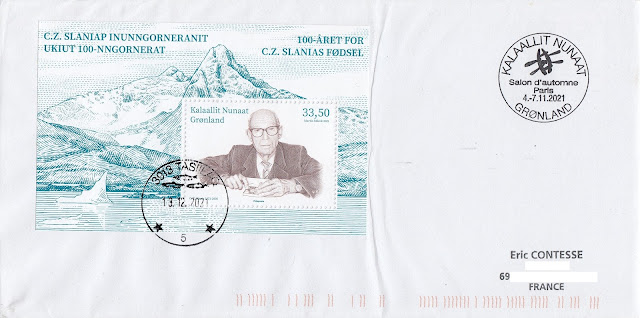
Le 12 août 2021, les administrations postales du Groenland, des îles Féroé et du Danemark ont mis en circulation un bloc-feuillet commun consacré au 100ème anniversaire de la naissance du maître graveur Czesław Słania (1921-2005), surnommé "le graveur aux 1000 timbres".
Né en Pologne, Czesław Słania est en effet considéré comme l'artiste le plus prolifique de l'histoire du timbre-poste et le graveur (technique de la taille-douce) le plus connu dans le monde, sa gravure étant louée par les critiques, pouvant reproduire avec le plus de détails possibles une œuvre d'art que ce soit une peinture ou une œuvre contemporaine...
Ayant influencé de nombreuses générations d'artistes graveurs de timbres à travers le monde, Czesław Słania est reconnu par le Livre Guinness des records, ayant créé un total de 1070 timbres pour 32 administrations postales !
Sa carrière philatélique débute en 1951 en Pologne mais il choisi la Suède comme pays d'adoption à partir de 1956, pays pour lequel il grave son 1er timbre en 1960.
On August 12, 2021, the postal administrations of Greenland, Faroe Islands and Denmark put into circulation a splendid joint souvenir sheet dedicated to the 100th anniversary of the birth of the master engraver Czesław Słania (1921-2005), nicknamed "the 1000 stamps' engraver".
Born in Poland, Czesław Słania is indeed considered the most prolific artist in the history of the postage stamp and the most famous engraver (technique of intaglio) in the world, his engraving being praised by critics, being able to reproduce with the greatest possible detail a work of art whether it is a painting or a contemporary work ...
Having influenced many generations of stamp-engraving artists around the world, Czesław Słania is recognized by the Guinness Book of Records, having created a total of 1,070 stamps for 32 postal administrations!
His philatelic career began in 1951 in Poland but he chose Sweden as his adopted country from 1956, a country for which he engraved his first stamp in 1960. 

La version groenlandaise de ce bloc-feuillet (33,50 DKK) figure sur cette lettre envoyée le 13 décembre 2021 depuis Tasiilaq. A noter à droite le cachet spécial de la poste groenlandaise émis lors du dernier Salon Philatélique d'Automne à Paris (du 4 au 7 novembre 2021). 
Le même timbre, un portrait de Slania gravé par Martin Mörck (parfois considéré comme son successeur) à partir d'une photographie de Wayne Chen, figure sur les 3 blocs-feuillets, les marges étant différentes (paysage typique pour Groenland et îles Féroé).
Le Groenland a émis son premier timbre gravé par Słania en 1963, une série courante représentant le portrait du roi Frederik IX. Il a gravé également 3 séries courantes de portraits de la reine actuelle, Margrethe II. Le dernier timbre du Groenland gravé par Słania a été émis le 5 avril 1990. Au total, Słania a gravé 46 timbres pour le Groenland.
Slania a gravé la plupart de ses timbres pour la Suède, différents autres pays scandinaves, la Pologne, Monaco ou les Nations Unies. Il a conçu 4 timbres pour la poste française entre 1982 et 1999.
A noter qu'un autre bloc-feuillet commun consacré à Czesław Słania a également été émis en 2021 par les administrations postales de Pologne et de Suède. Monaco a également émis un timbre en hommage à Slania (gravé par Martin Mörck aussi).
The Greenlandic version of this souvenir sheet (DKK 33.50) was used on this letter sent on December 13, 2021 from Tasiilaq. To note on the right the special cachet of the Greenland Post issued during the last Salon Philatélique d'Automne in Paris (from November 4 to 7, 2021). 
The same stamp, a portrait of Slania engraved by Martin Mörck (sometimes considered his successor) from a photograph by Wayne Chen, is present on the 3 souvenir sheets, the margins being different (typical landscape for Greenland and the Faroe Islands).
Greenland issued its first stamp engraved by Słania in 1963, a definitive series featuring the portrait of King Frederik IX. He also engraved 3 definitive series of portraits of the current queen, Margrethe II. The last Greenland stamp engraved by Słania was issued on April 5, 1990. In total, Słania engraved 46 stamps for Greenland.
Slania engraved most of his stamps for Sweden, various other Scandinavian countries, Poland, Monaco or the United Nations. He designed 4 stamps for the French Post, issued between 1982 and 1999.
To note that another joint souvenir sheet dedicated to Czesław Słania was also issued in 2021 by the postal administrations of Poland and Sweden. Monaco also issued a stamp paying tribute to Slania (engraved by Martin Mörck too).

lundi 24 janvier 2022

EUROPA 2021 (Endangered National Wildlife) stamp set on cover from Greenland

Série EUROPA 2021 (Faune en voie de disparition) sur lettre du Groenland

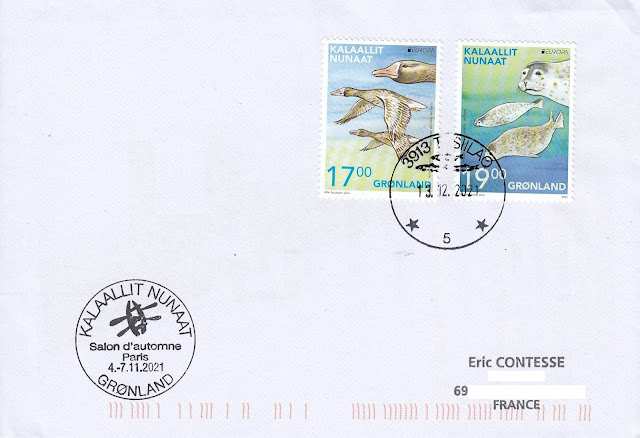
Le 8 juin 2021, la poste du Groenland (Tusass Greenland) a mis en circulation une très jolie série (2 timbres), illustrant le thème EUROPA choisi cette année-là par l'organisation PostEurop, la faune nationale en voie de disparition.
Ces 2 timbres (17 et 19 DKK), conçus par l'artiste Miki Jacobsen (ses 29ème et 30ème timbres pour la poste du Groenland depuis 1992), imprimés chacun en feuillet de 10 timbres gommés et dans un carnet composé de 12 timbres autocollants (6 de chaque), figurent sur la jolie lettre ci-dessous envoyée le 13 décembre 2021 depuis Tasiilaq.
A noter en bas à gauche le cachet spécial de la poste groenlandaise émis lors du dernier Salon Philatélique d'Automne à Paris (du 4 au 7 novembre 2021). 
L'Institut de la Nature du Groenland et l'Université d'Aarhus (Danemark) ont conjointement préparé une liste rouge. Il s'agit d'une liste des statuts de menace des animaux et des plantes groenlandais et a été commandée par le gouvernement du Groenland (ministère des Pêches, de la Chasse et de l'Agriculture). 
On June 8, 2021, the Greenland Post (Tusass Greenland) put into circulation a very nice series (2 stamps), illustrating the EUROPA theme chosen that year by the PostEurop organization, endangered national wildlife.
These two stamps (17 and 19 DKK), designed by the artist Miki Jacobsen (his 29th and 30th stamps for the Post of Greenland since 1992), each printed in sheet of 10 gummed stamps as well as in a booklet composed of 12 self-adhesive stamps (6 of each), are present on the pretty cover below sent on December 13, 2021 from Tasiilaq.
To note at the bottom left the special cachet of the Greenland Post issued during the last Salon Philatélique d'Automne in Paris (from November 4 to 7, 2021). 
The Greenland Institute of Nature and the University of Aarhus in Denmark have jointly prepared a red list. It is a list of Greenlandic animals and plants’ threatening status and was commissioned by the Government of Greenland (Department of Fisheries, Hunting and Agriculture).

 
Selon la dernière liste rouge, qui date de 2018, peu d'espèces animales au Groenland sont considérées comme menacées. Cependant, parmi ceux qui sont considérés comme en danger, cette série EUROPA illustre l'oie rieuse du Groenland, qui est évaluée comme modérément en danger et le phoque commun, considéré comme en danger critique.
L'oie rieuse du Groenland (Anser albifrons flavirostris) est une espèce migratrice qui se reproduit dans la frange côtière de l'ouest du Groenland (entre Nuuk et Upernavik) entre avril et septembre et hiverne exclusivement en Irlande et en Grande-Bretagne. Les plus grands nombres se trouvent dans le comté de Wexford, en République d'Irlande, et à Islay, en Écosse.
Le phoque commun (Phoca vitulina concolor) est un mammifère marin carnivore, rare au large du Groenland, observé entre Upernavik sur la côte ouest, le Cap Farewell au sud et Ittoqqortoormiit sur la côte est.
Cette espèce, vivant principalement dans les fjords et archipels, est protégée depuis 2010 au Groenland. 
According to the latest Red List, which dates from 2018, few animal species in Greenland are considered threatened. However, among those considered endangered, this EUROPA series illustrates the Greenland white-fronted goose, which is assessed as moderately endangered, and the Harbour seal, which is considered critically endangered.
The Greenland white-fronted goose (Anser albifrons flavirostris) is a migratory species that breeds in the coastal fringe of western Greenland (between Nuuk and Upernavik) between April and September and winters exclusively in Ireland and Great Britain. The largest numbers are in County Wexford, Republic of Ireland, and Islay, Scotland.
The Harbour seal (Phoca vitulina concolor) is a carnivorous marine mammal, rare off Greenland, observed between Upernavik on the west coast, Cape Farewell in the south and Ittoqqortoormiit on the east coast.
This species, living mainly in fjords and archipelagos, has been protected since 2010 in Greenland.
 

vendredi 14 janvier 2022

Sepac 2021 (historical maps) stamp on cover from Greenland

Timbre Sepac 2021 (cartes historiques) sur lettre du Groenland

Pour rappel, la Small European Postal Administration Cooperation (SEPAC) est une association de petites administrations postales européennes (13 actuellement), créée en 1999, afin de discuter de diverses questions philatéliques et postales spécifiques à ces petites structures.
Depuis 2007 (thème des paysages), des timbres sur un thème commun sont émis par certains membres et une élection du plus beau timbre Sepac est organisée depuis 2010.
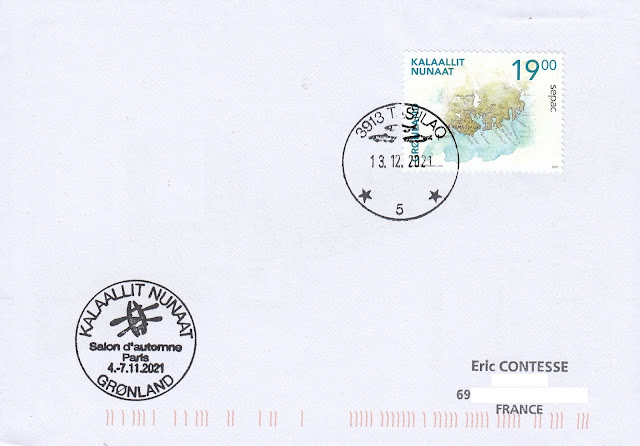
Le Groenland participe à ces émissions Sepac depuis 2007 et a émis, le 8 juin 2021, son 12ème timbre Sepac, dont le thème cette année-là était consacré à des cartes historiques.
As a reminder, the Small European Postal Administration Cooperation (SEPAC) is an association of small European postal administrations (13 currently), created in 1999, in order to discuss various philatelic and postal issues specific to these small structures.
Since 2007 (theme : landscapes), stamps having a common theme are issued by some members and an election of the most beautiful Sepac stamp has been organized for the first time in 2010. 
Greenland participated in these Sepac stamps since 2007 and issued, on June 8, 2021, its eighth Sepac stamp, whose theme this year was devoted to old maps.  

Ce timbre (19 DKK), conçu par l'illustrateur et graphiste Nuka K. Godtfredseng (né en 1970, son 9ème timbre groenlandais), a été utilisé sur la lettre ci-dessus, envoyée le 13 décembre 2021 depuis Tasiilaq, la principale ville située sur la côte sud-est du Groenland où est situé le siège des services postaux de l'île.
Pour concevoir ce timbre, Nuka K. Godtfredseng s'est inspiré d'une carte historique du Groenland incluant les routes maritimes des 2 explorateurs arctiques danois Gustav Holm et Georg Carl Amdrup datant de 1884-85 et 1900, ainsi que des cartes de la côte nord-est de Tasiilaq selon des croquis créés par le philologue danois, spécialiste des Inuits, William Thalbitzer (1873-1958), qui fit de nombreux voyages d'études au Groenland.
A noter en bas à gauche le cachet spécial de la poste groenlandaise émis lors du dernier Salon Philatélique d'Automne à Paris (du 4 au 7 novembre 2021).
This stamp (19 DKK), designed by illustrator and graphic artist Nuka K. Godtfredseng (born in 1970, his 9th Greenlandic stamp), was used on the above letter, sent on December 13, 2021 from Tasiilaq, the main town located on the southeast coast of Greenland where the headquarters of the island's postal services are located.
To design this stamp, Nuka K. Godtfredseng was inspired by a historical map of Greenland including the maritime routes of the two Danish Arctic explorers Gustav Holm and Georg Carl Amdrup dating from 1884-85 and 1900, as well as maps of the coast northeast of Tasiilaq according to sketches created by the Danish philologist, Inuit specialist, William Thalbitzer (1873-1958), who made numerous study trips to Greenland.
To note at the bottom left the special cachet of the Greenland Post issued during the last Salon Philatélique d'Automne in Paris (from November 4 to 7, 2021).

lundi 8 mars 2021

Norden 2020 "Mammals" stamp set on cover from Greenland

Timbres Norden 2020 (Mammifères) sur lettre du Groenland

Après des émissions consacrées à la cuisine nordique en 2016 et aux poissons nordiques en 2018, les 8 administrations postales des pays ou territoires du nord de l'Europe (Åland, Finlande, Danemark, îles Féroé, Groenland, Islande, Norvège et Suède) ont choisi le thème des "mammifères" pour illustrer les timbres communs "Norden" en 2020.
Pour rappel, ces séries comportent des illustrations différentes pour chaque pays, avec le logo "Norden" (inspiré d'un cor postal) sur les timbres ou dans les marges pour les bloc-feuillets.
La poste groenlandaise a malheureusement annoncé que cette série Norden 2020 était la dernière, suite à un accord unanime des 8 administrations postales concernées...
Pour cette dernière série, la poste groenlandaise a émis 2 timbres représentant respectivement un mammifère terrestre et un mammifère marin, emblématiques de cet immense territoire et qui ont été rarement illustrés sur des timbres depuis 1938.
After stamp issues devoted to Nordic cuisine in 2016 and to Nordic fish in 2018, the 8 postal administrations of the countries or territories of northern Europe (Åland, Finland, Denmark, Faroe Islands, Greenland, Iceland, Norway and Sweden) have chosen the theme of "mammals" to illustrate the joint stamps "Norden" in 2020.
As a reminder, these series have different illustrations for each country, with the "Norden" logo (inspired by a post horn) on stamps or in the margins for the miniature sheets. 
The Greenlandic Post unfortunately announced that this Norden 2020 series was the last one, following a unanimous agreement among all 8 Nordic postal administrations ...

For this last set, the Greenlandic Post issued two stamps representing respectively a land mammal and a sea mammal, emblematic of this immense territory and which have rarely been illustrated on stamps since 1938.

 
Ces 2 timbres, émis le 18 mai 2020, figurent sur cette jolie lettre envoyée le 19 janvier 2021 depuis Daneborg, une station située sur le littoral du parc national du Nord-Est du Groenland, qui constitue le plus grand parc national au monde. Merci beaucoup Jens !
J'aime beaucoup cette série, dans un style de BD, conçue par l'artiste Miki Jacobsen, créateur de timbres pour la poste groenlandaise depuis 1992 (ces 2 timbres sont ses 27ème et 28ème).
Le timbre à droite (16 DKK) est consacré au bœuf musqué (Ovibos moschatus), une espèce de capriné recouverte d'une épaisse toison laineuse isolante, vivant dans l'extrême nord canadien et au Groenland.
Proche de l'extinction au milieu du 20ème siècle à cause de la chasse, ses effectifs ont augmenté depuis (environ 75000 animaux recensés en 1999) et il a été réintroduit dans plusieurs pays.
L'autre timbre (18 DKK) représente un morse (Odobenus rosmarus), un mammifère marin reconnaissable à ses défenses, ses moustaches drues et son allure massive.
Le morse occupe une place importante dans la culture de nombreux peuples autochtones de l'Arctique, qui le chassèrent pour sa viande, sa graisse, sa peau, ses défenses et ses os. Cette espèce est classée "vulnérable", en partie à cause du réchauffement climatique.
These 2 stamps, issued on May 18, 2020, have been used on this pretty letter sent on January 19, 2021 from Daneborg, a station located on the coast of the North East Greenland National Park, which is the largest national park in the world. Thanks a lot Jens!
I really love this series, in a comic book style, designed by artist Miki Jacobsen, creator of stamps for Greenlandic Post since 1992 (these 2 stamps are his 27th and 28th).
The stamp on the right (16 DKK) is dedicated to the muskox (Ovibos moschatus), a species of goat covered with a thick woolly insulating fleece, living in the far north of Canada and in Greenland.
Close to extinction in the mid-20th century due to hunting, its numbers have since increased (around 75,000 animals recorded in 1999) and it has been reintroduced in several countries.
The other stamp (18 DKK) depicts a walrus (Odobenus rosmarus), a sea mammal recognizable by its tusks, thick whiskers and massive appearance.
Walrus occupies an important place in the culture of many indigenous peoples of the Arctic, who hunted it for its meat, fat, skin, tusks and bones. This species is classified as "vulnerable", in part because of global warming.
 

lundi 8 février 2021

EUROPA 2020 (Ancient postal routes) stamp set on cover from Greenland

Série EUROPA 2020 (Anciennes routes postales) sur lettre du Groenland

Le 14 septembre 2020, la poste du Groenland (Post Greenland) a mis en circulation une très intéressante série (2 timbres), illustrant le thème EUROPA choisi cette année-là par l'organisation PostEurop, les anciennes routes postales ("Allakkisarnermi aqqutitoqqat" en kalaallisut). 
Ces 2 timbres, conçus par l'artiste Robert Dam (né en 1964), imprimés chacun en feuillet de 10 timbres gommés et dans un carnet composé de 12 timbres autocollants (6 de chaque), figurent sur la jolie lettre ci-dessous envoyée le 19 janvier 2021 depuis Tasiilaq. Merci beaucoup Roland ! 
Cette série nous rappelle que Charles Lindbergh (1902-1974), pionnier de l'aviation, effectua une mission au Groenland entre juillet et août 1933 dans le cadre d'une étude pour établir une liaison commerciale entre Terre-Neuve (Canada) et l'Europe, via le Groenland.
On September 14, 2020, the Greenland Post put into circulation a very interesting series (2 stamps), illustrating the EUROPA theme chosen that year by the PostEurop organization, the ancient postal routes ("Allakkisarnermi aqqutitoqqat" in kalaallisut).
These two stamps, designed by the artist Robert Dam (born in 1964), each printed in a sheet of 10 gummed stamps and in a booklet made of 12 self-adhesive stamps (6 of each), are present on the nice letter below sent on January 19, 2021 from Tasiilaq. Thank you very much Roland! 
This series reminds us that Charles Lindbergh (1902-1974), an aviation pioneer, carried out a mission to Greenland from July to August 1933 as part of a study to establish a commercial route between Newfoundland, Canada and Europe, via Greenland.

 
Surnommé "L'aigle solitaire", l'américain Charles Lindbergh était éntré dans la légende de l'aviation en devenant le premier pilote à relier, sans escale et en solitaire, New York à Paris entre le 20 et le 21 mai 1927 en 33 heures et 30 minutes, à bord de son avion "Spirit of Saint Louis".
Lors de cette expédition au Groenland, accompagné par son épouse Anne, il effectua plusieurs liaisons aériennes entre différentes localités de l'île, à bord d'un avion Lockheed Model 8 Sirius, surnommé "Tingmissartoq" ("celui qui vole comme un oiseau") par les inuits.
Il transportait en particulier du courrier, lors de sa dernière étape entre le Groenland et l'Islande (puis le courrier à été transporté par bateau au Danemark, via Bergen).
Charles Lindbergh est ainsi considéré comme le premier "facteur des airs" dans l'histoire du Groenland, ce que ces 2 timbres nous rappellent, reproduisant des photographies de cette époque, conservées au musée de Qaqortoq dans lequel une pièce a été reconstituée, une chambre où ont dormi Lindbergh et l'explorateur danois Knud Rasmussen.
Ils sont représentés sur le timbre à 16 DKK, l'autre timbre (18 DKK) montrant Lindbergh et son avion "Tingmissartoq", sur fond de drapeau du Groenland.
Nicknamed "Lone Eagle", the American Charles Lindbergh had entered the aviation legend by becoming the first pilot to connect, non-stop and alone, New York to Paris between May 20 and 21, 1927 in 33 hours and 30 minutes, aboard his "Spirit of Saint Louis" airplane.
During this expedition to Greenland, accompanied by his wife Anne, he made several air connections between different localities of the island, aboard a Lockheed Model 8 Sirius plane, nicknamed "Tingmissartoq" ("he who flies like a bird" ) by the Inuit.
In particular, it carried mail, during his last stop between Greenland and Iceland (then the mail was transported by boat to Denmark, via Bergen).
Cha6rles Lindbergh is thus considered to be the first "airborne postman" in the history of Greenland, what these two stamps remind us of, reproducing photographs from this period, kept at the Qaqortoq Museum in which a room has been reconstructed, a bedroom where Lindbergh and Danish explorer Knud Rasmussen slept.
They are pictured on the 16 DKK stamp, the other stamp (18 DKK) showing Lindbergh and his plane "Tingmissartoq", with a Greenland flag in the background.

samedi 19 octobre 2019

EUROPA 2019 (National birds) stamp set on cover from Greenland

Série EUROPA 2019 (Oiseaux nationaux) sur lettre du Groenland

Comme de nombreux autres pays ou territoires européens, le Groenland n'a pas d'oiseau national officiel mais a toutefois choisi d'illustrer cette thématique retenue pour les timbres EUROPA 2019 (2 timbres) avec différents oiseaux communs et familiers, figurant dans des mythes et légendes : le lagopède alpin (Lagopus muta) et le canard colvert (Anas platyrhynchos) d'une part (15 DKK) et le plectrophane des neiges (Plectrophenax nivalis) et le grand corbeau (Corvus corax) d'autre part (17 DKK).
Ces 2 timbres, conçus par l'artiste Naja Abelsen (née en 1964), imprimés chacun en feuillet de 10 timbres gommés et dans un carnet composé de 12 timbres autocollants (6 de chaque), figurent sur la jolie lettre ci-dessous envoyée le 27 septembre 2019 depuis Tasiilaq. Merci beaucoup Roland !
Au Groenland, une tradition explique que les personnes nées en hiver sont des "Ptarmigan People" (en référence au lagopède alpin, en anglais) et que celles nées en été sont des "Duck People" (en référence au canard colvert), ce que le timbre à gauche illustre.
Like many other European countries or territories, Greenland does not have any official national bird but has chosen to illustrate this theme chosen for EUROPA 2019 stamps (2 stamps) with different common and familiar birds, appearing in various myths and legends: the rock ptarmigan (Lagopus muta) and the mallard duck (Anas platyrhynchos) on the one hand (DKK 15) and the snow bunting (Plectrophenax nivalis) and the common raven (Corvus corax) on the other hand (DKK 17).
These two stamps, designed by the artist Naja Abelsen (born in 1964), each printed in a sheet of 10 gummed stamps and in a booklet made of 12 self-adhesive stamps (6 of each), are present on the nice letter below sent on September 27, 2019 from Tasiilaq. Thank you very much Roland!
In Greenland, a tradition explains that the people born in winter are "Ptarmigan People" and that those born in summer are "Duck People", what the stamp on the left is illustrating.


A noter que le lagopède alpin figurait également sur le timbre EUROPA émis cette année par la poste française en Andorre, le canard colvert étant représenté sur un des 2 timbres émis par la Cité du Vatican.
Le 2ème timbre représente un plectrophane des neiges, considéré comme le messager du Grand Soleil, accompagné d'un grand corbeau, qui a aidé à la création du soleil selon plusieurs mythes groenlandais. Ces 2 oiseaux sont également réunis dans certains mythes comme par exemple "Le corbeau qui était désespéré de se marier"...
A noter enfin qu'une vingtaine de pays ou territoires émettant des timbres EUROPA cette année, incluant le Groenland, participent au projet "Europa Bird Stamps 2019" consistant à scanner les timbres (via une application gratuite CEE-app) pour écouter le chant des oiseaux.
Comme les années précédentes, le logo EUROPA est présent sur ces 2 timbres avec une police minuscule... dommage !
It should be noted that the rock ptarmigan also appeared on the EUROPA stamp issued this year by the French Post in Andorra, the mallard duck being featured on one of the two stamps issued by the Vatican City.
The 2nd stamp above is depicting a snow bunting, considered as the messenger of the Great Sun, accompanied by a common raven, which helped to create the sun according to several Greenlandic myths. These 2 birds are also appear alongside each other in some myths such as "The raven that was desperate to get married" for example...
Finally, to note that about twenty countries or territories issuing EUROPA stamps this year, including Greenland, are participating in the "Europa Bird Stamps 2019" project consisting in scanning the stamps (via a free CEE-Application) to listen to the birds singing.
As in past years, the EUROPA logo is present on these two stamps with a tiny font ... too bad! 

Related Posts Plugin for WordPress, Blogger...