Affichage des articles dont le libellé est Liechtenstein. Afficher tous les articles

samedi 30 mai 2026

"Peregrine Falcon Migration" joint stamp set with Liechtenstein, on FDC from Gibraltar

Série "Migration des faucons pèlerins", commune avec le Liechtenstein, sur FDC de Gibraltar 

Le 10 novembre 2025, les administrations postale de Gibraltar et du Liechtenstein ont mis en circulation 2 blocs-feuillets mixtes communs intitulés "Jeunes faucons pèlerins - migration d'hier et d'aujourd'hui".
Chaque bloc-feuillet est constitué de 2 timbres, un émis par Gibraltar et un par le Liechtenstein, illustrant les routes de migration du faucon pèlerin (Falco peregrinus) entre les Alpes et la Méditerranée.
Les 2 timbres (1,70£) de cette série commune émis par Gibraltar, conçus par Stephen Perera à partir d'illustrations de Jonathan Pointer, figurent sur le FDC officiel ci-dessous.
Le faucon pèlerin est un oiseau réputé pour sa puissance, sa vitesse et son élégance. Considéré comme l'animal le plus rapide de la planète, il peut atteindre des vitesses de piqué supérieures à 320 km/h lorsqu'il fond sur sa proie.
Doté d'une vue perçante, estimée huit fois plus performante que celle de l'homme, il chasse avec une précision remarquable. Présent sur tous les continents à l'exception de l'Antarctique, le faucon pèlerin incarne l'adaptabilité et l'endurance. 
On November 10, 2025, the postal administrations of Gibraltar and Liechtenstein released two joint souvenir sheets entitled "The young Peregrine falcon - Migration yesterday and today".
Each souvenir sheet consists of two stamps, one issued by Gibraltar and one by Liechtenstein, illustrating the migration routes of the peregrine falcon (Falco peregrinus) between the Alps and the Mediterranean.
The two stamps (£1.70) in this joint series issued by Gibraltar, designed by Stephen Perera based on illustrations by Jonathan Pointer, are present on the official first day cover below.
The peregrine falcon is a bird renowned for its power, speed, and grace. Regarded as the fastest animal on Earth, it can reach diving speeds of over 320 km/h when stooping after its prey.
With keen eyesight, estimated to be eight times sharper than that of humans, it hunts prey with remarkable precision. Found on every continent except Antarctica, the peregrine falcon embodies adaptability and endurance. 

À Gibraltar, l'espèce niche le long des falaises calcaires abruptes du Rocher, où l'on peut souvent observer les adultes planant au-dessus du détroit ou perchés sur les corniches côtières scrutant la mer en contrebas. Sa présence imposante au-dessus de ce passage entre l'Europe et l'Afrique en a fait un emblème de vigilance et de force.
Au Liechtenstein, le faucon pèlerin évolue dans un territoire alpin où se mêlent sommets et vallées. Il plane avec aisance sur les courants ascendants et niche sur les crêtes rocheuses surplombant la vallée du Rhin.
Ces habitats contrastés, mer et montagne, illustrent à merveille l'étendue de sa répartition géographique et sa capacité à prospérer des falaises côtières aux hautes altitudes.
Sur cette série, chaque pays a représenté le faucon pèlerin dans son milieu naturel : les timbres de Gibraltar le montrent en vol et perché au sommet du Rocher, ceux du Liechtenstein le présentent planant avec élégance au-dessus des cimes alpines et perché sur fond de vallée.
Ensemble, ces quatre timbres forment une collection qui unit la mer et le ciel, le nord et le sud - deux petites nations liées par une même admiration pour la nature.
Au-delà de leur attrait esthétique, ces timbres véhiculent un message de résilience. Autrefois menacé d'extinction dans certaines régions d'Europe à cause des pesticides, le faucon pèlerin a connu l'un des plus grands succès de conservation grâce aux efforts de protection internationaux.
In Gibraltar, the species nests along the Rock's sheer limestone cliffs, where adults can often be seen soaring above the Strait or perched on coastal ledges scanning the sea below. Its commanding presence above the gateway between Europe and Africa has made it an emblem of vigilance and strength.
In Liechtenstein, the peregrine falcon's domain lies among alpine peaks and valleys, where it glides effortlessly on mountain thermals and nests on rocky crags high above the Rhine Valley.
These contrasting habitats, sea and mountain, beautifully illustrate the bird's global range and its ability to thrive from coastal cliffs to high altitudes.
In this series, each country has depicted the peregrine falcon in its natural habitat: Gibraltar's stamps show it in flight, perched atop the Rock, whilst Liechtenstein's stamps present it soaring with elegance over alpine summits and perched with a mountain valley backdrop.
Together, these four stamps form a collection that unites sea and sky, north and south - two small nations bound by a shared admiration for nature.
Beyond their aesthetic appeal, these stamps carry a deeper message of resilience. Once brought to the brink of extinction in parts of Europe due to pesticide use, the peregrine falcon has made one of conservation's greatest comebacks thanks to international protection efforts.  

mardi 28 avril 2026

EUROPA 2026 (70th anniversary of the EUROPA stamps) stamp on FDC from Liechtenstein

Timbre EUROPA 2026 (70ème anniversaire des timbres EUROPA) sur FDC du Liechtenstein 

L'année 2026 marque le 70ème anniversaire des timbres EUROPA, une initiative philatélique lancée pour renforcer les relations entre les pays européens et promouvoir une paix et une unité durables.
Émis pour la première fois en 1956 par six nations – la Belgique, la France, l'Allemagne, l'Italie, le Luxembourg et les Pays-Bas, membres fondateurs de l'Union européenne – ce programme s'est étendu progressivement à 53 organisations postales participantes.
L'an dernier, le groupe de travail Timbres et Philatélie de PostEurop a organisé un concours interne pour choisir un motif commun sur le thème "70ème anniversaire du timbre EUROPA : Unis par...".
Guidés par des valeurs partagées telles que la communication, l'innovation, la coopération et des racines communes, les membres ont soumis 15 propositions créatives, chacune présentant une vision unique. 
Suite au vote de 50 organisations postales, ce concours a été remporté par la poste finlandaise (Posti), devant la poste de Bosnie-Herzégovine (Sarajevo) et la poste luxembourgeoise.
C'est donc le projet de l'artiste et graphiste Klaus Welp qui figure sur les timbres EUROPA émis en 2026. 
The year 2026 marks the 70th anniversary of the EUROPA stamps, a philatelic initiative launched to strengthen relations between European countries and promote lasting peace and unity.
First issued in 1956 by six nations – Belgium, France, Germany, Italy, Luxembourg, and the Netherlands, founding members of the European Union – this program has gradually expanded to include 53 participating postal organizations.
Last year, PostEurop's Stamps and Philately Working Group organized an internal competition to choose a common design on the theme "70th Anniversary of the EUROPA Stamp: United by...".
Guided by shared values ​​such as communication, innovation, cooperation, and common roots, the members submitted 15 creative proposals, each presenting a unique vision.
Following a vote by 50 postal organizations, the Finnish Post (Posti) won the competition, ahead of the Post of Bosnia & Herzegovina (Sarajevo) and the Post of Luxembourg.
The design by artist and graphic designer Klaus Welp will therefore be featured on the EUROPA stamps issued in 2026.

Le 2 mars 2026, la poste de la Principauté du Liechtenstein a mis en circulation un seul timbre EUROPA reproduisant le dessin conçu par Klaus Welp.
Ce timbre (1,90 CHF, tirage inconnu), imprimé (par Royal Joh. Enschedé) en feuillet de 4 timbres, a été utilisé sur la lettre ci-dessus avec TAD Premier Jour (conception : Armin Hoop) de Vaduz. Merci beaucoup Jürgen !
Une partie de la marge du bloc-feuillet, avec mention "70ème anniversaire des timbres EUROPA" (en anglais !), figure à gauche sur cette enveloppe.
Ce timbre EUROPA allie éléments abstraits et symboliques. La ligne pointillée ascendante en diagonale représente à la fois la perforation du timbre et le travail progressif de PostEurop. Les sept points, reliés par une ligne droite, symbolisent soixante-dix ans d'efforts concertés des opérateurs postaux à travers le continent.
Les dégradés et les motifs pointillés en arrière-plan forment une surface harmonieuse et dynamique, reflétant le joyeux mélange de couleurs du drapeau européen et symbolisant l'unité de tous les États membres.
A noter que le Liechtenstein a émis son premier timbre EUROPA en 1960, sans toutefois reproduire le dessin commun (roue de char romain à 19 rayons) choisi cette année-là... 

On March 2, 2026, the Principality of Liechtenstein's postal service issued a single EUROPA stamp reproducing the design by Klaus Welp.
This stamp (CHF 1.90, unknown print run), printed (by Royal Joh. Enschedé) in a minisheet of four, was used on the cover above with First Day cancellation (design: Armin Hoop) from Vaduz. Thank you very much, Jürgen!
Part of the margin of the minisheet, inscribed "70th anniversary of EUROPA Stamps" (in English!), appears on the left side of this envelope. 
This EUROPA stamp combines abstract and symbolic elements. The diagonally ascending dotted line represents both the perforation of a stamp and the progressive work of the PostEurop. The seven dots, connected by a straight line, symbolize seventy years of unified effort by postal operators across the continent.
The blending gradients and dotted patterns in the background form a cohesive and vibrant surface, reflecting the joyful mix of colours from the European flag and symbolizing the unity of all member nations. 

It should be noted that Liechtenstein issued its first EUROPA stamp in 1960, without however reproducing the common design (Roman chariot wheel with 19 spokes) chosen that year...  

samedi 29 novembre 2025

"Panorama - Fürstensteig" stamps on cover from Liechtenstein

Timbres "Panorama - Fürstensteig" sur lettre du Liechtenstein 

Sauf erreur, l'administration postale du Liechtenstein a débuté en 2010 une très jolie série illustrant différents panoramas spectaculaires de la Principauté.
Le 2 juin 2025, 4 nouveaux timbres ont été mis en circulation, consacrés cette fois à des panoramas depuis le sentier de randonnée Fürstensteig ("Chemin des Princes"), long de 11,9 km (point le plus bas : 769 mètres, point le plus haut : 2052 mètres).
Ces 4 timbres (1,90 CHF, tirage : 18000 chacun) ont été imprimés par Cartor dans un même feuillet composé de 8 timbres (2 de chaque).
Deux de ces timbres, conçus par Marco Büchel, le célèbre skieur et randonneur passionné, ont été utilisés sur la lettre ci-dessous envoyée le 27 octobre 2025 depuis Vaduz, la capitale. Merci beaucoup Jens ! 
Unless I'm mistaken, the Liechtenstein postal administration began a very attractive series in 2010 illustrating various spectacular panoramas of the Principality.
On June 2, 2025, four new stamps have been issued, this time featuring views from the 11.9 km long Fürstensteig ("Prince's Path") hiking trail (lowest point: 769 meters, highest point: 2052 meters).
These four stamps (CHF 1.90, print run: 18,000 each) were printed by Cartor in a single sheet of eight stamps (two of each).
Two of these stamps, designed by Marco Büchel, the renowned skier and avid hiker, have been used on the cover below, sent on October 27, 2025, from Vaduz, the capital. Thank you very much, Jens!  

Ce sentier de randonnée, le plus célèbre du Liechtenstein (niveau de difficulté T3) à travers la face nord-ouest de l'Alpspitz (1942 mètres d'altitude), a été financé par le prince Johann II et ouvert en 1898. Le chemin, en partie taillé dans la roche, exige d'avoir le pied sûr, mais est récompensé par des vues à couper le souffle.
Chaque année, le jour de la fête nationale du Liechtenstein, une retraite aux flambeaux (timbre ci-dessus à gauche) est organisée sur le Fürstensteig.
Le Kuhgrat, point culminant de cette randonnée de montagne variée, est récompensé par une vue spectaculaire sur le Rätikon et les majestueuses montagnes de Suisse et du Vorarlberg (Autriche).
La vue en contrebas sur les pittoresques villages rhénans jusqu'au lac de Constance est inoubliable, tandis que la flore colorée des éboulis le long du chemin est une source de fascination supplémentaire.
Le timbre à droite, intitulé "Mer de lumières", montre une vue de nuit depuis ce sentier, sur la vallée du Rhin en contrebas. 
This hiking trail, the most famous in Liechtenstein (difficulty level T3), traverses the northwest face of the Alpspitz (1,942 meters above sea level). It was financed by Prince Johann II and opened in 1898. 
The path, which is partly carved into the rock, requires sure-footedness but rewards you with breathtaking views.
A torchlight procession (stamp above left) along the "Fürstensteig" takes place every year on Liechtenstein's national holiday.
The Kuhgrat, the highest point of this varied mountain hike, rewards you with a spectacular view of the Rätikon and the majestic mountains of Switzerland and Vorarlberg (Austria).
The view down to the picturesque Rhine villages as far as Lake Constance is unforgettable, while the colorful scree flora along the way provides additional fascination.
The stamp on the right, entitled "Sea of ​​Lights", shows a night view from this path, overlooking the Rhine Valley below.  

vendredi 26 septembre 2025

"Dove of Peace" joint embroidered stamp on FDC from Liechtenstein

Timbre brodé commun "Colombe de la Paix" sur FDC du Liechtenstein 

Si nous aspirons tous à vivre en paix, les conflits sont une réalité bien présente, que ce soit en nous-mêmes, au sein de nos communautés ou dans le monde. 
Le timbre brodé "Dove of Peace" ("Colombe de la Paix") s'inscrit dans le cadre d'une initiative internationale qui vise à envoyer un signal fort en faveur de la paix et de la cohésion.
La poste de la Principauté du Liechtenstein fait partie de la dizaine d'administrations postales internationales (Åland, Arménie, Autriche, Barbade, Chypre, Groenland, îles Féroé, Liechtenstein, Luxembourg, Suisse) qui ont uni leurs forces pour concevoir un timbre exceptionnel, finement brodé avec du fil, en collaboration avec les Nations Unies (les 3 bureaux de New-York, Genève et Vienne), l'Union postale universelle (UPU) et le spécialiste autrichien de la broderie Hämmerle & Vogel GmbH & Co KG.  
We all wish to live in peace and yet we are often surrounded by conflict, in ourselves and our communities, or at the global level.
An international initiative is now sending a specific signal with the embroidered "Dove of Peace" stamp, to strengthen awareness of peace and solidarity. 
The post of the Principality of Liechtenstein is one of ten international postal administrations (Åland, Armenia, Austria, Barbados, Cyprus, Greenland, Faroe Islands, Liechtenstein, Luxembourg, Switzerland) that have joined forces to design an exceptional stamp, finely embroidered with thread, in collaboration with the United Nations (the three offices in New York, Geneva and Vienna), the Universal Postal Union (UPU) and the Austrian embroidery manufacturer Hämmerle & Vogel GmbH & Co KG.  

La version liechtensteinoise de ce timbre (5,80 CHF, tirage : 18000) figure sur le FDC officiel ci-dessus avec TAD de Vaduz du 19 septembre 2025.
La colombe, symbole universel de paix, d'espoir et de compréhension, a été délibérément choisie en tant que motif central pour transmettre un message clair par-delà les frontières.
Plus qu'un simple objet de collection en édition limitée, ce timbre se veut également un rappel symbolique : la paix ne va pas de soi, elle exige un effort quotidien et un engagement personnel comparables à la patience et au soin nécessaires à la conception de chaque timbre brodé.
Le timbre "Dove of Peace" envoie un message simple mais puissant, fédérateur au-delà des frontières : la paix commence à petite échelle, avec chaque individu. 
The Liechtenstein version of this stamp (CHF 5.80, print run: 18,000) appears on the official FDC above with cancellation from Vaduz dated September 19, 2025.
The dove, a universal symbol of peace, hope, and understanding, was deliberately chosen as the central motif to convey a clear message across borders.
More than just a limited-edition collectible, this stamp is also intended as a symbolic reminder: peace is not self-evident; it requires daily effort and personal commitment comparable to the patience and care required to design each embroidered stamp.
The "Dove of Peace" stamp sends a simple yet powerful, unifying message across borders: peace begins with the small gestures made by each of us.  

lundi 4 août 2025

Sepac 2025 (Architecture) stamp on FDC from Liechtenstein

Timbre Sepac 2025 (Architecture) sur FDC du Liechtenstein 

Pour rappel, la Small European Postal Administration Cooperation (SEPAC) est une association de petites administrations postales européennes (12 actuellement), créée en 1999, afin de discuter de diverses questions philatéliques et postales spécifiques à ces petites structures.
Depuis 2007 (thème des paysages), des timbres sur un thème commun sont émis par certains membres (10 en 2025 a priori, tous sauf l'île de Man et la Cité du Vatican) et une élection du plus beau timbre Sepac est organisée depuis 2010.
La Principauté du Liechtenstein participe à ces émissions Sepac depuis 2007 et a émis, le 2 juin 2025, son 16ème timbre Sepac, dont le thème cette année est consacré à l'architecture.
Ce joli timbre (1,90 CHF, tirage inconnu), représentant la Hagenhaus, a été utilisé sur la lettre ci-dessous, envoyée le Premier Jour d'émission depuis Nendeln, le hameau où est situé cet édifice historique. Merci beaucoup Jens !
As a reminder, the Small European Postal Administration Cooperation (SEPAC) is an association of small European postal administrations (12 currently), created in 1999, in order to discuss various philatelic and postal issues specific to these small structures.
Since 2007 (theme : landscapes), stamps having a common theme are issued by some members (10 in 2025 a priori, all except the Isle of Man and Vatican City) and an election for the most beautiful Sepac stamp has been organized for the first time in 2010.

The Principality of Liechtenstein has been participating in these Sepac issues since 2007 and issued its 16th Sepac stamp on June 2, 2025, this year's theme being architecture.
This rather nice stamp (CHF 1.90, unknown print run), depicting the Hagenhaus, was used on the cover below, sent on the First Day of Issue from Nendeln, the hamlet where this historic building is located. Thank you very much, Jens! 

Conçu par Armin Hoop et imprimé par Gutenberg AG (Schaan) en feuillet de 9 timbres, ce timbre (avec logo Sepac en haut à droite) montre l'imposante façade de cette ferme Hagenhaus ("Hofstätte Hagenhaus").
La Hagenhaus est une ferme du 19ème siècle, classé monument historique depuis 1988 et est sans doute l'ensemble de fermes le mieux conservé du Liechtenstein datant de la première moitié du 19ème siècle.
Là où elle se trouve aujourd'hui, bien en vue, sur l'une des routes les plus fréquentées de la Princpauté, la Hagenhaus faisait partie, au 19ème siècle, de la ligne postale historique Lindau - Milan.
La Hagenhaus a été construite en 1837 par le maître d'œuvre de Vaduz, Joseph Anton Seger, et a été utilisée par deux familles comme maison d'habitation et de commerce avec des bâtiments agricoles attenants.
Elle abrita à partir de 1864 le premier bureau de poste K&K ("Kaiserlich & Königlich" - "Impérial & Royal") dans l'Unterland liechtensteinois. Le maître d'ouvrage était Josef Alois Schlegel, qui était également le chef de poste. Le relais de poste a existé jusqu'en 1912. 
Depuis le printemps 2024, cet édifice accueille l'Académie de musique du Liechtenstein.
Designed by Armin Hoop and printed by Gutenberg AG (Schaan) in a sheetlet of 9 stamps, this stamp (with the Sepac logo at the top right) depicts the imposing facade of this Hagenhaus farmhouse ("Hofstätte Hagenhaus").
The Hagenhaus is a 19th-century farmhouse, listed as a historic monument since 1988, and is arguably the best preserved farmstead in Liechtenstein from the first half of the 19th century.

Where it now stands prominently on one of the busiest roads in the Principality, the Hagenhaus was part of the historic Lindau - Milan postal route in the 19th century.
The Hagenhaus was built in 1837 by the Vaduz master builder Joseph Anton Seger and was used by two families as a combined residential and commercial building with adjoining agricultural outbuildings.
From 1864 it housed the first K&K ("Kaiserlich & Königlich" - "Imperial & Royal") post office in the Liechtenstein Unterland. The owner was Josef Alois Schlegel, who also acted as postmaster himself. The post office existed until 1912. 

Since spring 2024, this building has housed the Academy of Music in Liechtenstein.

jeudi 5 juin 2025

EUROPA 2025 (National Archaeological Discoveries) stamp set on cover from Liechtenstein

Série EUROPA 2025 (Découvertes archéologiques nationales) sur lettre du Liechtenstein 

Le thème choisi par l'association PostEurop pour les timbres EUROPA 2025 est intitulé "Découvertes archéologiques nationales", ce que la poste du Liechtenstein a décliné en "Fouilles archéologiques nationales" ("Nationale archäologische Ausgrabungen").
Le 1er avril 2025, la poste du Liechtenstein a mis en circulation une très jolie série EUROPA (2 timbres) illustrant ce thème.
Comme en 2020, 2021, 2022 et 2024, ces 2 timbres (1,90 CHF, tirage : 22000), conçus par Armin Hoop, ont été imprimés (au Liechtenstein par Gutenberg AG) dans un même feuillet composé de 4 timbres (2 paires).
Ces 2 timbres se-tenant ont été utilisés sur la jolie lettre ci-dessous envoyée le 12 mai 2025 depuis Vaduz. Merci beaucoup Jürgen !  
Le Liechtenstein possède un riche patrimoine archéologique. Des recherches y sont menées depuis plus de 170 ans. L'une des premières fouilles a eu lieu après l'incendie du village de Schaan en 1849, qui a conduit à la découverte du fort romain sous l'église Saint-Pierre.  
The theme chosen by the PostEurop association for the 2025 EUROPA stamps is entitled "National Archaeological Discoveries", which Liechtenstein Post has translated into "National Archaeological Excavations" ("Nationale archäologische Ausgrabungen").
On April 1, 2025, Liechtenstein Post released a very attractive EUROPA set (two stamps) illustrating this theme.
As in 2020, 2021, 2022, and 2024, these two stamps (CHF 1.90, print run: 22,000), designed by Armin Hoop, have been printed (in Liechtenstein by Gutenberg AG) in the same sheetlet of four stamps (two pairs).
These two se-tenant stamps have been used on the lovely cover below, sent on May 12, 2025, from Vaduz. Thank you very much, Jürgen!
Liechtenstein is rich in archaeological heritage. Research has been carried out in the country for over 170 years. One of the earliest excavations took place after the village fire of 1849 in Schaan, which led to the discovery of the Roman fort beneath the St. Peter's Church. 

Entre 1940 et 1965, de nombreuses découvertes d'importance internationale ont été réalisées. Des sites importants, tels que le Lutzengüetle, le Schneller et le Borscht sur la crête de l'Eschnerberg, mais aussi le château de Gutenberg, ont fait l'objet de premières fouilles archéologiques. 
Les figurines (cerf et guerriers, musée national du Liechtenstein) reproduits sur ces 2 timbres EUROPA sont quatre figures votives en bronze massif sur un total de dix, découvertes en 1932 dans des couches déplacées sur le versant sud-est de la colline du château de Gutenberg à Balzers.
Elles datent du début de l'âge de fer (500-100 avant J.-C.) et sont uniques dans leur composition thématique. Avec des couches compactes de cendres et d'os d'animaux, ces figurines indiquent un site de crémation à proximité. Les historiens supposent que les figurines y ont été offertes en sacrifice symbolique à une puissance surnaturelle.
Les statuettes votives de Gutenberg montrent des influences de la culture des Celtes et des Rhètes et peuvent être classées selon trois thèmes : la guerre, la fertilité et les animaux. La qualité très variable des représentations et la composition hétérogène du bronze parlent en faveur de différents ateliers ou périodes de fabrication.
Between 1940 and 1965, multiple discoveries of international significance were made. Important sites, such as the Lutzengüetle, the Schneller and the Borscht on the ridge of the Eschnerberg, but also Gutenberg Castle, were archaeologically investigated for the first time during this period.  
The figurines (deer and warriors, Liechtenstein National Museum) reproduced on these two EUROPA stamps are four of a total of ten solid bronze votive figures, discovered in 1932 in redeposited layers on the south-eastern slope of the Gutenberg castle hill in Balzers.
They date from the Late Iron Age (500-100 BC) and are unique in their thematic composition. Together with compact layers of ash and animal bones, the figurines point to a nearby cremation site. Historians assume that the figures were offered there as symbolic sacrifices to a supernatural power.
The Gutenberg votive statuettes show influences from the Celtic and Rhaetian cultures and can be assigned to the three themes of war, fertility and animals. The very different quality of the depictions and the inconsistent composition of the bronze indicate different workshops and production times. 

vendredi 7 mars 2025

"30 years of diplomatic relations" joint stamp set with Liechtenstein, on cover from Mexico

Série "30 ans de relations diplomatiques", commune avec le Liechtenstein, sur lettre du Mexique

L'une des relations bilatérales les plus récentes du Mexique est celle avec la Principauté du Liechtenstein, avec des relations diplomatiques établies le 1er juillet 1994, dans le cadre de sa stratégie de diversification de ses relations internationales.
Les 2 pays, si opposés en terme de superficie et de population, ont convenu de renforcer le dialogue politique et la coopération bilatérale, l'importance de promouvoir la croissance des flux commerciaux, les investissements réciproques, l'importance de promouvoir la perspective de genre à travers une politique étrangère féministe et le maintien d'une étroite collaboration sur la scène multilatérale, notamment dans le cadre des Nations Unies.
En ce qui concerne la coopération éducative entre les deux pays, on constate une participation croissante de professionnels et d'étudiants diplômés mexicains à l'Université du Liechtenstein. 
One of Mexico's most recent bilateral relations is with the Principality of Liechtenstein, with diplomatic relations established on July 1, 1994, as part of its strategy to diversify its international relations.
The two countries, so opposite in terms of area and population, have agreed to strengthen political dialogue and bilateral cooperation, the importance of promoting the growth of trade flows, reciprocal investments, the importance of promoting the gender perspective through a feminist foreign policy and the maintenance of close collaboration in the multilateral arena, especially within the framework of the United Nations.
Regarding educational cooperation between the two countries, there is a growing participation of Mexican professionals and graduate students at the University of Liechtenstein.

En 2022, le Liechtenstein était le 97ème partenaire commercial du Mexique dans le monde et le 3ème parmi les pays qui composent l'Association européenne de libre-échange (Islande, Liechtenstein, Norvège et Suisse). Pour la Principauté du Liechtenstein, le Mexique est le 11ème partenaire commercial (7ème acheteur et 31ème fournisseur).
Le 3 juillet 2024, les administrations postales des 2 pays ont mis en circulation une série commune (2 timbres) à l'occasion du 30ème anniversaire de ces relations diplomatiques, représentant des paysages montagneux, respectivement l'Alpspitz (1943 mètres, Liechtenstein) et le parc national El Chico et la localité de Mineral del Chico (état d'Hidalgo, Mexique).
La version mexicaine de cette série composée de 2 timbres se-tenant (13,50 MXN, tirage : 50000 chacun), conçue par Nancy Torres López et incluant des rubans aux couleurs des drapeaux des 2 pays, a été utilisée sur la lettre ci-dessus envoyée le 27 novembre 2024 depuis la ville d'Hermosillo. Merci beaucoup Cecy !
A noter que, du côté du Liechtenstein, 2 timbres personnalisés avec mention "Liechtenstein Post" (ne faisant pas partie du programme philatélique officiel) ont été mis en circulation en tirage très limité, étant déjà épuisés le lendemain de l'émission... 
In 2022, Liechtenstein was Mexico's 97th largest trading partner in the world and the 3rd among the countries that make up the European Free Trade Association (Iceland, Liechtenstein, Norway and Switzerland). For the Principality of Liechtenstein, Mexico is the 11th largest trading partner (7th largest buyer and 31st largest supplier).
On July 3, 2024, the postal administrations of the two countries put into circulation a joint series (2 stamps) on the occasion of the 30th anniversary of these diplomatic relations, representing mountainous landscapes, respectively the Alpspitz (1943 meters, Liechtenstein) and the El Chico National Park and the locality of Mineral del Chico (Hidalgo state, Mexico).
The Mexican version of this series composed of two se-tenant stamps (13.50 MXN, print run: 50,000 each), designed by Nancy Torres López and including ribbons in the colors of the flags of the two countries, was used on the cover above sent on November 27, 2024 from the city of Hermosillo. Thank you very much Cecy!
To note that, on the Liechtenstein side, two personalized stamps with the mention "Liechtenstein Post" (not part of the official stamp program) were put into circulation in a very limited print run, being already sold out the day after the issue... 

mercredi 23 octobre 2024

Sepac 2024 (Main tourist attractions) stamp on FDC from Liechtenstein

Timbre Sepac 2024 (Principales attractions touristiques) sur FDC du Liechtenstein

Pour rappel, la Small European Postal Administration Cooperation (SEPAC) est une association de petites administrations postales européennes (12 actuellement), créée en 1999, afin de discuter de diverses questions philatéliques et postales spécifiques à ces petites structures.
Depuis 2007 (thème des paysages), des timbres sur un thème commun sont émis par certains membres (9 en 2024 a priori, tous sauf l'île de Man, Guernesey et la Cité du Vatican) et une élection du plus beau timbre Sepac est organisée depuis 2010.
La Principauté du Liechtenstein participe à ces émissions Sepac depuis 2007 et a émis, le 3 juin 2024, son 15ème timbre Sepac, dont le thème cette année est "Principales attractions touristiques".
Ce joli timbre (1,90 CHF, tirage : 31500), représentant le château de Vaduz, a été utilisé sur la lettre ci-dessous, envoyée le Premier Jour d'émission depuis Vaduz (TAD illustré montrant une vue différente du même château). Merci beaucoup Jens ! 
As a reminder, the Small European Postal Administration Cooperation (SEPAC) is an association of small European postal administrations (12 currently), created in 1999, in order to discuss various philatelic and postal issues specific to these small structures.
Since 2007 (theme : landscapes), stamps having a common theme are issued by some members (9 in 2024 a priori, all except the Isle of Man, Guernsey and Vatican City) and an election for the most beautiful Sepac stamp has been organized for the first time in 2010.

The Principality of Liechtenstein has been participating in these Sepac issues since 2007 and issued its 15th Sepac stamp on June 3, 2024, with the theme this year being "Main Tourist Attractions".
This nice stamp (CHF 1.90, print run: 31,500), featuring Vaduz Castle, was used on the cover below, sent on the First Day of Issue from Vaduz (illustrated postmark showing a different view of the same castle). Many thanks Jens!  

Conçu par Christoph Schöch et imprimé par Gutenberg AG (Schaan) en feuillet de 9 timbres, ce timbre montre le château de Vaduz photographié depuis la pelouse du château en direction du sud.
Le château trône à quelque 120 mètres au-dessus de la capitale Vaduz, au cœur de l'imposant paysage montagneux du Liechtenstein. Depuis le centre-ville, on accède à ce symbole visible au loin grâce à une promenade longue de presque deux kilomètres.
Les origines du château datent probablement du 12ème siècle. Il est mentionné pour la première fois en 1322. Il change plusieurs fois de propriétaires au cours des siècles, entre les comtes et seigneurs de la région, jusqu'à son acquisition par la famille Liechtenstein en 1712.
Pendant 20 ans, il sert de siège au bailliage sous le nom de Hohenliechtenstein, puis il tombe en ruines peu à peu. Autour de 1900, il est rénové et restauré en profondeur pendant le règne du prince Jean II. Le prince François-Joseph II, père du prince actuel, fait ensuite agrandir le château et le rend habitable. Depuis 1939, le château de Vaduz sert de résidence permanente à la famille princière. 
Designed by Christoph Schöch and printed by Gutenberg AG (Schaan) in a sheetlet of 9 stamps, this stamp shows Vaduz Castle photographed from the castle lawn looking south.
Nestled in the majestic mountain landscape of Liechtenstein, the castle towers around 120 metres above the capital of Vaduz. The landmark, which can be seen from afar, can be reached via an almost two-kilometre walk from the town centre.
The origins of the castle are believed to date back to the 12th century. It was first mentioned in 1322 and changed hands several times over the centuries between counts and barons from the region until it came into the ownership of the House of Liechtenstein in 1712.
Under the name Hohenliechtenstein, it served as the family’s official residence for 20 years, after which it increasingly fell into disrepair. Around 1900, it underwent a thorough renovation and was restored under Prince Johann II. Prince Franz Josef II, the father of the current Prince Regnant, then had it extended and made habitable.
Vaduz Castle has served as the permanent residence of the Princely Family since 1939. 

lundi 29 juillet 2024

EUROPA 2024 (Underwater Fauna and Flora) stamp set on cover from Liechtenstein

Série EUROPA 2024 (Faune et flore subaquatiques) sur lettre du Liechtenstein

Pour rappel, le thème choisi par l'association PostEurop pour les timbres EUROPA émis en 2024, la faune et flore subaquatiques, met en lumière la biodiversité des eaux européennes qui souffrent de la surpêche, de la pollution et du changement climatique et qui doivent être protégées pour les générations futures. 
Le 3 juin 2024, la poste du Liechtenstein a mis en circulation une très jolie série EUROPA (2 timbres) illustrant ce thème.
Comme en 2020, 2021 et 2022, ces 2 timbres (1,90 CHF, tirage : 34000), conçus par Rainer Kühnis, ont été imprimés (au Liechtenstein par Gutenberg AG) dans un même feuillet composé de 4 timbres (2 paires).
Ces 2 timbres se-tenant ont été utilisés sur la jolie lettre ci-dessous envoyée le 20 juin 2024 depuis Vaduz. Merci beaucoup Jürgen ! 
As a reminder, the theme chosen by the PostEurop association for the EUROPA stamps issued in 2024, underwater fauna and flora, highlights the biodiversity of European waters which suffer from overfishing, pollution and climate change and which must be protected for future generations. 
On June 3, 2024, the Liechtenstein Post put into circulation a very nice EUROPA series (2 stamps) illustrating this theme.
As in 2020, 2021 and 2022, these two stamps (1.90 CHF, print run: 34,000), designed by Rainer Kühnis, have been printed (in Liechtenstein by Gutenberg AG) in
the same sheetlet consisting of 4 stamps (2 pairs).
These two se-tenant stamps were used on the nice cover below sent on June 20, 2024 from Vaduz. Thank you very much Jürgen!  

Ces 2 timbres ont été conçus à partir de photographies du monde subaquatique local, en particulier de la réserve naturelle de St. Katrinabrunna à Balzers (sud de la Principauté).
L'espace nature et détente avec deux étangs a été créé par la commune en 1973. Les espèces végétales et animales menacées y trouvent un habitat. C'est par exemple le cas de l'Egli, appelée perche commune (Perca fluviatilis) en dehors des régions de langue suisse. On la trouve dans différents cours d'eau au Liechtenstein. On la reconnaît facilement grâce aux cinq ou six lignes transversales sombres sur ses flancs et à sa nageoire dorsale épineuse.
L'autre timbre représente des feuilles immergées du potamot nageant (Potamogeton natans) et les feuilles qui n'ont pas encore atteint la surface de l'eau. Cette plante aquatique sert de cachette aux petits poissons et apporte de l'oxygène à l'étang.
These two stamps have been designed based on photographs of the local underwater world, in particular the St. Katrinabrunna nature reserve in Balzers (south of the Principality).
The nature and recreation area with two ponds was created by the municipality in 1973. Endangered plant and animal species have found a habitat there. This includes the fish named "Egli", known outside the Swiss-speaking world as the river perch (Perca fluviatilis). It is found in a wide variety of waters in Liechtenstein. It is easily recognisable thanks to the five to six dark transverse bands on its body and its spiny dorsal fin.
The other stamp shows submerged leaves of an aquatic plant named floating pondweed (Potamogeton natans) and those leaves that have not yet made it to the surface. This plant serves as a hiding place for
small fish and provides the pond with oxygen.

dimanche 21 juillet 2024

"Wildlife of the Samina Valley" (with and without overprint) stamps on covers from Liechtenstein

Timbres "Faune de la vallée de la Samina" (avec et sans surcharge) sur lettres du Liechtenstein

Le 6 mars 2023, la poste du Liechtenstein a mis en circulation une très jolie série courante (4 timbres) consacrée à la faune de la vallée de la Samina, un torrent (17 km) dont la source se situe au Liechtenstein et qui a creusé la vallée de même nom.
Ce cours d'eau est intensivement utilisé pour la production d'électricité c'est aussi une source d'eau potable pour la population du Liechtenstein. La rivière est réputée auprès des amateurs de rafting.
La nature sauvage et romantique de cette région alpine très prisée offre un habitat optimal à différentes espèces animales, à l'honneur sur cette série, sont certaines sont en danger.
La conception de ces timbres (par Christine Böhmwalder) avec des illustrations, des esquisses et l'écriture ancienne rappelle les livres d'écoles du temps passé. Chaque timbre présente différents détails et phases de l'évolution de l'animal concerné.
On March 6, 2023, the Liechtenstein Post put into circulation a very nice definitive series (4 stamps) dedicated to the fauna of the Samina valley, a torrent (17 km) whose source is located in Liechtenstein and which dug the valley of the same name.
This watercourse is intensively used for the production of electricity and is also a source of drinking water for the population of Liechtenstein. The river is famous among rafting enthusiasts.
The wild and romantic nature of this popular alpine region offers an optimal habitat for different animal species, in the spotlight in this series, some of which are in danger.
The design of these stamps (by Christine Böhmwalder) with illustrations, sketches and old handwriting is reminiscent of textbooks from days gone by. Each stamp depicts different details and stages of development of the respective animal.

Deux de ces 4 timbres autocollants dits "provisoires" (imprimés chacun par Gutenberg AG en feuille de 20 timbres) ont été remis en circulation le 4 mars 2024 avec des modifications de valeurs faciales, la valeur d'origine étant rayée et une surcharge appliquée au-dessus avec la nouvelle valeur. Les augmentations de tarif de la Liechtensteinische Post AG en sont la cause.
C'est le cas sur la lettre ci-dessus envoyée le 20 juin 2024 depuis Eschen, avec le timbre d'origine à gauche (0,90 CHF) et le timbre avec surcharge (1,90 CHF) à droite. Merci beaucoup Jens !
Ce timbre est consacré à la salamandre noire ou salamandre alpestre (Salamandra atra), vivant entre 400 et 2800 mètres d'altitude, uniquement en Europe, dans la région alpine et une partie des Balkans. Cet amphibien d'un noir brillant donne naissance à des petits entièrement formés, il n'a donc pas besoin d'eaux de frai.
Two of these four so-called "provisional" self-adhesive stamps (each printed by Gutenberg AG in sheets of 20 stamps) were put back into circulation on March 4, 2024 with changes in face values, the original value being crossed out and a surcharge applied to the above with the new value. The reason for this is the rate increases by Liechtensteinische Post AG.
This is the case on the cover above sent on June 20, 2024 from Eschen, with the original stamp on the left (CHF 0.90) and the stamp with surcharge (CHF 1.90) on the right. Thank you very much Jens!
This stamp is dedicated to the alpine salamander (Salamandra atra), living between 400 and 2800 meters above sea level, only in Europe, in the Alpine region and part of the Balkans. This shiny black amphibian gives birth to live young and is therefore not dependent on spawning waters.

Le 2ème timbre de cette série "Faune de la vallée de la Samina", concerné par cette réémission du 4 mars 2024, a été utilisé sur la 2ème lettre ci-dessus envoyée le 20 juin 2024 depuis Schaan, avec le timbre d'origine à gauche (1,10 CHF) et le timbre avec surcharge (2,50 CHF) à droite. Merci beaucoup Jens !
Ce timbre illustre une espèce de fourmi (formica selysi) qui ne se trouve plus que localement dans les Alpes orientales. Cette fourmi est donc classée en haut des listes rouges des espèces menacées de la région.
The 2nd stamp of this series "Wildlife of the Samina Valley", concerned by this reissue of March 4, 2024, was used on the 2nd cover above sent on June 20, 2024 from Schaan, with the original stamp to the left (CHF 1.10) and the stamp with surcharge (CHF 2.50) on the right. Thank you very much Jens!
This stamp illustrates a species of ant, the Alpine Silver Ant (formica selysi) which is now only found locally in the Eastern Alps. This ant is therefore classified at the top of the red lists of threatened species in the region. 

mardi 26 mars 2024

"Peace" stamp on cover from Liechtenstein

Timbre "Paix" sur lettre du Liechtenstein

Au vu des conflits et guerres inhumaines dans le monde actuellement (Ukraine, Gaza, Soudan...), la Philatelie Liechtenstein a souhaité lancer un appel pour la paix à travers l'émission d'un nouveau timbre, le 4 mars 2024, illustrant de façon très élégante ce concept de paix ("Frieden" en allemand).
Comme ce n'est pas du tout une évidence de vivre dans un pays en paix, l'émission de ce timbre doit faire l'objet d'une attention particulière...
Ce timbre (1,90 CHF, tirage : 32000), imprimé (par Royal Joh. Enschedé) en feuillet de 16 timbres, a été utilisé sur la lettre ci-dessous (l'enveloppe FDC officielle associé au timbre) envoyée le 18 mars 2024 depuis la ville de Triesen, située dans le sud-ouest du Liechtenstein. Merci beaucoup Jens !
A noter ce TAD illustré représentant la chapelle de Saint-Mamertus (9ème siècle), considérée comme la plus ancienne de la Principauté.  
In view of the conflicts and inhumane wars in the world currently (Ukraine, Gaza, Sudan...), Philatelie Liechtenstein wanted to send out a call for peace to the world through the issue of a new stamp, on March 4, 2024, illustrating in a very elegant way this concept of peace ("Frieden" in German).
As living in a peaceful country cannot be taken for granted, special attention is to be paid to this stamp's topic of peace...
This stamp (CHF 1.90, print run: 32,000), printed (by Royal Joh. Enschedé) in a sheet of 16 stamps, was used on the cover below (the official FDC envelope associated with the stamp) sent on March 18, 2024 from the town of Triesen, located in southwest Liechtenstein. Thank you very much Jens!
To note this illustrated postmark representing the Saint Mamertus Chapel (9th century), considered to be the oldest in the Principality.

Ce timbre a été conçu par l'artiste locale Michèle Steffen-Goop, qui a exprimé l'idée que la paix naît dans les petites choses, dans les relations humaines, à travers une aquarelle qui se décline sobrement en bleu et blanc. En tant qu'individu, chaque personne peut et doit toujours garder la paix à l'esprit, et se montrer respectueuse dans ses rapports aux autres.
Malgré sa discrétion et sa fragilité, la colombe est au centre de ce timbre spécial "Paix". Elle forme l'œil dans un visage représenté de profil et parfois, on la remarque seulement dans un deuxième temps.
La colombe symbolise la perspective de paix, mais aussi la paix dans ses propres pensées.
This stamp was designed by local artist Michèle Steffen-Goop, who expressed the idea that peace comes from small things and from interpersonal relationships, through a watercolor which is kept simple in the colours of white and blue. As an individual, every person can and should always keep peace in mind and live in respectful interaction with others.
Despite its restraint and fragility, the dove of peace is the focus of thi "Peace" special stamp. It forms the eye of a face depicted in profile, which is sometimes only recognisable at second glance.
The dove symbolises the prospect of peace as well as peace in one's own thoughts.

lundi 12 février 2024

"Cultural heritage in Balzers - Umbrella reel" stamp on cover from Liechtenstein

Timbre "Biens culturels à Balzers - dévidoir parapluie" sur lettre du Liechtenstein

Dès le milieu des années 1950, une collection privée d'objets historiques a commencé dans la commune située le plus au sud du Liechtenstein, Balzers. Le lancement officiel de la collection de biens culturels a eu lieu à Balzers en 1967.
Parmi ces objets, on trouve notamment un "dévidoir parapluie" ("Schirmhaspel") en bois. Cet instrument ressemblant à un parapluie servait et sert toujours à bobiner facilement des écheveaux de laine ou de fil. Pour cela, il est en général vissé à une table.
Le dévideur parapluie fait partie de la famille des bobinoirs. Ceux-ci ont été importés de l'Orient au 13ème siècle avec les métiers à tisser, les rouets et bobinoirs, et d'autres accessoires pour le tissage.
Cet ustensile utilisé d'abord pour l'usage domestique pour la broderie et la filature doit empêcher l'enchevêtrement et les nœuds dans les écheveaux de laine.  
As early as the mid-1950s, private collectors in Liechtenstein's southernmost municipality, Balzers, began collecting cultural and historical artefacts. In 1967, the official starting signal was given in Balzers to build up a collection of cultural artefacts.
These items include a wooden "umbrella reel" ("Schirmhaspel"). This tool, similar in construction to an umbrella, was used then as it is today to effortlessly unwind strands of wool or yarn. For this purpose, the device is usually screwed to the table.
The umbrella reel belongs to the family of yarn winches. These were introduced from the Orient in the 13th century along with looms, winding and spinning wheels and other weaving accessories.

Primarily used in the home for embroidery and spinning, the device is intended to prevent tangling and knotting of the linear strands of wool by using it to wind them into convenient balls. 

Entre-temps la collection de biens culturels de Balzers compte presque 12000 objets. Les pièces les plus anciennes datent du 18ème siècle. Sont collectionnés les biens culturels ayant un lien direct avec la commune, parce qu'ils y ont été utilisés ou produits.
Après les "Beigla", des bâtons de comptage sur lesquels on marquait autrefois les parts sur les droits de forêt et de prairie dans les coopératives d'alpage paysannes, en 2022, la poste du Liechtenstein a mis en circulation, le 13 novembre 2023, un 2ème timbre de cette série "Biens culturels à Balzers", consacré à ce dévidoir parapluie en bois.
Ce timbre (1,80 CHF, tirage : 32000), conçu par Isabella Gassner, a été utilisé sur cette lettre envoyée le 29 janvier 2024, avec TAD illustré (château princier) de Vaduz. Merci beaucoup Jens !
Jens a utilisé un timbre de complément (0,10 CHF) pour atteindre le tarif en vigueur (1,90 CHF) pour un envoi en Europe jusqu'à 20g.
Ce timbre ne fait pas partie du programme philatélique officiel de la Principauté du Liechtenstein mais a été créé (tirage inconnu) par le service dieMarke.li de la poste du Liechtenstein permettant de personnaliser des timbres ou cartes pré-timbrées. 
The Balzers cultural artifacts collection now comprises almost 12,000 items with the oldest items dating back to the 18th century. Cultural artefacts are collected that have a direct connection to the community by having been used or produced there. 
After the "Beigla", tally sticks on which in olden days members of farmers' alpine cooperatives etched their shares in forest and grazing rights, in 2022, the Liechtenstein Post put into circulation, on November 13, 2023, a 2nd stamp in this series "Cultural heritage in Balzers", dedicated to this wooden umbrella reel.
This stamp (1.80 CHF, print run: 32,000), designed by Isabella Gassner, was used on this cover sent on January 29, 2024, with illustrated cancellation (princely castle) from Vaduz. Thank you very much Jens!
Jens used an additional stamp (0.10 CHF) to reach the current rate (1.90 CHF) for sending to Europe up to 20g.
This stamp is not part of the official philatelic program of the Principality of Liechtenstein but was created (unknown print run) by the dieMarke.li service of the Liechtenstein Post allowing the personalization of stamps or prepaid cards.

samedi 18 novembre 2023

"Customs treaty - 100th anniversary" joint stamp with Switzerland, on cover from Liechtenstein

Timbre "100 ans du traité douanier", commun avec la Suisse, sur lettre du Liechtenstein

La principauté du Liechtenstein et la Suisse fêtent cette année un anniversaire important: le traité d'union douanière entre les deux pays a été signé le 29 mars 1923, il y a 100 ans.
Les administrations postales des 2 pays ont célébré cet anniversaire en émettant, le 29 mars 2023, une série commune (2 timbres) consacrée aux 100 ans de ce traité douanier.
Ce traité concernant la réunion de la principauté du Liechtenstein au territoire douanier suisse est considéré comme un facteur essentiel de l'essor économique du Liechtenstein au 20ème siècle. Le petit état fait depuis partie du territoire douanier suisse et le franc suisse est sa devise officielle.
Un de ces 2 timbres communs (0,90 CHF, tirage : 50000, conception : Serap Bulut) émis par le Liechtenstein a été utilisé à gauche sur cette lettre. Merci beaucoup Olivier !
La fermeture éclair dessinée sur ce timbre intitulé "Relation", symbolise l'alliance des deux pays (drapeaux respectifs de chaque côté) et la proximité acquise grâce à elle au fil des ans. On y voit également le Rhin, une frontière naturelle abolie avec le traité douanier.
The Principality of Liechtenstein and Switzerland are celebrating an important anniversary this year: the customs union treaty between the two countries was signed on March 29, 1923, 100 years ago.
The postal administrations of the two countries celebrated this anniversary by issuing, on March 29, 2023, a joint series (2 stamps) dedicated to the 100th anniversary of this customs treaty.
This treaty concerning the reunion of the Principality of Liechtenstein with the Swiss customs territory is considered to be an essential factor in the economic development of Liechtenstein in the 20th century. The small state has since been part of the Swiss customs territory and the Swiss franc is its official currency.

One of these two joint stamps (0.90 CHF, print run: 50,000, design: Serap Bulut) issued by Liechtenstein was used on the left on this cover. Thank you very much Olivier!
The zip drawn on this stamp entitled "Relationship", symbolizes the alliance of the two countries (respective flags on each side) and the closeness acquired thanks to it over the years. We also see the Rhine, a natural border abolished with the customs treaty.

A noter cette oblitération spéciale (conception : Isabella Gassner) mise en circulation par la poste du Liechtenstein à l'occasion de sa participation à l'exposition philatélique internationale organisée à Ulm (Allemagne) du 26 au 28 octobre 2023. Ce TAD représente en particulier l'église principale (Ulmer Münster), la plus grande église protestante d'Allemagne et célèbre pour la hauteur de son clocher (162 mètres, le plus haut clocher d'église dans le monde), ainsi que la tour "Gänsturm" à droite.
De nombreuses autres administrations postales étaient présentes lors de cette exposition : Slovaquie, République tchèque, Autriche, Luxembourg, Vatican...
L'autre timbre ci-dessus (0,90 CHF, tirage : 24600, conception : Karin Beck-Söllner) fait partie de la jolie série "Vues de villages", émise le 4 septembre 2023, consacrée à la capitale de l'Unterland liechtensteinois, Eschen et en particulier le village de Nendeln ici.
Ce timbre montre le bâtiment de l'entreprise traditionnelle "Keramik Werkstatt Schaedler", qui héberge l'école des beaux-arts du Liechtenstein dans l'annexe latérale. De l'autre côté de la rue, un autre bâtiment abrite un monument culturel riche en histoire : le four Hoffmann restauré, le seul four circulaire de ce type encore conservé au Liechtenstein et en Suisse, témoin de la production de briques au 18ème siècle. 
To note this special cancellation (design: Isabella Gassner) put into circulation by the Liechtenstein Post on the occasion of its participation in the international philatelic exhibition organized in Ulm (Germany) from October 26 to 28, 2023. This postmark represents in particular the main church (Ulmer Münster), the largest Protestant church in Germany and famous for the height of its bell tower (162 meters, the tallest church tower in the world), as well as the "Gänsturm" tower on the right.
Many other postal administrations were present during this exhibition: Slovakia, Czech Republic, Austria, Luxembourg, Vatican...
The other stamp above (0.90 CHF, print run: 24,600, design: Karin Beck-Söllner) is part of the pretty "Village Views" series, issued on September 4, 2023, dedicated to the capital of the Liechtenstein's Unterland region, Eschen and in particular the village of Nendeln here.
This stamp shows the building accommodating a traditional business, the "Schaedler Ceramics Workshop", which houses the Liechtenstein School of Art in its side extension. On the opposite side of the street, another building contains a cultural monument steeped in history: the restored Hoffman'sche Ringofen is the only ring kiln of its kind still preserved in Liechtenstein and Switzerland and bears witness to brick production in the 18th century.

mardi 27 juin 2023

"Customs treaty - 100th anniversary" joint stamp set with Switzerland, on cover from Liechtenstein

Série "100 ans du traité douanier", commune avec la Suisse, sur lettre du Liechtenstein 

La principauté du Liechtenstein et la Suisse fêtent cette année un anniversaire important: le traité d'union douanière entre les deux pays a été signé le 29 mars 1923, il y a 100 ans.
Les administrations postales des 2 pays ont célébré cet anniversaire en émettant, le 29 mars 2023, une série commune (2 timbres) consacrée aux 100 ans de ce traité douanier.
Ce traité concernant la réunion de la principauté du Liechtenstein au territoire douanier suisse est considéré comme un facteur essentiel de l'essor économique du Liechtenstein au 20ème siècle. Le petit état fait depuis partie du territoire douanier suisse et le franc suisse est sa devise officielle.
Ce traité international stipule qu'aucune taxe ne doit être imposée de part et d'autre de la frontière et qu'aucune interdiction d'importation et d'exportation ne doit être promulguée.
Dans les années 1990, le traité international a été adapté à l'évolution des besoins. Depuis, le Liechtenstein peut conclure des conventions internationales et devenir membre d'organisations internationales relevant du traité d'union douanière, que la Suisse en soit également membre ou pas. 
The Principality of Liechtenstein and Switzerland are celebrating an important anniversary this year: the customs union treaty between the two countries was signed on March 29, 1923, 100 years ago.
The postal administrations of the two countries celebrated this anniversary by issuing, on March 29, 2023, a joint series (2 stamps) dedicated to the 100th anniversary of this customs treaty.
This treaty concerning the reunion of the Principality of Liechtenstein with the Swiss customs territory is considered to be an essential factor in the economic development of Liechtenstein in the 20th century. The small state has since been part of the Swiss customs territory and the Swiss franc is its official currency.
This international treaty stipulates that no taxes should be imposed on either side of the border and that no import and export bans should be enacted.
In the 1990s, the state treaty was adapted to changing needs. Since then, Liechtenstein has been able to accede to international conventions and become a member of international organisations within the scope of the customs treaty, regardless of whether Switzerland is also a member of them. 

La version du Liechtenstein de cette série commune (chaque timbre a été imprimé en feuille de 16 timbres, imprimeur : Gutenberg AG au Liechtenstein) a été utilisée sur cette lettre envoyée le 5 juin 2023 depuis Vaduz. Merci beaucoup Jürgen !
La fermeture éclair dessinée sur le premier timbre intitulé "Relation" (0,90 CHF, tirage : 50000), conçu par Serap Bulut, symbolise l'alliance des deux pays (drapeaux respectifs de chaque côté) et la proximité acquise grâce à elle au fil des ans. On y voit également le Rhin, une frontière naturelle abolie avec le traité douanier.
L'autre timbre (1,10 CHF, tirage : 50000), conçu par Isabella Gassner et intitulé "Amitié", souligne quant à lui l'importance historique de ces relations de longue date entre les 2 pays et reproduit des éléments du traité d'origine de 1923.
A noter sur ce timbre la mention "100 ans du traité douanier - 29.03.2023" en allemand, imprimée avec une encre spéciale avec effet doré.
La principauté du Liechtenstein a déjà émis plusieurs timbres dans le passé consacré à ce traité douanier, en 1998 et 2013 en particulier.
The Liechtenstein version of this joint series (each stamp was printed in a sheet of 16 stamps, printer: Gutenberg AG in Liechtenstein) was used on this cover sent on June 5, 2023 from Vaduz. Thank you very much Jürgen!
The zip drawn on the first stamp entitled "Relationship" (0.90 CHF, print run: 50,000), designed by Serap Bulut, symbolizes the alliance of the two countries (respective flags on each side) and the closeness acquired thanks to it over the years. We also see the Rhine, a natural border abolished with the customs treaty.
The other stamp (1.10 CHF, print run: 50,000), designed by Isabella Gassner and entitled "Friendship", underlines the historical importance of these long-standing relations between the 2 countries and reproduces elements of the treaty of origin of 1923.
To note on this stamp the mention "100 years of the customs treaty - 29.03.2023" in German, printed with a special ink with golden effect.
The Principality of Liechtenstein has already issued several stamps in the past devoted to this customs treaty, in 1998 and 2013 in particular.

mercredi 21 juin 2023

EUROPA 2023 (Peace - the highest value of humanity) stamp set on cover from Liechtenstein

Série EUROPA 2023 (La Paix - la valeur humaine la plus importante) sur lettre du Liechtenstein

Sur proposition de la poste ukrainienne, le thème choisi par l'organisation PostEurop pour les timbres EUROPA 2023 est "La Paix - la valeur humaine la plus importante", en écho à l'agression du pays par la Russie débutée il y a plus d'un an.
Ce choix sonne comme un rappel de la volonté qui avait présidé en 1950 à la création de l'Union européenne après la 2ème Guerre mondiale, résumée par Robert Schuman en une formule désormais célèbre : faire l'Europe pour faire la Paix.
Pour illustrer ce thème 2023, PostEurop a organisé un concours au sein des pays membres et c'est le projet "Nœud de la paix" de la poste luxembourgeoise (auteurs : Linda Bos et Runa Egilsdottir - A Designers' Collective) qui a été choisi, parmi 29 propositions.
Ce projet représente des cœurs entrelacés, et des mains aux doigts entremêlés, inspirés des nœuds d'amour celtiques. Les différentes couleurs renvoient à tous les pays du monde, unis par ce nouveau symbole de paix, une sorte de société fondée sur la coopération, dans laquelle les individus sont solidaires.
On the proposal of the Ukrainian Post, the theme chosen by the PostEurop organization for the EUROPA 2023 stamps is "Peace - the highest value of humanity", echoing the aggression of the country by Russia which began more than one year ago.
This choice sounds like a reminder of the will that presided over the creation of the European Union in 1950 after the Second World War, summed up by Robert Schuman in a now famous formula: make Europe to make Peace.
To illustrate this 2023 theme, PostEurop organized a competition within the member countries and the Luxembourg Post's "Peace Knot" project (authors: Linda Bos and Runa Egilsdottir - A Designers' Collective) was chosen from among 29 proposals.
This project represents intertwined hearts, and hands with intertwined fingers, inspired by Celtic love knots. The different colors refer to all the countries of the world, united by this new symbol of peace, a kind of society based on cooperation, in which individuals stand together.

Le 9 mai 2023 (Journée de l'Europe), la poste de la principauté du Liechtenstein a mis en circulation sa série EUROPA, avec un timbre reproduisant ce "Nœud de la paix" commun et un autre timbre représentant le projet de la poste du Liechtenstein (conception : Isabella Gassner) pour ce concours PostEurop. 
Ces 2 timbres (1,80 CHF, tirage : 31200 chacun), imprimés chacun en feuillets de 12 timbres, ont été utilisés sur cette lettre envoyée le 5 juin 2023 depuis Vaduz. Merci beaucoup Jürgen !
Le 2ème timbre, intitulé "Espoir", représente un enfant qui porte la fragile planète Terre comme un ballon et tient une sucette symbolisant le goût de la paix dans l'autre main. La fillette regarde vers un avenir paisible où l'attendent un arc-en-ciel coloré et une colombe de la paix...
On May 9, 2023 (the Europe Day), the Post of the Principality of Liechtenstein put its EUROPA series into circulation, with a stamp reproducing this common "Peace Knot" and another one representing the project of the Post of Liechtenstein (design: Isabella Gassner) for this PostEurop contest.
These two stamps (1.80 CHF, print run: 31,200 each), each printed in sheetlets of 12 stamps, were used on this cover sent on June 5, 2023 from Vaduz. Thank you very much Jürgen!
The 2nd stamp, entitled "Hope", represents a child carrying the fragile planet Earth as a balloon while holding a lollipop in her other hand, symbolising the taste of peace. The girl looks towards a peaceful future where a colourful rainbow and a dove of peace await her...

vendredi 26 mai 2023

"Customs treaty - 100th anniversary" joint stamp set with Liechtenstein, on FDC from Switzerland

Série "100 ans du traité douanier", commune avec le Liechtenstein, sur FDC de Suisse

La principauté du Liechtenstein et la Suisse fêtent cette année un anniversaire important: le traité d'union douanière entre les deux pays a été signé le 29 mars 1923, il y a 100 ans.
Les administrations postales des 2 pays ont célébré cet anniversaire en émettant, le 29 mars 2023, une série commune (2 timbres) consacrée aux 100 ans de ce traité douanier.
Ce traité concernant la réunion de la principauté du Liechtenstein au territoire douanier suisse est considéré comme un facteur essentiel de l'essor économique du Liechtenstein au 20ème siècle. Le petit état fait depuis partie du territoire douanier suisse et le franc suisse est sa devise officielle.
Ce traité international stipule qu'aucune taxe ne doit être imposée de part et d'autre de la frontière et qu'aucune interdiction d'importation et d'exportation ne doit être promulguée.
Dans les années 1990, le traité international a été adapté à l'évolution des besoins. Depuis, le Liechtenstein peut conclure des conventions internationales et devenir membre d'organisations internationales relevant du traité d'union douanière, que la Suisse en soit également membre ou pas. 
The Principality of Liechtenstein and Switzerland are celebrating an important anniversary this year: the customs union treaty between the two countries was signed on March 29, 1923, 100 years ago.
The postal administrations of the two countries celebrated this anniversary by issuing, on March 29, 2023, a joint series (2 stamps) dedicated to the 100th anniversary of this customs treaty.
This treaty concerning the reunion of the Principality of Liechtenstein with the Swiss customs territory is considered to be an essential factor in the economic development of Liechtenstein in the 20th century. The small state has since been part of the Swiss customs territory and the Swiss franc is its official currency.
This international treaty stipulates that no taxes should be imposed on either side of the border and that no import and export bans should be enacted.
In the 1990s, the state treaty was adapted to changing needs. Since then, Liechtenstein has been able to accede to international conventions and become a member of international organisations within the scope of the customs treaty, regardless of whether Switzerland is also a member of them.

La version suisse de cette série commune (chaque timbre a été imprimé en feuille de 16 timbres, imprimeur : Gutenberg AG au Liechtenstein) a été utilisée sur cette lettre, avec TAD Premier Jour de Berne. Merci beaucoup Jürgen !
Ce TAD a été conçu à partir de la fermeture éclair qui figure sur le timbre à gauche (1,10 CHF), conçu par Serap Bulut, intitulé "Relation".
La fermeture éclair dessinée sur ce timbre symbolise l'alliance des deux pays (drapeaux respectifs de chaque côté) et la proximité acquise grâce à elle au fil des ans. On y voit également le Rhin, une frontière naturelle abolie avec le traité douanier.
L'autre timbre (0,90 CHF), conçu par Isabella Gassner et intitulé "Amitié", souligne quant à lui l'importance historique de ces relations de longue date entre les 2 pays et reproduit des éléments du traité d'origine de 1923.
A noter sur ce timbre la mention "100 ans du traité douanier - 29.03.2023" en allemand, imprimée avec une encre spéciale avec effet doré.
La principauté du Liechtenstein a déjà émis plusieurs timbres dans le passé consacré à ce traité douanier, en 1998 et 2013 en particulier.
The Swiss version of this joint series (each stamp was printed in sheet of 16 stamps, printer: Gutenberg AG, Liechtenstein) was used on this cover, with First Day cancellation from Bern. Thank you very much Jürgen!
This postmark was designed from the zipper that appears on the stamp on the left (1.10 CHF), designed by Serap Bulut, entitled "Relationship".
The zip drawn on this stamp symbolizes the alliance of the two countries (respective flags on each side) and the closeness acquired thanks to it over the years. We also see the Rhine, a natural border abolished with the customs treaty.
The other stamp (0.90 CHF), designed by Isabella Gassner and entitled "Friendship", underlines the historical importance of these long-standing relations between the two countries and reproduces elements of the original treaty of 1923.
To note on this stamp the mention "100 years of the customs treaty - 29.03.2023" in German, printed with a special ink with golden effect.
The Principality of Liechtenstein has already issued several stamps in the past devoted to this customs treaty, in 1998 and 2013 in particular. 

jeudi 23 février 2023

"Equality / Equal rights" (punched & Braille dots) stamp on cover from Liechtenstein

Timbre "Égalité / Équité" (trous et braille) sur lettre du Liechtenstein

Le 14 novembre 2022, la poste du Liechtenstein a mis en circulation un timbre très spécial consacré à l'égalité et l'équité entre les êtres humains.
Depuis des années, les deux notions d'égalité et d'équité sont acceptées par tous et déjà inscrites dans la loi de nombreux pays occidentaux. Mais cela suffit-il ? Comment une société parvient-elle à expérimenter une réelle égalité ?
Ce sont les questions posées à travers ce timbre (2,40 CHF, tirage : 30000), conçu par Isabella Gassner et imprimé par Gutenberg AG en feuillet de 12 timbres, utilisé sur cette lettre envoyée le premier jour d'émission depuis Vaduz. Merci beaucoup Jens !
On November 14, 2022, the Post of Liechtenstein put into circulation a very special stamp dedicated to equality and equal rights among human beings.
For years, the two notions of equality and equity have been accepted by all and already enshrined in the law in many Western countries. But is that enough? How can a society practise true equality?
These are the questions posed through this stamp (CHF 2.40, print run: 30,000), designed by Isabella Gassner and printed by Gutenberg AG in a sheetlet of 12 stamps, used on this cover sent on the first day of issue from Vaduz. Thank you very much Jens!

 
Ce timbre spécial de couleur jaune vive (ce qui ne ressort pas vraiment sur cette enveloppe scannée...) est intitulé "égal = égal" illustrant en particulier les différences comme des égalités et les innombrables exemples des défis en matière d'égalité, à travers l'écriture braille inventée pour les personnes malvoyantes.
Le signe de l'égalité (=) est représenté une fois en braille et une fois de manière très frappante en noir. Le fond jaune fluo permet d'attirer l'attention.
Les différents caractères de l'écriture braille sont composés de six points sur trois lignes et deux colonnes. Ils constituent la matrice des combinaisons permettant de former les lettres, chiffres et autres caractères. Pour une bonne lisibilité du caractère sur le timbre, les deux points du haut ont été évidés et les quatre points du bas ont été imprimés en relief.
This special stamp in bright yellow color (which doesn't really show on this scanned envelope...) is titled "equal = equal" illustrating in particular the differences as equalities and the countless examples of the challenges surrounding the subject of equality, through braille writing invented for the visually impaired.
The equals sign (=) is graphically depicted once in Braille and once in black print. The neon yellow background draws the viewer's attention to the sign.
The individual Braille characters consist of six dots, three arranged vertically and two horizontally. These form the grid for the combinations with which letters, numbers and other characters are represented. For correct legibility of the character on the stamp, the upper two dots were punched and the lower four dots were embossed.
 

samedi 21 janvier 2023

Special "Sberatel exhibition 2022 in Prague" souvenir sheet on cover from Liechtenstein

Bloc-feuillet spécial "Expo Sběratel 2022 à Prague" sur lettre du Liechtenstein

Afin de marquer sa présence lors d'expositions philatéliques internationales, la poste du Liechtenstein met régulièrement en circulation des blocs-feuillets spéciaux. 
A noter que ces blocs-feuillets ne font toutefois pas partie du programme philatélique officiel de la Principauté du Liechtenstein mais sont créés (tirage inconnu) par le service dieMarke.li de la poste du Liechtenstein (Liechtensteinische Post AG) permettant de personnaliser des timbres ou cartes pré-timbrées.
Un exemple avec ce bloc-feuillet mis en circulation à l'occasion de la foire internationale des collectionneurs "Sběratel", organisée à Prague du 9 au 10 septembre 2022, présent sur cette lettre envoyée depuis cette exposition. Merci beaucoup Olivier ! 
In order to mark its presence at international philatelic exhibitions, the Liechtenstein Post regularly puts into circulation special souvenir sheets.
To note that these souvenir sheets are not, however, part of the official philatelic program of the Principality of Liechtenstein but are created (unknown print run) by the dieMarke.li service of the Liechtenstein Post (Liechtensteinische Post AG) to personalize stamps or prepaid cards.
An example with this souvenir sheet put into circulation on the occasion of the international collectors' fair "Sběratel", organized in Prague from September 9 to 10, 2022, used on this letter sent from this exhibition. Thank you very much Olivier! 

 
Ce bloc-feuillet, avec la mention "Salut Prague" en tchèque dans la marge supérieure, est composé de 3 timbres (1,80 CHF chacun) illustrant une vue de la capitale tchèque avec la rivière Vltava au centre.
Le célèbre pont Charles (14ème siècle) et ses 30 statues de saints, qui relie la Vieille Ville de Prague (Staré Město) au quartier de Malá Strana, au pied du château de Prague, est à l'honneur sur ces 3 timbres.
On devine également la tour gothique et le dôme de l'église Saint-Nicolas à gauche ainsi que la tour de Petřín dans le fond sur le timbre à droite. Cette tour métallique (60 mètres de haut), construite en 1891, domine la ville de Prague. 
A noter sur cette enveloppe l'application du TAD spécial "Rose des vents" (conception : Mathias Maurer) émis lors de cette exposition Sběratel.
This souvenir sheet, with the words "Hello Prague" in Czech in the upper margin, consists of 3 stamps (CHF 1.80 each) illustrating a view of the Czech capital with the Vltava river in the centre.
The famous Charles Bridge (14th century) and its 30 statues of saints, which connects the Old Town of Prague (Staré Město) to the Malá Strana district, at the foot of Prague Castle, is featured on these 3 stamps.
We can also make out the Gothic tower and the dome of the Saint Nicholas Church on the left, as well as the Petřín Lookout Tower in the background on the stamp on the right. This metal tower (60 meters high), built in 1891, dominates the city of Prague.
To note on this envelope the application of the special "compass" postmark (design: Mathias Maurer) issued during this Sběratel exhibition.

 
Un des 3 timbres de ce bloc-feuillet a été utilisé sur cette 2ème lettre ci-dessus avec le même TAD émis lors de cette exposition Sběratel. Merci beaucoup Maxim !
One of the 3 stamps of this souvenir sheet was used on this 2nd cover above with the same postmark issued during this Sběratel exhibition. Thank you very much Maxim!
 

dimanche 25 décembre 2022

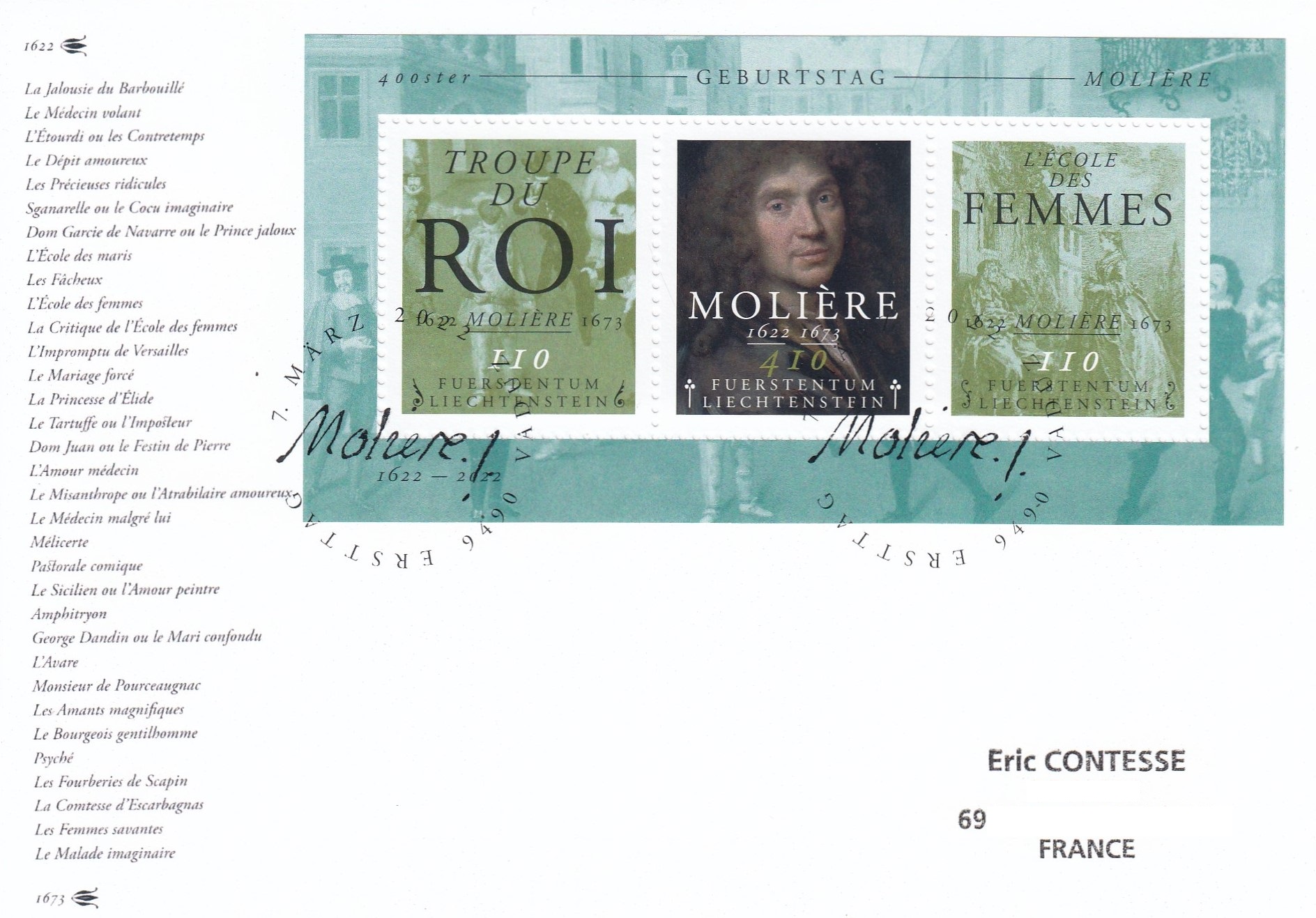
"Molière - 400th birth anniversary" souvenir sheet on FDC from Liechtenstein

Bloc-feuillet "Molière - 400 ans de sa naissance" sur FDC du Liechtenstein

Acteur, chef de troupe, auteur et metteur en scène, Jean-Baptiste Poquelin (1622-1673), dit Molière, est l'homme de théâtre complet par excellence.
Il a exploité toute la gamme des effets comiques et a créé des personnages à la psychologie complexe qui sont rapidement devenus des archétypes. Il s'est distingué par des pièces à la fois comique et critique, faisant du rire une arme pour combattre les mœurs et les contraintes de son époque, suscitant de retentissantes polémiques et l'hostilité durable des milieux dévots.
L'œuvre de Molière constitue un des piliers de l'enseignement littéraire en France et reste l'une des références de la littérature universelle. 
Parmi ses principales œuvres : Les Précieuses ridicules, L'École des femmes, Le Misanthrope, L'Avare, Le Tartuffe, Les Fourberies de Scapin, Le Bourgeois gentilhomme, Les Femmes savantes ou Le Malade imaginaire.
Actor, troupe leader, author and director, Jean-Baptiste Poquelin (1622-1673), known as Molière, is the complete man of theater par excellence.
He exploited the full range of comic effects and created characters with complex psychology that quickly became archetypes. He distinguished himself with plays that were both comic and critical, using laughter as a weapon to combat the mores and constraints of his time, arousing resounding controversy and lasting hostility from devout circles.
The work of Molière constitutes one of the pillars of literary education in France and remains one of the references of universal literature.
Among his main works: Les Précieuses ridicules, L'École des femmes, Le Misanthrope, L'Avare, Le Tartuffe, Les Fourberies de Scapin, Le Bourgeois gentilhomme, Les Femmes savantes or Le Malade imaginaire.

Comme quelques autres administrations postales (France, République tchèque, Monaco, Luxembourg), la poste du Liechtenstein a mis en circulation, le 7 mars 2022, un bloc-feuillet (3 timbres, tirage : 25000), conçu par Detlef Behr, consacré au 400ème anniversaire de la naissance de Molière, présent sur le FDC officiel ci-dessus, avec TAD (signature de Molière) de Vaduz.
Pendant 12 années, Molière voyage en province avec une troupe de théâtre et s'approprie les langues et dialectes du peuple. Il les utilisera plus tard de façon magistrale comme figures de style.
De retour à Paris, les comédiens ont l'autorisation de se nommer "Troupe du Roi" (timbre à gauche) et de jouer devant le roi.
"L'école des Femmes" (timbre à droite) est considérée comme le premier chef-d'œuvre de Molière, voire de la comédie française. La manière peu conventionnelle avec laquelle il contourne les codes du genre dramatique suscite de virulents débats publics à l'époque.
Le timbre au centre (4,10 CHF) a été conçu à partir d'un portrait de Molière (Chantilly, musée Condé) par Pierre Mignard, peint en 1658, des scènes extraites de ses pièces de théâtre étant reproduites en arrière-plan des deux timbres latéraux.
Certaines des principales pièces écrites par Molière figurent (en français) à gauche sur cette enveloppe.
Like some other postal administrations (France, Czech Republic, Monaco, Luxembourg), the Post of Liechtenstein put into circulation, on March 7, 2022, a souvenir sheet (3 stamps, print run: 25,000), designed by Detlef Behr, dedicated to the 400th anniversary of the birth of Molière, present on the official FDC above, with postmarks (Molière's signature) from Vaduz.
For 12 years, Molière travelled through the provinces with a theatre group and acquired the language and dialects of the people. He became brilliant in using these as stylistic devices later.
Back in Paris, the comedians were allowed to call themselves "Troupe du Roi" (King's Troop, stamp on the left) and present their performances before the King.
"L'école des femmes" (The School of Women, stamp on the right) is considered Molière's and French comedy's first ever masterpiece. The unconventional way in which he subverted the rulebook of dramatic genres led to a heated public debate at the time.
The stamp in the center (CHF 4.10) was designed from a portrait of Molière (Chantilly, Musée Condé) by Pierre Mignard, painted in 1658, scenes from his plays being depicted in the background of the two stamps at the side.
Some of the main plays written by Molière are mentioned (in French) on the left on this envelope.

Related Posts Plugin for WordPress, Blogger...