Affichage des articles dont le libellé est Montenegro. Afficher tous les articles

jeudi 22 août 2024

EUROPA 2023 (Peace - the highest value of humanity) s/s and stamp on cover from Montenegro

Bloc-feuillet et timbre EUROPA 2023 (La Paix - la valeur humaine la plus importante) sur lettre du Monténégro

Sur proposition de la poste ukrainienne, le thème choisi par l'organisation PostEurop pour les timbres EUROPA 2023 était "La Paix - la valeur humaine la plus importante" ("Mir - najveća vrijednost čovječanstva" en monténégrin), en écho à l'agression du pays par la Russie débutée en février 2022.
Ce choix sonne comme un rappel de la volonté qui avait présidé en 1950 à la création de l'Union européenne après la 2ème Guerre mondiale, résumée par Robert Schuman en une formule désormais célèbre : faire l'Europe pour faire la Paix.
Pour illustrer ce thème 2023, PostEurop a organisé un concours au sein des pays membres et c'est le projet "Nœud de la paix" de la poste luxembourgeoise (auteurs : Linda Bos et Runa Egilsdottir - A Designers' Collective) qui a été choisi, parmi 29 propositions.
Ce projet représente des cœurs entrelacés, et des mains aux doigts entremêlés, inspirés des nœuds d'amour celtiques. Les différentes couleurs renvoient à tous les pays du monde, unis par ce nouveau symbole de paix, une sorte de société fondée sur la coopération, dans laquelle les individus sont solidaires.
On the proposal of the Ukrainian Post, the theme chosen by the PostEurop organization for the EUROPA 2023 stamps was "Peace - the highest value of humanity" ("Mir - najveća vrijednost čovječanstva" in Montenegrin), echoing the aggression of the country by Russia which started on February 2022.
This choice sounds like a reminder of the will that presided over the creation of the European Union in 1950 after the Second World War, summed up by Robert Schuman in a now famous formula: make Europe to make Peace.
To illustrate this 2023 theme, PostEurop organized a competition within the member countries and the Luxembourg Post's "Peace Knot" project (authors: Linda Bos and Runa Egilsdottir - A Designers' Collective) was chosen from among 29 proposals.
This project represents intertwined hearts, and hands with intertwined fingers, inspired by Celtic love knots. The different colors refer to all the countries of the world, united by this new symbol of peace, a kind of society based on cooperation, in which individuals stand together.

Le 9 mai 2023 (Journée de l'Europe), la poste du Monténégro a mis en circulation un timbre EUROPA unique (comme cela est le cas depuis 2013), reproduisant ce "Nœud de la paix" commun.
Ce timbre (0,95€, tirage : 40000) a été imprimé en feuillet composé de 8 timbres + 1 vignette centrale, ainsi que dans un bloc-feuillet numéroté (tirage : 10000).
Le timbre et le bloc-feuillet ont été utilisé sur cette lettre envoyée le 31 juillet 2024 depuis Podgorica, la capitale. Merci beaucoup Antea ! 
Selon le rapport du jury de PostEurop, ce motif "Nœud de la paix" est une métaphore visuelle d'une société pacifique dans laquelle la coopération dans le respect de la culture de chacun est centrale. 
On May 9, 2023 (Europe Day), the Post of Montenegro put into circulation a unique EUROPA stamp (as it has been since 2013), reproducing this common "Peace Knot".
This stamp (€0.95, print run: 40,000) was printed in a sheetlet composed of 8 stamps + 1 central label, as well as in a numbered souvenir sheet (print run: 10,000).
The stamp and souvenir sheet have been used on this cover sent on July 31, 2024 from Podgorica, the capital. Thank you very much Antea!
According to the PostEurop jury report, this "Peace Knot" motif is a visual metaphor for a peaceful society in which cooperation with respect for each other's culture is central. 

lundi 23 janvier 2023

"70 years of the Philatelic Association of Podgorica" special postmark on cover from Montenegro

TAD spécial "70 ans de l'association philatélique de Podgorica" sur lettre du Monténégro

Un grand merci Aleksandra et Mihailo pour l'envoi de cette enveloppe spéciale (tirage : 100) mise en circulation à l'occasion du 70ème anniversaire de l'association philatélique de Podgorica, la capitale du Monténégro!
Créée en 1952, cette association, présidée par Mihailo Radičević depuis 12 ans, est composée aujourd'hui de seulement 20 membres (150 membres autrefois).
A noter ce TAD bleu spécial du 24 juin 2022 évoquant ce 70ème anniversaire et l'utilisation d'un timbre (0,30€, tirage : 50000) émis le 12 décembre 2019 à l'occasion de la Journée du Timbre ("Dan Marke").
Ce timbre, conçu par Zoran Popović, est consacré à Simo Popović, considéré comme l'auteur du premier timbre émis dans le pays.
A big thank you to Aleksandra and Mihailo for sending this special envelope (print run: 100) put into circulation on the occasion of the 70th anniversary of the philatelic association of Podgorica, the capital of Montenegro!
Created in 1952, this association, chaired by Mihailo Radičević for 12 years, is today composed of only 20 members (150 members in the past).
To note this special blue postmark of June 24, 2022 evoking this 70th anniversary and the use of a stamp (€0.30, print run: 50,000) issued on December 12, 2019 on the occasion of Stamp Day ("Dan Marke").
This stamp, designed by Zoran Popović, is dedicated to Simo Popović, considered the author of the first stamp issued in the country.

 
Simo Popović était un célèbre écrivain, auteur et homme politique. Il s'est distingué en tant que secrétaire du prince Nikola, qui lui a donné le titre de duc. Il a représenté le Monténégro dans diverses missions diplomatiques et politiques. Il était également gouverneur de la région côtière monténégrine.
Dans l'histoire des services postaux du Monténégro, le duc Simo Popović a été enregistré comme l'auteur du premier timbre-poste en 1874, représentant le prince Nikola, prince souverain du Monténégro de 1860 à 1910 puis roi du pays de 1910 à 1918.
A noter sur cette enveloppe le Mémorial du soldat partisan, érigé en 1957 sur la colline de Gorica à Podgorica. Ce monument, conçu par les sculpteurs Drago Đurović et Vojislav Đokić, est dédié aux 97 héros du peuple du Monténégro, tués autour de Podgorica pendant la Seconde Guerre mondiale.
Simo Popović was a famous writer, author and politician. He stood out as Secretary of Prince Nikola, who gave him the title of the Duke. He represented Montenegro in various diplomatic and political missions. He was also the governor of the Montenegrin-coastal region.
In the history of Montenegro postal services, Duke Simo Popović was recorded as the author of the first postage stamp in 1874, depicting Prince Nikola, sovereign prince of Montenegro from 1860 to 1910 and then king of the country from 1910 to 1918.
To note on this envelope the Monument of the partisan soldier, erected in 1957 on the Gorica hill in Podgorica. This monument, designed by sculptors Drago Đurović and Vojislav Đokić, is dedicated to the 97 heroes of the people of Montenegro who were killed around Podgorica during World War II. 
 

jeudi 6 octobre 2022

Euromed Postal 2022 (Antique Cities of the Mediterranean) stamp on cover from Montenegro

Timbre Euromed Postal 2022 (Cités antiques de la Méditerranée) sur lettre du Monténégro

Le 24 juin 2019, la poste du Monténégro est devenue membre de l'Union Postale pour la Méditerranée (PUMed), une union restreinte de l'UPU créée le 11 mars 2011.
Avec l'adhésion de la Bosnie-Herzégovine le 14 novembre 2019, cette union est aujourd'hui composée de 21 opérateurs postaux de pays situés sur le pourtour méditerranéen (Albanie, Algérie, Bosnie-Herzégovine, Croatie, Chypre, Égypte, Espagne, France, Grèce, Italie, Jordanie, Liban, Libye, Malte, Maroc, Monaco, Monténégro, Slovénie, Syrie, Tunisie, Turquie) ainsi que le Portugal et la Mauritanie.
Depuis 2014, certains pays membres de la PUMed émettent chaque année des timbres "Euromed Postal" ayant un thème commun lié à la région méditerranéenne.
Le 12 juillet 2022, la poste du Monténégro a mis en circulation son 2ème timbre Euromed Postal, consacré cette année au thème de l'archéologie maritime ou les cités antiques de la Méditerranée ("Pomorska arheologija ili antički gradovi Mediterana" en monténégrin). 
On June 24, 2019, Montenegro Post became a member of the Postal Union for the Mediterranean (PUMed), a restricted union of the UPU created on March 11, 2011.
With the accession of Bosnia & Herzegovina on November 14, 2019, this union is today composed of 21 postal operators from countries located on the Mediterranean basin (Albania, Algeria, Bosnia & Herzegovina, Croatia, Cyprus, Egypt, Spain, France, Greece, Italy, Jordan, Lebanon, Libya, Malta, Morocco, Monaco, Montenegro, Slovenia, Syria, Tunisia, Turkey) as well as Portugal and Mauritania.
Since 2014, some PUMed member countries have issued "Euromed Postal" stamps each year with a common theme linked to the Mediterranean region.
On July 12, 2022, the Montenegrin Post issued its 2nd Euromed Postal stamp, dedicated this year to the theme of
Maritime Archeology or Antique Cities of the Mediterranean ("Pomorska arheologija ili antički gradovi Mediterana" in Montenegrin).

Le logo Euromed Postal (un faucon stylisé) est inclus en haut à droite sur ce timbre, utilisé sur cette lettre envoyée le 23 août 2022 depuis Podgorica, la capitale. Merci beaucoup Antea !
A ce jour, 13 pays ont émis des timbres Euromed Postal cette année, sauf erreur de ma part.
Ce joli timbre (0,95€, tirage : 40000), conçu par Romana Pehar et imprimé en feuillet composé de 8 timbres + 1 vignette centrale, est consacré à la ville antique de Rhizon ("Antički Risan").
Rhizon est la plus ancienne colonie de la baie de Kotor et la ville moderne de Risan se dresse aujourd'hui près de la vieille ville.
L'ancienne Risan était la capitale de la tribu illyrienne des Ardiéens (sud de l'Illyrie, principalement en Albanie et au Monténégro actuellement), qui a formé un état puissant et a conquis les tribus illyriennes environnantes, contrôlant les routes commerciales à la fois sur mer et sur terre.
Les objets archéologiques témoignent de l'importance de la ville dans la période antique, et l'un des plus importants est la pièce de monnaie du roi illyrien Ballaios (représentée sur ce timbre), qui a régné entre 260 et 230 avant J.-C., considéré comme un roi puissant et influent comme en témoigne l'abondance de ce type de pièces de monnaies d'argent et de bronze trouvées le long des deux côtes de l'Adriatique. 
The Euromed Postal logo (a stylized falcon) is included on the top right on this stamp, used on this cover sent on August 23, 2022 from Podgorica, the capital. Thank you very much Antea!
To date, 13 countries have issued Euromed Postal stamps this year, unless I am mistaken.
This pretty stamp (€0.95, print run: 40,000), designed by Romana Pehar and printed in a sheetlet consisting of 8 stamps + 1 central label, is dedicated to the ancient city of Rhizon ("Antički Risan").
Rhizon is the oldest settlement in the Bay of Kotor and the modern town of Risan stands today near the old town.
Ancient Risan was the capital of the Illyrian tribe of the Ardiaei (southern Illyria, mainly in present-day Albania and Montenegro), which formed a powerful state and conquered the surrounding Illyrian tribes, controlling trade routes both on sea and on land.
Archaeological objects testify to the importance of the city in the ancient period, and one of the most important is the coin of the Illyrian king Ballaios (featured on this stamp), who reigned between 260 and 230 BC, considered a powerful and influential king as evidenced by the abundance of this type of silver and bronze coins found along both coasts of the Adriatic.

mercredi 28 septembre 2022

EUROPA 2022 (Stories and Myths) souvenir sheet and stamp on covers from Montenegro

Bloc-feuillet et timbre EUROPA 2022 (Mythes et légendes) sur lettres du Monténégro

Le 24 juin 2022, la poste du Monténégro "Pošta Crne Gore" a émis un timbre unique (comme cela est le cas depuis 2013) dans le cadre des séries EUROPA, dont le thème cette année était consacré aux histoires et mythes ("Priče i mitovi" en monténégrin), et en particulier à la légende du lac Bukumir.
Ce timbre (0,95€, tirage : 50000), conçu Adela Zejnilović, a été imprimé en feuillet composé de 8 timbres + 1 vignette centrale, ainsi que dans un bloc-feuillet numéroté (tirage : 10000).
Ce bloc-feuillet mentionnant cette légende ("Legenda o Bukumirskom jezeru") a été utilisé sur cette lettre envoyée le 23 août 2022 depuis Podgorica, la capitale. Merci beaucoup Antea !
J'aime beaucoup ce timbre représentant un dragon, cette créature à l'origine de cette légende liée au lac Bukumir. A noter que ce lac est associé à de nombreuses autres légendes au Monténégro.
On June 24, 2022, the Post of Montenegro "Pošta Crne Gore" issued a unique stamp (as it has been since 2013) as part of the EUROPA series, the theme of which this year being dedicated to Stories and myths ("Priče i mitovi" in Montenegrin), and in particular to the legend of Lake Bukumir.
This stamp (€0.95, print run: 50,000), designed by Adela Zejnilović, was printed in a sheetlet consisting of 8 stamps + 1 central label, as well as in a numbered souvenir sheet (print run: 10,000).
This souvenir sheet mentioning this legend ("Legenda o Bukumirskom jezeru") was used on this cover sent on August 23, 2022 from Podgorica, the capital. Thank you very much Antea!
I really love this stamp representing a dragon, this creature at the origin of this legend linked to Lake Bukumir. To note that this lake is associated with many other legends in Montenegro.

 
Ce petit lac d'origine glaciaire (210 mètres de log, 130 mètres de large, environ 17 mètres de profondeur) est situé à 1443 mètres d'altitude dans les monts Kučka krajina, à la frontière entre l'Albanie et le Monténégro. 
Une espèce de triton, Tritus alpestis montenegrinus, endémique vivant près de ce lac, descendrait de ce fameux dragon qui vivait dans le lac.
Bukumir est le nom d'une tribu illyrienne qui habitait cette région de l'actuelle Kuča et qui décida d'éliminer ce dragon. Ils mirent le feu à des énormes rochers situés près du lac. Lorsque la roche était rougeoyante à cause de la chaleur, ils l'ont laissée tomber dans le lac, qui a bouilli.
Les ailes du dragon prirent feu et il s'enfuit, mais pas avant d'avoir lancer une malédiction à cette tribu des Bukumir. Et c'est ainsi que les Bukumir ont disparu, se battant entre eux, où se mélangeant avec d'autres tribus.
This small lake of glacial origin (210 meters long, 130 meters wide, about 17 meters deep) is located at an altitude of 1,443 meters in the Kučka krajina mountains, on the border between Albania and Montenegro.
An endemic species of triton, Tritus alpestis montenegrinus, living near this lake, would descend from this famous dragon who lived in the lake.
Bukumir is the name of an Illyrian tribe who inhabited this region of present-day Kuča and who decided to eliminate this dragon. They set fire to huge rocks near the lake. When the rock was glowing red from the heat, they dropped it into the lake, which boiled.
The dragon's wings caught fire and he fled, but not before casting a curse on this Bukumir tribe. And that's how the Bukumir disappeared, fighting among themselves, or mixing with other tribes.

Antea a eu la gentillesse de m'envoyer également cette 2ème lettre, avec cette fois le timbre isolé et une partie de la marge du feuillet.
Antea was kind enough to also send me this 2nd cover, this time with the single stamp and a part of the sheetlet's margins.
 

mardi 14 décembre 2021

Euromed Postal 2021 (Handicraft Jewelry in the Mediterranean) stamp on FDC from Montenegro

Timbre Euromed Postal 2021 (Bijoux artisanaux de la Méditerranée) sur FDC du Monténégro

Le 24 juin 2019, la poste du Monténégro est devenue membre de l'Union Postale pour la Méditerranée (PUMed), une union restreinte de l'UPU créée le 11 mars 2011.
Avec l'adhésion de la Bosnie-Herzégovine le 14 novembre 2019, cette union est aujourd'hui composée de 21 opérateurs postaux de pays situés sur le pourtour méditerranéen (Albanie, Algérie, Bosnie-Herzégovine, Croatie, Chypre, Égypte, Espagne, France, Grèce, Italie, Jordanie, Liban, Libye, Malte, Maroc, Monaco, Monténégro, Slovénie, Syrie, Tunisie, Turquie) ainsi que le Portugal et la Mauritanie.
Depuis 2014, certains pays membres de la PUMed émettent chaque année des timbres "Euromed Postal" ayant un thème commun lié à la région méditerranéenne.
Le 12 juillet 2021, la poste du Monténégro a mis en circulation son 1er timbre Euromed Postal, consacré cette année au thème des bijoux artisanaux de la Méditerranée ("Mediteranski ručno rađeni nakit" en monténégrin). 
On June 24, 2019, Montenegro Post became a member of the Postal Union for the Mediterranean (PUMed), a restricted union of the UPU created on March 11, 2011.
With the accession of Bosnia & Herzegovina on November 14, 2019, this union is today composed of 21 postal operators from countries located on the Mediterranean basin (Albania, Algeria, Bosnia & Herzegovina, Croatia, Cyprus, Egypt, Spain, France, Greece, Italy, Jordan, Lebanon, Libya, Malta, Morocco, Monaco, Montenegro, Slovenia, Syria, Tunisia, Turkey) as well as Portugal and Mauritania.
Since 2014, some PUMed member countries have issued "Euromed Postal" stamps each year with a common theme linked to the Mediterranean region.
On July 12, 2021, the Montenegrin Post issued its first Euromed Postal stamp, dedicated this year to the theme of Handicraft Jewelry in the Mediterranean ("Mediteranski ručno rađeni nakit" in Montenegrin).

Le logo Euromed Postal (un faucon stylisé) est inclus en haut à droite sur ce timbre (et sur l'enveloppe), présent sur ce FDC officiel (tirage : 300) avec TAD de Budva.
A ce jour, 16 pays ont émis des timbres Euromed Postal cette année.
Ce joli timbre (0,95€, tirage : 30000), conçu par Romana Pehar et imprimé en feuillet composé de 8 timbres + 1 vignette centrale, représente des boucles d'oreilles découvertes dans l'ancienne nécropole (époque gréco-illyrienne et romaine) de la ville de Budva, située sur la côte méditerranéenne.
Ce bijou raffiné et décoré (datant du 4ème ou 3ème siècle avant J.C.), faisant partie des collections du musée archéologique de Budva, est caractéristique de l'artisanat hellénistique de l'époque, avec insertion d'ornements en pierres semi-précieuses (ambre, granit, pâte de verre) dans du fil doré, des têtes de bœufs en or et granit ici.
The Euromed Postal logo (a stylized hawk) is included at the top right on this stamp (and on the envelope), present on this official FDC (print run: 300) with postmark from Budva.
To date, 16 countries have issued Euromed Postal stamps this year.
This pretty stamp (€ 0.95, print run: 30,000), designed by Romana Pehar and printed in a sheetlet consisting of 8 stamps + 1 central label, features earrings discovered in the ancient necropolis (Greco-Illyrian and Roman times) of the town of Budva, located on the Mediterranean coast.
This refined and decorated jewel (dating from the 4th or 3rd century BC), part of the collections of the Archaeological Museum of Budva, is characteristic of the Hellenistic craftsmanship of the time, with the insertion of ornaments in semi-precious stones (amber, granite, glass paste) into golden thread, bull's heads in gold and granite here.

mercredi 1 décembre 2021

EUROPA 2021 (Endangered National Wildlife) stamp on FDC from Montenegro

Timbre EUROPA 2021 (Faune en voie de disparition) sur FDC du Monténégro

Le 9 mai 2021 (Journée de l'Europe), la poste du Monténégro "Pošta Crne Gore" a émis un timbre unique (comme cela est le cas depuis 2013) dans le cadre des séries EUROPA, dont le thème cette année était consacré à la faune nationale en voie de disparition ("Ugroženi divlji svijet u zemlji" en monténégrin).
Ce timbre (0,95€, tirage : 40000), conçu par Romana Pehar, a été imprimé en feuillet composé de 8 timbres + 1 vignette centrale, ainsi que dans un bloc-feuillet numéroté (tirage : 10000).
Ce timbre figure sur le FDC officiel ci-dessous (tirage : 1000) avec TAD de Podgorica, la capitale.  
J'aime beaucoup ce timbre et l'enveloppe illustrée montrant un paysage caractéristique de la réserve naturelle de Tivatska solila ("Salines de Tivat"), située dans les bouches de Kotor. 
On May 9, 2021 (the Europe Day), Montenegro Post "Pošta Crne Gore" issued a unique stamp (as has been the case since 2013) as part of the EUROPA series, whose theme this year was dedicated to endangered national wildlife ("Ugroženi divlji svijet u zemlji" in Montenegrin).
This stamp (€ 0.95, print run: 40,000), designed by Romana Pehar, was printed in sheetlet consisting of 8 stamps + 1 central label, as well as in a numbered souvenir sheet (print run: 10,000).
This stamp is present on the official FDC below (print run: 1,000) with postmark from Podgorica, the capital.
I really love this stamp and the illustrated envelope showing a characteristic landscape of the nature reserve of Tivatska solila ("Tivat saltworks"), located in the Bay of Kotor.

 
Cette zone (150 ha) est située dans la zone marécageuse de la baie de Tivat entre Odoljenštica et Koložunja, protégée en 2008 en tant que réserve naturelle spéciale dans le but de préserver les espèces animales et végétales rares et menacées, en premier lieu l'ornithofaune et les communautés végétales. 
Depuis 2013, la réserve est inscrite sur la liste des marais d'importance internationale selon la Convention de Ramsar. Tivatska solila est l'un des rares habitats côtiers humides restants pour les oiseaux. En raison de la nourriture abondante dans les eaux peu profondes, c'est un habitat privilégié pour 115 espèces d'oiseaux (50% des oiseaux recensés au Monténégro) pendant l'hiver et l'aire de repos des oiseaux migrateurs en provenance du nord et de l'est de l'Europe. 
L'aigrette garzette (Egretta garzetta), illustrée sur ce timbre, est un des oiseaux emblématiques de cette réserve. 
This area (150 ha) is located in the marshy area of Tivat Bay between Odoljenštica and Koložunja, protected in 2008 as a special nature reserve with the aim of preserving rare and endangered animal and plant species, in the first place the ornithofauna and plant communities.
Since 2013, the reserve has been included in the list of marshes of international importance according to the Ramsar Convention. Tivatska solila is one of the few remaining wet coastal habitats for birds. Due to the abundant food in the shallow waters, it is a privileged habitat for 115 species of birds (50% of the birds recorded in Montenegro) during the winter and resting area for migrating birds on the way from the Northern and Eastern Europe.
The little egret (Egretta garzetta), illustrated on this stamp, is one of the emblematic birds of this reserve.
 

lundi 15 novembre 2021

"Olympic Games Tokyo 2020" stamp on FDC from Montenegro

Timbre "Jeux Olympiques Tokyo 2020" sur FDC du Monténégro

Comme cela est le cas pour toutes les éditions des jeux olympiques d'été et d'hiver depuis 2006 (Turin), la poste du Monténégro "Pošta Crne Gore" a mis en circulation, le 16 juin 2021, un timbre (1,00€, conception : Nikoleta Ćorović) consacré aux jeux olympiques d'été de Tokyo 2020 (32ème olympiade), organisés du 23 juillet au 8 août 2021 à cause de la pandémie mondiale de Covid-19.
Ce timbre (tirage : 40000) a été imprimé au Monténégro par la société Golbi (ce qui est le cas depuis ce début d'année, imprimeur précédent : Blicdruk à Sarajevo) en feuillet composé de 8 timbres + 1 vignette centrale ainsi que dans un bloc-feuillet numéroté (tirage : 10000).
Ce timbre figure sur le FDC officiel ci-dessous (tirage : 500) avec TAD de Podgorica, la capitale.
Le timbre, le TAD ainsi que l'enveloppe ont été conçus à partir des éléments du logo de ces jeux de Tokyo 2020 : 3 variétés de formes rectangulaires, représentant différents pays, cultures et modes de pensée et véhiculant le message "l'Unité dans la Diversité".
As it has been the case for all Summer and Winter Olympic Games since 2006 (Torino), the Montenegrin Post "Pošta Crne Gore" has put into circulation, on June 16, 2021, a stamp (€ 1.00 , design: Nikoleta Ćorović) dedicated to the Tokyo 2020 Summer Olympics (32nd Olympiad), organized from July 23 to August 8, 2021 due to the global Covid-19 pandemic.
This stamp (print run: 40,000) was printed in Montenegro by the company Golbi (which has been the case since the beginning of the year, previous printer: Blicdruk in Sarajevo) in sheetlet consisting of 8 stamps + 1 central label as well as in a numbered souvenir sheet (print run: 10,000).
This stamp is present on the official FDC below (print run: 500) with postmark from Podgorica, the capital.
The stamp, the postmark as well as the envelope were designed from the elements of the logo of these Tokyo 2020 games: 3 varieties of rectangular shapes, representing different countries, cultures and ways of thinking and conveying the message "Unity in the diversity".

 
Ce timbre comporte également l'emblème du comité olympique monténégrin (également présent sur l'enveloppe).
Indépendant depuis 2006, le Monténégro participe aux jeux olympiques d'été depuis 2008 (Pékin) et l'équipe était composée de 34 athlètes (16 hommes, 18 femmes) à Tokyo, engagés dans 7 sports (athlétisme, judo, handball, waterpolo, voile, natation et tir).
Aucune médaille remportée lors de ces jeux de Tokyo malgré les bonnes performances de l'équipe masculine de waterpolo et de l'équipe féminine de handball, éliminées lors des quarts de finale.
En 2012 à Londres, le pays avait remporté sa 1ère médaille olympique, l'argent dans le tournoi de handball féminin, célébrée par un timbre spécial émis le 28 décembre 2012.
This stamp also features the emblem of the Montenegrin Olympic Committee (also present on the envelope).
Independent since 2006, Montenegro has participated in the Olympic Summer Games since 2008 (Beijing) and the team was composed of 34 athletes (16 men, 18 women) in Tokyo, engaged in 7 sports (athletics, judo, handball, waterpolo, sailing, swimming and shooting).
No medals won at these Tokyo Olympics despite the good performances of the men's waterpolo team and the women's handball team, eliminated in the quarter-finals.
In 2012 in London, the country won its first ever Olympic medal, silver in the women's handball tournament, celebrated with a special stamp issued on December 28, 2012. 
 

jeudi 6 mai 2021

EUROPA 2019 souvenir sheet and UN75 stamp on cover from Montenegro

Bloc-feuillet EUROPA 2019 et timbre UN75 sur lettre du Monténégro

Le 9 mai 2019 (Journée de l'Europe), la poste du Monténégro "Pošta Crne Gore" a émis un timbre unique (comme cela est le cas depuis 2013) dans le cadre des séries EUROPA, dont le thème cette année était consacré aux oiseaux nationaux ("Nacionalne ptice" en monténégrin).
Ce timbre (0,95€, tirage : 60000), conçu par Zoran Popović, a été imprimé en feuillet composé de 8 timbres + 1 vignette centrale, ainsi que dans un bloc-feuillet numéroté (tirage : 20000).
C'est ce bloc-feuillet n° 16920 qui a été utilisé pour affranchir la lettre ci-dessous envoyée le 14 avril 2021 depuis Podgorica, la capitale. 
Le Monténégro n'a pas désigné officiellement d'oiseau national (parmi les 350 espèces recensées dans le pays) et ce bloc-feuillet EUROPA est consacré au grand tétras (Tetrao urogallus), un mâle et une femelle, une espèce de gros gallinacé vivant en montagne dans les forêts de conifères, menacée dans de nombreux pays d'Europe, en France en particulier.
On May 9, 2019 (Europe Day), Montenegro Post "Pošta Crne Gore" issued a unique stamp (as has been the case since 2013) as part of the EUROPA series, whose theme this year was dedicated to national birds ("Nacionalne ptice" in Montenegrin).
That stamp (€ 0.95, print run: 60,000), designed by Zoran Popović, was printed in a sheetlet consisting of 8 stamps + 1 central label, as well as in a numbered miniature sheet (print run: 20,000). 
This miniature sheet No 16920 was used to stamp the letter below sent on April 14, 2021 from Podgorica, the capital.
Montenegro has not officially designated any national bird (among the 350 species recorded in the country) and this EUROPA souvenir sheet is dedicated to the capercaillie (Tetrao urogallus), a male and a female, a species of large gallinaceous living in the mountains in coniferous forests, threatened in many European countries, in France in particular.

 
En 2020, une quarantaine d'administrations postales ont mis en circulation des timbres consacrés au 75ème anniversaire de la création des Nations Unies.
Pour rappel, 51 pays ont fondé l'Organisation des Nations Unies en 1945 suite à la ratification de la Charte des Nations Unies à San Francisco le le 24 octobre 1945.
La Yougoslavie fut l'un de ces pays fondateurs et le Monténégro est membre de facto des Nations Unies depuis le 1er novembre 2000 lorsqu'il faisait partie de la République fédérale de Yougoslavie, avec la Serbie.
A la suite de la partition du pays, le Monténégro est devenu membre des Nations Unies le 28 juin 2006.
La poste du Monténégro a mis en circulation, le 24 octobre 2020, un timbre consacré à ce 75ème anniversaire des Nations Unies. 
Ce timbre (0,30€, tirage : 50000), conçu par Adela Zejnilović, figure également sur cette lettre, incluant les armoiries du Monténégro en haut à gauche et le logo officiel de ce 75ème anniversaire (emblème des Nations Unies et mention "UN75").
In 2020, around 40 postal administrations put into circulation stamps dedicated to the 75th anniversary of the creation of the United Nations.
As a reminder, 51 countries founded the United Nations in 1945 following the ratification of the United Nations Charter in San Francisco on October 24, 1945.
Yugoslavia was one of these founding countries and Montenegro has been de facto a member of the United Nations since November 1, 2000 when it was part of the Federal Republic of Yugoslavia, along with Serbia.
Following the partition of the country, Montenegro became a member of the United Nations on June 28, 2006.
On October 24, 2020, Montenegro Post issued a stamp dedicated to this 75th anniversary of the United Nations.
This stamp (€ 0.30, print run: 50,000), designed by Adela Zejnilović, is also present on this letter, including the coat of arms of Montenegro at the top left and the official logo of this 75th anniversary (United Nations emblem and mention "UN75"). 
 

vendredi 23 avril 2021

EUROPA 2020 (Ancient postal routes) m/s on cover from Montenegro

Bloc-feuillet EUROPA 2020 (Anciennes routes postales) sur lettre du Monténégro

Le 9 mai 2020 (Journée de l'Europe), la poste du Monténégro "Pošta Crne Gore" a émis un timbre unique (comme cela est le cas depuis 2013) dans le cadre des séries EUROPA, dont le thème cette année était consacré aux anciennes routes postales ("Drevne poštanske rute" en monténégrin).
Ce timbre (0,95€, tirage : 60000), conçu par Adela Zejnilović, a été imprimé en feuillet composé de 8 timbres + 1 vignette centrale, ainsi que dans un bloc-feuillet numéroté (tirage : 20000).
C'est ce bloc-feuillet n°00029 qui a été utilisé pour affranchir la lettre ci-dessous envoyée le 14 avril 2021 depuis Podgorica, la capitale. 
On May 9, 2020 (the Europe Day), the Post of Montenegro "Pošta Crne Gore" issued a unique stamp (as has been the case since 2013) as part of the EUROPA series, having this year the ancient postal routes ("Drevne poštanske rute" in Montenegrin) for theme.
That stamp (€ 0.95, print run: 60,000), designed by Adela Zejnilović, was printed in a sheetlet consisting of 8 stamps + 1 central label, as well as in a numbered miniature sheet (print run: 20,000). 
This miniature sheet No 00029 was used to stamp the letter below sent on April 14, 2021 from Podgorica, the capital.

 
Ce timbre EUROPA est consacré à un bas-relief romain représentant un attelage ("Voyage vers le monde souterrain") emmuré aujourd'hui dans l'église du village de Maria Saal en Autriche, lieu de pèlerinage connu pour son sanctuaire de Sainte-Marie.
Ce bas-relief, qui semble constituer la plus ancienne représentation d'un transport postal (?), a été découvert dans une tombe de l'ancienne cité romaine de Virunum (Carinthie, sud de l'Autriche).
A noter que ce même bas-relief figure également sur des timbres EUROPA 2020 émis par la Bosnie-Herzégovine (HP Mostar), Macédoine du nord, Bulgarie et Slovénie.
This stamp is featuring a Roman bas-relief representing a carriage ("Journey to the underworld") walled up today in the church of the village of Maria Saal, Austria, a place of pilgrimage known for its St Mary's sanctuary. 
This bas-relief, which seems to constitute the oldest representation of a postal transport (?), was discovered in a tomb in the ancient Roman city of Virunum (Carinthia, southern Austria).
To note that this same bas-relief is also featured on EUROPA 2020 stamps issued by Bosnia-Herzegovina (HP Mostar), North Macedonia, Bulgaria and Slovenia. 
 

mardi 19 mars 2019

EUROPA 2018 (Bridges) m/s on cover from Montenegro

Bloc-feuillet EUROPA 2018 (Ponts) sur lettre du Monténégro

Le 9 mai 2018 (Journée de l'Europe), la poste du Monténégro "Pošta Crne Gore" a émis un timbre unique (comme cela est le cas depuis 2013) dans le cadre des séries EUROPA, dont le thème cette année était consacré aux ponts ("Mostovi" en monténégrin).
Ce timbre (0,95€, tirage : 60000), conçu par Zorana Tošić, a été imprimé en feuillet composé de 8 timbres + 1 vignette centrale, ainsi que dans un bloc-feuillet numéroté (tirage : 20000).
C'est ce bloc-feuillet n°3498 qui a été utilisé pour affranchir la lettre ci-dessous envoyée le 1er mars 2019 depuis Podgorica, la capitale.
On May 9, 2018 (the Europe Day), the Post of Montenegro "Pošta Crne Gore" issued a unique stamp (as it has been the case since 2013) as part of the EUROPA series, having this year "Bridges" ("Mostovi" in Montenegrin) for topic. 
That stamp (€ 0.95, print run: 60,000), designed by Zorana Tošić, was printed in a sheetlet consisting of 8 stamps + 1 central coupon, as well as in a numbered miniature sheet (print run: 20,000). 
This miniature sheet No. 3498 was used to frank the letter below sent on March 1, 2019 from Podgorica, the capital.


Ce timbre est consacré au pont sur la rivière Moštanica ("Most na Moštanici"), situé près de la 2ème ville du pays, Nikšić.
Ce pont (22 mètres de long), construit probablement au 3ème siècle, est considéré comme le plus ancien pont préservé au Monténégro, localisé semble-t-il sur la voie romaine menant d'Épidaure à Nikšić via Skadar.
Au fil du temps, le pont a été détruit et réparé à plusieurs reprises mais son architecture est restée typiquement romaine (à base de pierres de siga taillées de forme régulière). Il a été en particulier restauré en 1957 par l'architecte Djordje Minjevic.
Le pont fonctionne toujours comme un pont piétonnier et les véhicules légers sont autorisés à traverser la rivière.
That stamp is dedicated to the bridge over the Moštanica River ("Most na Moštanici"), located near the 2nd city of the country, Nikšić.
This bridge (22 meters long), probably built in the 3rd century, is considered the oldest preserved bridge in Montenegro, located apparently on the Roman road that led from Epidaurus to Nikšić via Skadar.
Over time, the bridge has been destroyed and repaired several times, but its architecture has remained typically Roman (made of hewn siga stone with regular shape). It was in particular restored in 1957 by the architect Djordje Minjevic.
The bridge is still operating as a pedestrian bridge, and lighter vehicles are allowed to pass. 
 

jeudi 14 mars 2019

"PyeongChang Winter Olympics 2018" souvenir sheet on cover from Montenegro

Bloc-feuillet "Jeux olympiques d'hiver PyeongChang 2018" sur lettre du Monténégro

Comme cela est le cas pour toutes les éditions des jeux olympiques d'été et d'hiver depuis 2006 (Turin), la poste du Monténégro "Pošta Crne Gore" a mis en circulation, le 20 juin 2018 (4 mois après ces jeux...), un timbre (1,00€, conception : Ivana Kadić) consacré aux 23èmes jeux olympiques d'hiver, organisés à PyeongChang en Corée du sud du 9 au 25 février 2018.
Ce timbre (tirage : 40000) a été imprimé en feuillet composé de 8 timbres + 1 vignette centrale (Centre de saut à ski d'Alpensia à PyeongChang) ainsi que dans un feuillet numéroté (tirage : 5000).
Le bloc-feuillet (n° 2852) a été utilisé pour affranchir la lettre ci-dessous envoyée le 1er mars 2019 depuis Podgorica, la capitale.
As has been the case for all the Summer and Winter Olympic Games since 2006 (Turin), Montenegro Post "Pošta Crne Gore" put into circulation on June 20, 2018 (4 months after the games ...), a stamp (€ 1.00, design: Ivana Kadić) dedicated to the 23rd Olympic Winter Games, held in PyeongChang, South Korea from February 9 to 25, 2018.
That stamp (print run: 40,000) was printed in a sheet consisting of 8 stamps + 1 central label (Alpensia Ski Jumping Center in PyeongChang) as well as in a numbered souvenir sheet (print run: 5,000).
The souvenir sheet (No. 2852) was used to stamp the letter below sent on March 1, 2019 from Podgorica, the capital.


Ce timbre représente simplement la mascotte de ces jeux, Soohorang, un tigre blanc (le tigre apparaît dans la mythologie de la fondation de la Corée et est étroitement associé à la culture et au folklore coréen). C'était la première fois depuis 1992 que les jeux olympiques d'hiver avaient une mascotte unique.
Indépendant depuis 2006, le Monténégro participe aux jeux olympiques d'hiver depuis 2010 (Vancouver) et l'équipe était composée de seulement 3 athlètes (1 homme, 2 femmes) à PyeongChang, engagés dans 2 sports (ski alpin, ski de fond), sans aucune médaille remportée.
That stamp simply represents the mascot of these games, Soohorang, a white tiger (the tiger appears in the mythology of the founding of Korea and is closely associated with Korean culture and folklore). It was the first time since 1992 that the Olympic Winter Games had a unique mascot.
Independent since 2006, Montenegro has participated in the Olympic Winter Games since 2010 (Vancouver) and the team consisted of only 3 athletes (1 man, 2 women) in PyeongChang, engaged in 2 sports (alpine skiing, cross-country skiing) without any medals won.

mardi 6 février 2018

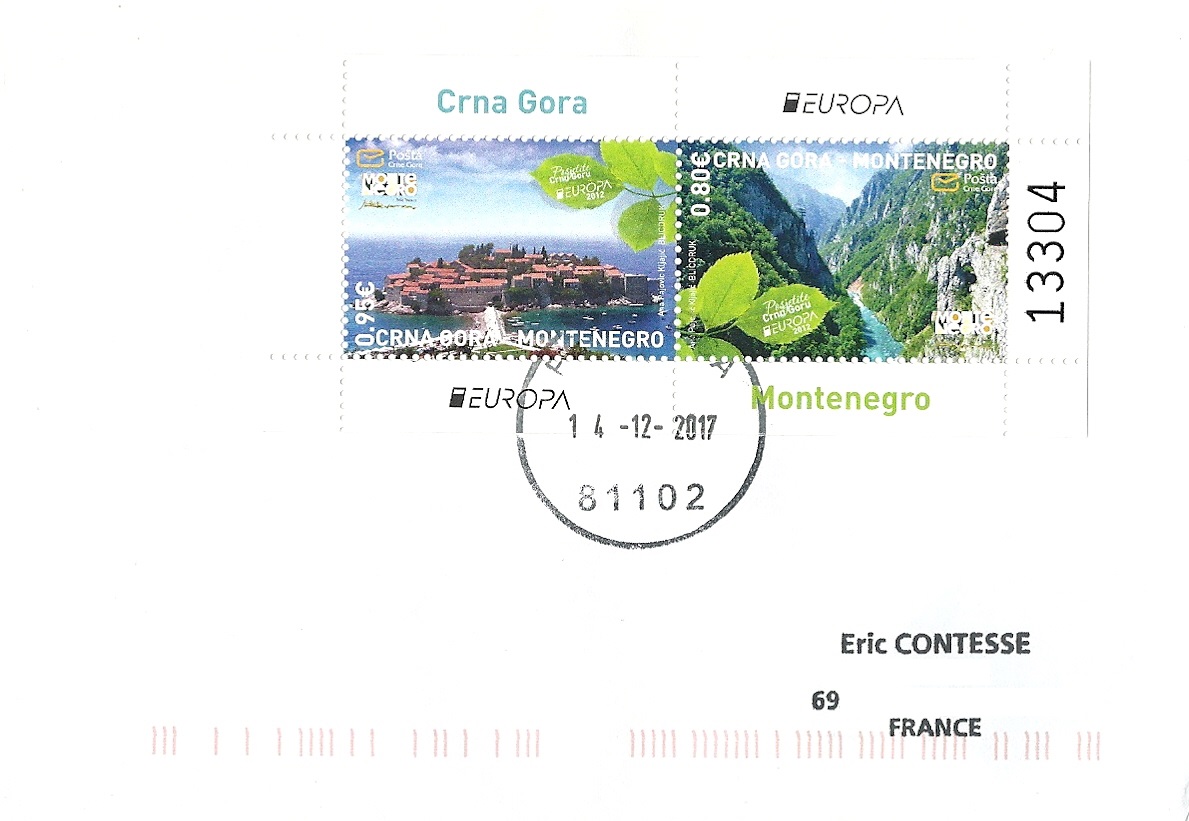
EUROPA 2012 (Visit...) m/s on cover from Montenegro

Bloc-feuillet EUROPA 2012 (Visitez...) sur lettre du Monténégro

Pour rappel, le thème EUROPA choisi par l'organisation PostEurop en 2012 était "Visitez..." et a donné lieu à de plutôt jolies séries de timbres donnant envie de voyager !
Le 17 octobre 2012, la poste du Monténégro "Pošta Crne Gore" a mis en circulation 2 timbres EUROPA (conception : Ana Pajović Kljajević), imprimés chacun en feuillet composé de 8 timbres + 1 vignette (tirage : 50000 chacun) ainsi que dans un même bloc-feuillet (tirage : 20000).
Ce bloc-feuillet numéroté (n° 13304) a été utilisé pour affranchir la lettre ci-dessous envoyée le 14 décembre 2017 depuis Podgorica, la capitale.
As a reminder, the EUROPA theme chosen by the organization PostEurop in 2012 was "Visit..." and gave rise to rather nice series of stamps giving wanderlust!
On October 17, 2012, the Montenegrin Post "Pošta Crne Gore" issued two EUROPA stamps (design: Ana Pajović Kljajević), each printed in a sheetlet consisting of 8 stamps + 1 label (print run: 50,000 each) and in one same miniature sheet (print run: 20,000).
This miniature sheet (numbered 13304) was used on the letter below sent on December 14, 2017 from Podgorica, the capital.


Deux des principales attractions touristiques du Monténégro sont à l'honneur sur ces 2 timbres : Sveti Stefan (0,95€) et la canyon de la rivière Tara (0,80€).
Ancien village fortifié de pêcheurs datant du 15ème siècle, Sveti Stefan est l'une des destinations les plus connues de la côte Adriatique, construit sur un îlot rocheux relié à la côte par un étroit isthme de sable. En 1960, sous l'impulsion de Tito, l'île est transformée en hôtel de luxe avant de tomber dans l'oubli pendant la guerre de Yougoslavie.
Le véritable trésor du Monténégro est sa ressource en eau, en particulier sa rivière Tara (144 km de long) qui passe dans un spectaculaire canyon sur environ 80 km, atteignant une profondeur maximale de 1300 mètres ce qui en fait le 2ème canyon le plus profond au monde après le Grand Canyon aux USA.
A noter sur ces 2 timbres ces feuilles incluant le logo EUROPA et la mention "Posjetite Crnu Goru" ("Visitez le Monténégro") ainsi que la présence de l'emblème de l'office du tourisme national.
Two of the main tourist attractions of Montenegro are in the spotlight on these two stamps: Sveti Stefan (€ 0.95) and Tara River canyon (€ 0.80).
Old fortified village of fishermen dating from the 15th century, Sveti Stefan is one of the most known destinations of the Adriatic coast, built on a rocky island connected to the coast by a narrow isthmus of sand. In 1960, under the impetus of Tito, the island was transformed into a luxury hotel before falling into oblivion during the war in Yugoslavia.
The real treasure of Montenegro is its water resource, in particular this Tara River (144 km long) which passes in a spectacular canyon on about 80 km, reaching a maximum depth of 1,300 meters which makes it the 2nd deepest in the world after the Grand Canyon in the USA.
To note on these two stamps these tree leaves including the EUROPA logo and the mention "Posjetite Crnu Goru" ("Visit Montenegro") and also the presence of the emblem of the national tourist agency.

vendredi 19 janvier 2018

Montenegro-Russia joint stamp issue : Friendship and Architecture

Émission commune Monténégro-Russie : amitié et architecture

Le 26 mai 2011, les administrations postales du Monténégro et de Russie ont mis en circulation une intéressante émission commune (2 timbres) consacrée à l'architecture et aux liens d'amitié entre les 2 pays.
La Russie et le Monténégro entretiennent de bonnes relations depuis plusieurs siècles, en particulier lorsque le Monténégro fut un royaume indépendant entre la fin du 19ème siècle et la fin de la 1ère guerre mondiale (indépendance à nouveau acquise en 2006).
La Russie joue un grand rôle dans l'économie du pays même si les relations sont plus tendues depuis 2017 lorsque le Monténégro est devenu membre de l'OTAN.
La ville de Cetinje était alors la capitale du Monténégro et plusieurs pays (Russie, France, Bulgarie, Royaume-Uni, Italie, Turquie, Autriche-Hongrie) y ouvrirent des ambassades.
Un des 2 timbres de cette série commune représente la façade classique de l'édifice qui abritait la mission russe à Cetinje à cette époque.
On May 26, 2011, the postal administrations of Montenegro and Russia put into circulation an interesting joint issue (2 stamps) devoted to architecture and to friendship between the two countries.
Russia and Montenegro have had good relations for several centuries, especially when Montenegro was an independent kingdom between the end of the 19th century and the end of the 1st World War (independence gained again in 2006).
Russia plays a big role in the country's economy even though relations have been strained since 2017 when Montenegro became a member of NATO.
The city of Cetinje was then the capital of Montenegro and several countries (Russia, France, Bulgaria, United Kingdom, Italy, Turkey, Austria-Hungary) opened embassies there.
One of the two stamps of this joint series represents the classical facade of the building that housed the Russian mission in Cetinje at that time.


C'est ce timbre (0,30€) qui figure en haut à droite sur cette lettre envoyée le 14 décembre 2017 de Podgorica, la capitale actuelle.
L'autre timbre (0,30€) de cette série commune (conception : Marko Zogović, tirage : 60000) est présent en haut à gauche, consacré à l'imposante cathédrale Notre-Dame-de-Kazan (construite de 1801 à 1811), une église orthodoxe vouée à l'icône de Notre-Dame de Kazan, située sur la perspective Nevski à Saint-Pétersbourg.
Ces 2 timbres ont été imprimés dans un même feuillet composé de 8 timbres (4 de chaque) + 1 vignette centrale, présente sur cette lettre, montrant les 2 mêmes édifices sous des angles différents.
A noter que les 2 timbres russes sont différents et que cette émission commune est la 2ème impliquant le Monténégro après une émission commune avec la Croatie en 2009.
Le 3ème timbre (0,90€, conception : Ana Pajović Kljajić) fait partie d'une série de 2 timbres, émise le 9 juin 2011, consacrée à la 14ème édition des Jeux des petits états d'Europe, organisés au Liechtenstein cette année-là.
Le Monténégro participait à cette compétition pour la 1ère fois, réunissant les 9 pays d'Europe peuplés de moins d'1 million d'habitants.
It is that stamp (€ 0.30) that is present at the top right on this letter sent on December 14, 2017 from Podgorica, the current capital.
The other stamp (€ 0.30) of this joint set (design: Marko Zogović, print run: 60,000) is in the top left, dedicated to the imposing Cathedral of Our Lady of Kazan (built from 1801 to 1811 ), an Orthodox church dedicated to the icon of Our Lady of Kazan, located on the Nevsky Prospekt in St. Petersburg.
These two stamps were printed in the same sheetlet of 8 stamps (4 of each) + 1 central label, present on this letter, showing the same 2 buildings from different angles.
To note that the two Russian stamps are different and that this joint issue is the 2nd one involving Montenegro after a joint issue with Croatia in 2009.
The 3rd stamp above (€ 0.90, design: Ana Pajović Kljajić) is part of a series of 2 stamps, issued on June 9, 2011, dedicated to the 14th edition of the Games of the Small States of Europe, held in Liechtenstein this year.
Montenegro participated in this competition for the first time, bringing together the 9 European countries having a population of less than one million people. 
 

mardi 16 janvier 2018

"Rio 2016 Olympic Games" m/s on cover from Montenegro

Bloc-feuillet "Jeux Olympiques de Rio 2016" sur lettre du Monténégro

Comme cela est le cas pour toutes les éditions des jeux olympiques d'été et d'hiver depuis 2006 (Turin), la poste du Monténégro "Pošta Crne Gore" a mis en circulation, le 9 juin 2016, un timbre (0,95€, conception : Đorđije Radević) consacré aux 31èmes jeux olympiques d'été, organisés à Rio de Janeiro du 5 au 21 août 2016.
Ce timbre (tirage : 40000) a été imprimé en feuillet composé de 8 timbres + 1 vignette centrale (logo des jeux de Rio 2016) ainsi que dans un feuillet numéroté (tirage : 5000).
Le bloc-feuillet (n° 1342) a été utilisé pour affranchir la lettre ci-dessous envoyée le 14 décembre 2017 depuis Podgorica, la capitale.
As it has been the case for all Summer and Winter Olympic Games since 2006 (Torino), the Montenegrin Post "Pošta Crne Gore" has put into circulation, on June 9, 2016, a stamp (€ 0.95, design: Đorđije Radević) dedicated to the 31st Summer Olympic Games, held in Rio de Janeiro from 5 to 21 August 2016.
That stamp (print run: 40,000) was printed in a sheetlet composed of 8 stamps + 1 central label (Rio 2016 games' logo) as well as in a numbered souvenir sheet (print run: 5,000).
The souvenir sheet (No. 1342) was used to frank the letter below sent on December 14, 2017 from Podgorica, the capital.


Inspiré par la célèbre statue du discobole datant de l'Antiquité, ce timbre comporte également l'emblème du comité olympique monténégrin (également présent dans la marge à gauche) ainsi que le logo de ces jeux de Rio 2016.
Indépendant depuis 2006, le Monténégro participe aux jeux olympiques d'été depuis 2008 (Pékin) et l'équipe était composée de 34 athlètes à Rio de Janeiro, engagés dans 7 sports (athlétisme, judo, handball, waterpolo, voile, natation et tennis).
Aucune médaille remportée lors de ces jeux de Rio avec une belle 4ème place dans le tournoi masculin de waterpolo (défaite contre l'Italie dans le match pour la médaille de bronze).
En 2012 à Londres, le pays avait remporté sa 1ère médaille olympique, l'argent dans le tournoi de handball féminin, célébrée par un timbre spécial émis le 28 décembre 2012.
Inspired by the famous ancient Discobolus statue, this stamp also features the emblem of the Montenegrin Olympic Committee (also present in the margin on the left) as well as the logo of these Rio 2016 Olympics.
Independent since 2006, Montenegro has participated in the Olympic Summer Games since 2008 (Beijing) and the team was composed of 34 athletes in Rio de Janeiro, engaged in 7 sports (athletics, judo, handball, water polo, sailing, swimming and tennis).
No medal won at these Rio Olympic games with a good 4th place in the men's waterpolo tournament (defeat against Italy in the bronze medal game).
In 2012 in London, the country won its first ever Olympic medal, silver in the women's handball tournament, celebrated with a special stamp issued on December 28, 2012.

samedi 13 janvier 2018

EUROPA 2015 (Old toys) m/s on cover from Montenegro

Bloc-feuillet EUROPA 2015 (jouets anciens) sur lettre du Monténégro

Comme de coutume, la poste du Monténégro "Pošta Crne Gore" a émis en 2015 (le 16 avril) un seul timbre EUROPA, également décliné en bloc-feuillet (tirage : 10000), consacré cette année-là au thème des jouets anciens ("Stare igračke").
Ce timbre (0,95€, tirage : 50000), conçu par Zoran Popović, a été également imprimé en feuillet composé de 8 timbres + 1 vignette centrale.
Le bloc-feuillet numéroté (n° 5020) a été utilisé pour affranchir la lettre ci-dessous envoyée le 14 décembre 2017 depuis Podgorica, la capitale.
As usual, the Montenegrin Post "Pošta Crne Gore" issued in 2015 (on April 16) only one EUROPA stamp, also declined in a souvenir sheet (print run: 10,000), dedicated that year to the theme of old toys ("Stare igračke").
That stamp (€ 0.95, print run: 50,000), designed by Zoran Popović, was also printed in a sheetlet composed of 8 stamps + 1 central coupon.
The numbered souvenir sheet (No. 5020) was used to frank the letter below sent on December 14, 2017 from Podgorica, the capital.


Ce timbre, sur fond bleu avec un cadre composé d'étoiles rappelant le drapeau européen (?), représente un jeune garçon et une jeune fille au milieu de différents types de jouets (plus ou moins anciens) : peluches, petit train, bateau, avion et cheval à bascule.
That stamp, on a blue background with a frame composed of stars reminiscent of the European flag (?), represents a young boy and a baby girl with different types of (more or less old) toys: stuffed animals, a little train, boat, plane and a rocking horse. 
 

samedi 6 janvier 2018

EUROPA 2017 (Castles) m/s on cover from Montenegro

Bloc-feuillet EUROPA 2017 (Châteaux) sur lettre du Monténégro

Le 9 mai 2017 (Journée de l'Europe), la poste du Monténégro "Pošta Crne Gore" a émis un timbre unique (comme cela est le cas depuis 2013) dans le cadre des séries EUROPA, dont le thème cette année était consacré aux châteaux ("Zamkovi" en monténégrin).
Ce timbre (0,95€, tirage : 70000), conçu par Jovana Mugoša, a été imprimé en feuillet composé de 8 timbres + 1 vignette centrale, ainsi que dans un bloc-feuillet numéroté (tirage : 15000).
C'est ce bloc-feuillet qui a été utilisé pour affranchir la lettre ci-dessous envoyée le 14 décembre 2017 depuis Podgorica, la capitale.
On 9 May 2017 (Europe Day), the Post of Montenegro "Pošta Crne Gore" issued a unique stamp (as it has been the case since 2013) as part of the EUROPA series, having this year "castles" ("Zamkovi" in Montenegrin) for topic.
That stamp (€ 0.95, print run: 70,000), designed by Jovana Mugoša, was printed in a sheetlet consisting of 8 stamps + 1 central coupon, as well as in a numbered miniature sheet (print run: 15,000).
This miniature sheet was used to frank the letter below sent on December 14, 2017 from Podgorica, the capital.


Ce timbre représente la façade néo-classique du palais du roi Nikola (Dvorac kralja Nikole) à Cetinje, considérée comme la capitale historique du pays, une petite ville située dans le sud du pays, à 30 km à l'ouest de Podgorica.
La résidence principale du président de la république actuel est toujours située à Cetinje et la famille royale y résida lorsque le pays fut indépendant à la fin du 19ème siècle, jusqu'à la fin de la 1ère guerre mondiale (indépendance à nouveau acquise en 2006).
Le roi Nikola Ier Petrović-Njegoš (1841-1921), prince souverain du Monténégro entre 1860 et 1910 puis roi jusqu'en 1918, résida en particulier dans ce palais construit entre 1863 et 1867, transformé en musée à partir de 1926 (les joyaux de la couronne y sont exposés).
That stamp depicts the neoclassical facade of King Nikola's palace (Dvorac kralja Nikole) in Cetinje, considered as the country's historic capital, a small town in the south of the country, 30 km west of Podgorica.
The main residence of the current President of the Republic is still located in Cetinje today and the royal family lived there when the country was independent at the end of the 19th century, until the end of the 1st World War (independence gained again in 2006).
King Nikola I Petrović-Njegoš (1841-1921), sovereign prince of Montenegro between 1860 and 1910 and then King until 1918, lived in this palace built between 1863 and 1867, transformed into a museum from 1926 (the crown jewels are exhibited in the entrance hall). 
 

dimanche 2 octobre 2016

Stamp "400th anniversary of the birth of Saint Basil of Ostrog" on letter from Montenegro

Timbre "400 ans de la naissance de Saint Basile d'Ostrog" sur lettre du Montenegro

Le 12 mai 2010, la poste du Montenegro (Pošta Crne Gore) a mis en circulation un timbre (0,50€) consacré au 400ème anniversaire de la naissance de Saint Basile d'Ostrog ("400 g. od rođ. Svetog V. Ostroškog").
Conçu par Đorđije Radević, ce timbre (tirage : 200000) a été utilisé en 2 exemplaires sur la lettre ci-dessous, envoyée le 6 septembre 2016 depuis la petite localité de Morinj (municipalité de Kotor), située dans les célèbres bouches de Kotor, dans le sud-ouest du pays. Merci beaucoup Lars !
On May 12, 2010, the Post of Montenegro (Pošta Crne Gore) has released a stamp (€ 0.50) devoted to the 400th anniversary of the birth of Saint Basil of Ostrog ("400 g. od rođ. Svetog V. Ostroškog").
Designed by Djordjije Radević, this stamp (print run : 200,000) was used in 2 copies on the letter below, sent on September 6, 2016 from the village of Morinj (municipality of Kotor), located in the famous Bay of Kotor, in the southwest of the country. Thank you very much Lars !


Basile est né en 1610 de parents pauvres dans un village d'Herzégovine, qui lui apprirent la charité envers les plus pauvres. Devenu moine, il eut à défendre la foi orthodoxe contre les pressions des turcs. Il fut menacé de mort et se retira en Russie puis au Mont-Athos avant de devenir métropolite d'Herzégovine.
Face à l'oppression turque (destructions d'églises, de monastères...) envers les serbes, Basile se cloîtra à Ostrog dans le monastère qu'il avait fondé et ou il repose depuis sa mort en 1671.
Ce monastère orthodoxe d'Ostrog, construit dans une falaise du Mont Ostrog, est aujourd'hui l'un des monastères les plus visités des Balkans, représentant un lieu de pèlerinage pour 3 grandes religions : les orthodoxes, les catholiques et les musulmans.
Basil was born in 1610 from poor parents in a village of Herzegovina, who taught him charity towards the poorest. Became a monk, he had to defend the Orthodox faith against the Turkish pressure. He was threatened with death and retired in Russia and then to Mount Athos before becoming Metropolitan of Herzegovina.
Facing Turkish oppression (destruction of churches, monasteries...) against Serbian people, Basil remained in Ostrog in the monastery he founded and where he rests since his death in 1671.
This Orthodox monastery of Ostrog, built into a cliff of Mount Ostrog, is now one of the most visited monasteries in the Balkans, representing a place of pilgrimage for three major religions : Orthodox, Catholics and Muslims.

mercredi 21 septembre 2016

EUROPA 2016 m/s on cover from Montenegro

Bloc-feuillet EUROPA 2016 sur lettre du Monténégro

Le 9 mai 2016 (Journée de l'Europe), la poste du Monténégro a émis un timbre unique (comme cela est le cas depuis 2013) dans le cadre des séries EUROPA, dont le thème cette année est consacré à l'écologie en Europe avec en particulier ce slogan "Think Green" ("Razmišljaj zeleno" en monténégrin).
Ce timbre (0,95€, tirage : 50000), conçu par Marko Zogović, a été imprimé en feuillet composé de 8 timbres + 1 vignette centrale, ainsi que dans un bloc-feuillet numéroté (quel tirage ?).
J'ai eu la chance de recevoir le joli pli ci-dessous affranchi avec ce bloc-feuillet. Merci beaucoup Lars !
Cette lettre a été envoyée le 6 septembre 2016 depuis la petite localité de Morinj (municipalité de Kotor), située dans les célèbres bouches de Kotor, dans le sud-ouest du pays.
On May 9, 2016 (Europe Day), the Post of Montenegro issued only one EUROPA stamp (as it is the case since 2013) having this year for theme "Ecology in Europe" especially with the slogan "Think Green" ("Razmišljaj zeleno" in Montenegrin).
That stamp (€ 0.95, print run : 50,000), designed by Marko Zogović, was printed in a sheetlet containing 8 stamps + 1 central vignette, as well as in a numbered souvenir sheet (which print run ?).
I was lucky to receive the nice cover below franked with this souvenir sheet. Thank you very much Lars !
This letter was sent on September 6, 2016 from the village of Morinj (municipality of Kotor), located in the famous Bay of Kotor, in south-west of Montenegro.


Pour rappel, ce timbre à été conçu à partir du dessin commun (auteur : Doxia Sergidou / poste chypriote) choisi parmi 24 projets suite à un concours organisé par PostEurop afin de célébrer cette année le 60ème anniversaire de l'émission des premiers timbres CEPT-EUROPA (en 1956).
Ce dessin symbolise la responsabilité de l'homme pour transformer le gris (pollution de l'environnement) en vert (énergies renouvelables...).
A noter que ce timbre ne mentionne curieusement que le nom de Marko Zogović, dommage pour Doxia Sergidou...
As a reminder, this stamps was designed from the joint drawing (author : Doxia Sergidou / Cyprus Post) selected among 24 projects following a competition organized by PostEurop to celebrate this year the 60th anniversary of the issue of the first CEPT-EUROPA stamps (it was in 1956)
This drawing symbolizes the man's responsibility to turn gray (environmental pollution) into green (renewable energies...).
To note that this stamp does curiously mention only the name of Marko Zogović, too bad for Doxia Sergidou... 

mercredi 17 septembre 2014

Timbre EUROPA 2014 au Monténégro

EUROPA 2014 stamp from Montenegro

Le 18 avril 2014, la poste du Monténégro a émis un timbre unique (comme en 2013) dans le cadre des séries EUROPA, dont le thème cette année est consacré aux instruments de musiques nationaux.
Ce timbre (0,95€, tirage : 30000), conçu par Marko Zogović, a été émis en feuillet composé de 8 timbres + 1 vignette centrale, ainsi que dans un bloc-feuillet numéroté (quel tirage ?).
J'ai eu la chance de recevoir les 2 plis ci-dessous affranchis respectivement avec ce bloc-feuillet ainsi que le timbre isolé. Merci beaucoup Lars :-)
Ces 2 lettres ont été envoyées le 6 septembre 2014 depuis la petite localité de Donja Lastva (municipalité de Tivat), située dans les bouches de Kotor, dans le sud-ouest du pays.
On April 18, 2014, the Post of Montenegro has issued a single stamp (as it was the case in 2013) being part of the EUROPA series, whose theme this year is devoted to the national musical instruments.
This stamp (€ 0.95, print run : 30,000), designed by Marko Zogović, was issued in a sheet consisting of 8 stamps + 1 central vignette as well as in a numbered souvenir sheet (which print run ?).
I was very lucky to receive the two covers below franked respectively with the souvenir sheet and the stamp. Thank you very much Lars :-)
These two letters were sent on September 6, 2014 from the village of Donja Lastva (Municipality of Tivat), located in the Bay of Kotor, in south-west Montenegro.


Ce timbre représente une gusle (ou guzla), un instrument à une seule corde frottée (avec un archet), typique de la région des Balkans, en particulier les pays de l'ex-Yougoslavie et l'Albanie.
Cet instrument, accompagnant les chants traditionnels et le folklore musical, est joué par un guslar, qui tient l'instrument verticalement entre ses genoux et avec les doigts de la main gauche sur les cordes.
Instrument musical national au Monténégro, la gusle y a la particularité d'être dotée d'une tête sculptée (comme celle figurant sur ce timbre), représentant le plus souvent un aigle à deux têtes (le symbole du pays représenté sur le drapeau), la forme de la montagne Lovcen ou encore des personnages célèbres de l'histoire du Monténégro (comme Petar II Petrović Njegoš).
That stamp depicts a gusle (or guzla), a rubbed single-stringed instrument (using a bow), typical of the Balkans region, particularly the countries of the former Yugoslavia and Albania.
This instrument, accompanying traditional songs and folk music, is played by a guslar, holding the instrument vertically between his knees, with the left hand fingers on the strings.
National musical instrument in Montenegro, the gusle has the distinction of having a carved head (like the one shown on the stamp), usually featuring a two-headed eagle (the symbol of the country represented on the flag), the shape of the mountain Lovcen or famous characters of the history of Montenegro (such as Petar II Petrović Njegoš).


lundi 9 décembre 2013

Émission commune Croatie-Monténégro

Croatia-Montenegro joint stamp issue

Le 3 février 2009, la poste du Monténégro (Pošta Crne Gore) avait émis sa première émission commune, avec la poste de la Croatie (Hrvatska Pošta) voisine.
Pour rappel, le Monténégro avait déclaré son indépendance en 2006...
Les 2 pays, proche géographiquement, ont toujours eu des relations intenses et en particulier lors d'échanges commerciaux entre les 2 villes touristiques de Dubrovnik et de Kotor, classées au patrimoine mondial de l'UNESCO.
Le thème de cette émission commune (2 timbres) était le 1200ème anniversaire de Saint-Tryphon (Sveti Tripun) à Kotor.
J'ai eu la chance de recevoir la version croate de cette série (en 2 exemplaires) sur la jolie lettre illustrée ci-dessous (avec une reproduction des 2 timbres du Monténégro à gauche) postée le 22 novembre 2013 de Rijeka. Merci beaucoup Dragan :-)
On February 3, 2009, the Post of Montenegro (Pošta Crne Gore) had issued its first joint stamp issue with the neighboring Post of Croatia (Hrvatska Pošta).
As a reminder, Montenegro declared its independence in 2006...
The two countries, geographically close, have always had close relations and especially with trade between the two tourist towns of Dubrovnik and Kotor, classified as UNESCO World Heritage sites.
The theme of this joint issue (two stamps) was the 1200th anniversary of St. Tryphon (Sveti Tripun) in Kotor.
I was lucky to receive the Croatian version of this set (in two copies) on the nice illustrated cover below (with a reproduction of the two stamps from Montenegro to the left) mailed on November 22, 2013 from Rijeka. Thank you very much Dragan :-)


Ces 2 timbres (3,50 HRK chacun), conçus par les graphistes Ana Matić (Monténégro) et Hrvoje Šercar (Croatie), ont été émis dans une même feuille de 20 timbres (10 de chaque, tirage : 100000).
Ces 2 timbres représentent respectivement une image du saint extraite du "Statut et des Lois" de la ville de Kotor (1616, Archives historiques de la ville) lorsqu'elle était rattachée à la République de Venise et une partie du ​​polyptyque en argent de l'autel (1440, Maître Hans de Bâle) de la cathédrale de Kotor dont Saint-Tryphon est le patron.
Tryphon est un saint martyr catholique et orthodoxe qui fut persécuté et torturé à Nicée vers 250 après JC. Ses reliques furent ensuite transportées à Constantinople puis à Rome.
En 809, des habitants de Kotor achetèrent les reliques de Saint-Tryphon à des marchands vénitiens et construisirent une église pour les conserver. La cathédrale de Kotor (consacrée en 1166), un des plus importants édifices romans de la côte adriatique, a été construite à l'emplacement de cette église.
Fêté traditionnellement le 10 novembre, Saint-Tryphon est célébré chaque année à Kotor le 3 février, un jour après les festivités de la Saint-Blaise (Sveti Vlaho), le patron de Dubrovnik...
These two stamps (3.50 HRK each), designed by graphic designers Ana Matić (Montenegro) and Hrvoje Šercar (Croatia) have been issued in a same sheet of 20 stamps (10 of each, print run : 100,000).
These two stamps are respectively featuring an image of the Saint taken from "the Statute and the Laws" of the town of Kotor (1616, Historical Archives of the city) when it was part of the Venetian Republic and a part of the silver polyptych of the altar (1440 , Master Hans Basel) in the Cathedral of Kotor dedicated to him.
Tryphon is a holy Catholic and Orthodox martyr who was persecuted and tortured in Nicea around 250 AD. His relics were transported to Constantinople and then to Rome.
In 809, some inhabitants of Kotor acquired the relics of St. Tryphon from Venetian merchants and built a church where the remains of the Saint were kept. The cathedral of Kotor (consecrated in 1166), one of the most important Romanesque buildings of the Adriatic coast, was built on the site of this church.
Traditionally celebrated on 10 November, St. Tryphon is celebrated every year in Kotor on 3rd February, one day after the festivities of St. Blaise (Sveti Vlaho), the patron of Dubrovnik...
Related Posts Plugin for WordPress, Blogger...